
READER RESOURCES: All my books are now available as paperbacks on Lulu. THE APOCALYPSE ALMANAC: Hidden cures in our dystopian age. Check out the “Cure Cancer in Your Kitchen” chapter. FULLSCRIPT SUPPLEMENTS: top quality and economical. AFFILIATE STORE: I offer competitively priced products HERE that I have personally tested and used.
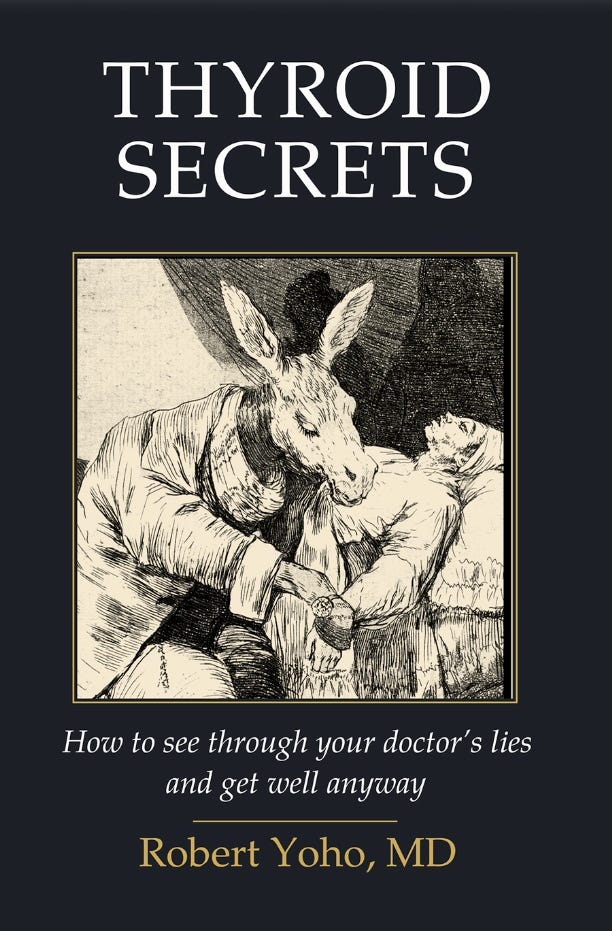
This is the front cover of my thyroid book, which I’ll drop in a week or two. It is a more complete version of this post. Scan this post, and you will get a second chance at the material soon.
You do not want to be treated by a jackass in a white coat.
Preface
The thyroid gland is the master and commander of the entire body’s activity and metabolism. If yours isn’t working at full capacity, you’ll feel terrible. This post may seem complex and technical, but you don’t need every detail to improve your health. I cover using T3 as the primary thyroid hormone, an over-the-counter source, and what I am doing myself.
This material is complex enough that you will need to review it several times, and this is an easy way to start. If you don’t understand everything by the end of this post, you will get a second chance when you read my book Thyroid Secrets, which follows in 3 days. To get a good result with a thyroid problem, it is more important to do your homework than in almost any other medical condition, because you can’t depend on doctors to manage it accurately. The reasons are in the book’s chapter on endocrinology’s corruption. The complexity is challenging, but not impossible, and I have broken it into digestible pieces and provided an algorithm for starting treatment.
Those who have experienced the frustrations of conventional hypothyroid care realize that no one is coming to save them and that they have to man up and learn as much as they can. Their doctors are trapped in corrupt “standards of care” that don’t adequately address many of their problems. As you read this, I want you to think about the themes in my other posts about how standards like this were purposely constructed to weaken the populace. It’s a little depressing, but we have to face the facts. I won’t say more about this here.
Endocrinologists, for all their training, history, and erudition, have failed to deliver consistent, predictable improvements for these patients. I explore several reasons for this here. I would go so far as to say that seeing one of these specialists is a counterproductive waste of time and energy in most cases of simple low thyroid, for they commonly undertreat their patients.
The most obvious flaw in the Endos’ thinking is their confidence in the utility of thyroid-stimulating hormone (TSH), a pituitary hormone from the brain that, by itself, affects no body systems and does not improve symptoms. As its name implies, when the brain detects low thyroid levels, TSH rises and stimulates thyroid hormone production, which secondarily improves the condition.
Comment: Using this indirect measure of a critical hormone like thyroid is like watching a werewolf chase you in the reflection of a hand mirror and not looking around. A generation of patients remained sick on Synthroid (levothyroxine/T4) because their doctors were focused on lab numbers rather than their patients’ clinical results.
Three sources went into this post. The first is my training: I spent many hundreds of hours studying under Neal Rouzier, MD, the founder of Worldlink Medical, who has trained tens of thousands of physicians in hormone replacement in the United States and abroad and whose teaching is the top working standard of the alternative hormone community. The second is my book Hormone Secrets, which I wrote using that training more than 5 years ago; its thyroid chapters and dosing appendix form the skeleton of what follows, and it is available on Amazon. StoptheThyroidMadness.com (STTM) is the third. It began in 2002 as one patient’s rejection of the failed idea that TSH could be used as a primary diagnostic tool for hypothyroidism. It grew into the largest patient-built reference on thyroid disease.
My experience prescribing thyroid medication is limited, and I was not fully familiar with the more complex material here, such as reverse T3, when I began this review. You don’t have to understand it all before you start taking action for your thyroid.
Three thyroid hormones are used for therapy. T3 (triiodothyronine; the synthetic brand is Cytomel) is the biologically active form of thyroid hormone. T4, or thyroxine, is the storage form of thyroid hormone. Desiccated thyroid, typically from pigs, contains both forms and has been used for 100 years to treat thyroid disease. It has a more consistent quality record than T4, which has had far more recalls; however, endocrinologists surprisingly view it as the standard of care for thyroid therapy.
As usual, I decided to review this subject because of a personal problem. I have hypothyroidism. I knew for several years that my thyroid labs were low, with a free T3 near 3.8 and a total T3 near the bottom of its range, but I had no symptoms I recognized, so I left it alone. The symptoms of fatigue verging on prostration arrived 6 to 8 months ago, and I did not connect them to my thyroid until the last few weeks, which is embarrassing for someone who wrote a book with a chapter on the subject. How could I miss this? The answer is the same one that keeps millions of patients undiagnosed: the symptoms are ordinary, they come on slowly, and every number on the lab report falls within the supposed normal range, according to endocrinologists.
When I finally looked, my labs were as follows: My afternoon temperature was 97.8 degrees Fahrenheit. My thyroid-stimulating hormone, the TSH that every physician checks, was 2.81, in the middle of the laboratory’s range but too high. My T3 was 72, supposedly normal but in the lowest one-fifth of the range. My free T4 was 1.1, in the middle of its range, which sounds acceptable until you understand, as the rest of this piece explains, that a middling T4 is like getting a C on a test when you are an A student. My free T3, the best measure of the active hormone and the number my mentors taught me to watch the most closely, was 2.8, still supposedly normal but too low for good health, and my reverse T3, an inactive form the body makes when it is slowing itself down, was 22, too high.
My Kaiser physician reviewed the panel and wrote that the labs “look stable.” He was right by conventional standards. Every value was within its reference range, and no endocrinologist would call a TSH of 2.81 abnormal.
Here is the point of this article. I am unmistakably hypothyroid when the clinical picture is considered: the fatigue, the afternoon fade, the low temperature, the lowest quartile total T3, my low free T3, the TSH, which reflects untreated hypothyroidism, and most of all, my positive initial response to thyroid replacement. My clinical appearance is much worse than my lab results suggest; the labs had failed to diagnose me.
In the group of physicians who trained me, a symptomatic patient who tolerates the hormone gets his TSH suppressed below 1 and his free T3 raised to 4.2 or a little higher using some sort of desiccated thyroid. They then adjust the dose based on how she feels. (This is not an attempt to be politically correct; most of these patients are women.) The labs are just indicators; how the patient feels is the key. My plan is to raise my thyroid doses, both T3 and porcine, until I feel well, monitoring my pulse, blood pressure, and temperature as I go, and rechecking the labs along the way. Desiccated thyroid takes about a month to show its full effect, but T3 is felt immediately.
As I write, I take Thyrovanz, a New Zealand bovine desiccated thyroid sold over the counter: 4 capsules of 50 mg each in the morning on an empty stomach. After about a week, I noticed better sleep, a subjective improvement in energy, and no longer feeling sleepy at the end of the day. My literature search, summarized below, explains why I intend to switch to a prescription porcine product as soon as I have one in hand, since bovine supplements’ quality is less consistent than that of prescription porcine thyroids available in the United States.
Comment: I just switched to another over-the-counter product, TriDex Thyro, a combination of bovine, porcine, and ovine (sheep) desiccated thyroid. It makes me feel even better. I haven’t had any blood testing or temperature monitoring with this yet, and I plan to start T3 at a low dose and get comfortably stabilized before I do.
As I finished this essay, a second number turned up that I had missed for as long as I missed the thyroid. My ferritin, the blood measure of stored iron, came back at 17 ng/mL, which is iron deficiency. A man is not supposed to run short of iron. He absorbs about 1 mg a day from food, loses almost none, and gains a few hundred milligrams over each decade unless he bleeds. I had yearly stool blood tests, several colonoscopies, and nothing beyond trivial hemorrhoidal bleeding. The bleeding source was me. I had been donating blood to bring down a hemoglobin that testosterone had pushed up, and each unit takes 200 to 250 mg of iron with it, about 8 months of a man’s intake. Iron deficiency produces a fatigue that is hard to tell from thyroid fatigue, it is symptomatic well before the hemoglobin falls, and it blunts the response to thyroid hormone. I feel about as stupid for missing it as for missing the thyroid. The iron section below tells more and what I am doing about it.
This piece is the short version of the story, and the complete one is my book Thyroid Secrets, which will follow soon. This post proceeds in the order a patient needs it. I start with a vocabulary section. Next are the laboratory tests, then why the standard approach fails, then the medicines, then how to dose them, then what to do when a seemingly correct dose stops working, and finally the brands, an explanation of the endocrinologists’ bizarre and corrupt point of view, and how to find a doctor who will treat you properly, including via telemedicine. Finding a doctor does not absolve you of the necessity to learn all you can. This is your problem, and even the best doctor won’t come to save you.
Summary
• The whole treatment fits in 6 steps: suspect it from symptoms and a low afternoon temperature; draw one panel that includes ferritin and a complete blood count; pick the medicine from the free T3, free T4, and reverse T3 pattern; raise the dose on a fixed schedule against pulse and temperature; recheck at 6 to 8 weeks; and look for the reason only if the first 5 steps fail. The great majority of patients never need step 6.
• The patient, not the lab report, is the treatment target. Every one of my thyroid values is inside its reference range, but I am unmistakably hypothyroid by symptoms and temperature. A symptomatic patient who tolerates the hormone should have his TSH suppressed below 1 and his free T3 raised to 4.2 or a little higher, then be dosed to how he feels.
• TSH measures a pituitary signal rather than the hormone delivered; this indirect measurement is next to worthless for evaluating a patient’s clinical status. Endocrinologists believe TSH is abnormal only above 4 to 4.5.
• T4 is the storage hormone, T3 is the active one, the conversion between them is the step that fails, and free T3 paired with free T4 is the measurement that shows whether a dose is working.
• Three families of medication exist: T4 alone (Synthroid, levothyroxine); desiccated porcine thyroid, which supplies T4 and T3 together; and synthetic T3 (Cytomel, liothyronine), taken alone or added to T4. Over-the-counter bovine thyroid is a fourth, weaker option with problems: seasonal variation in the raw material, a lighter regulatory standard, and a documented history of underperformance.
• A normal free T3 and a good clinical response make the thinking simple and further tests unnecessary; reverse T3, cortisol, and the rest are for the cases that don’t respond.
• Reverse T3, pooling, adrenal cortisol, iron, selenium, and iodine are the reasons a correct-looking dose stops working, and each is defined and handled in turn: a case for a lower iron target than the site recommends, a selenium dose most patients start without testing, and an iodine position more aggressive than mainstream guidance.
• T3 first, with a small amount of desiccated thyroid or T4 added once the patient is well, is the treatment endocrinology should have started with. T4-first prescribing assumed that every patient converts storage hormone to active hormone, and 70 years of patient experience and a handful of controlled trials show that a large minority does not. T3 skips the step. Below: the evidence, the dosing, the risks, an over-the-counter liquid source, and my plan.
• Iron deficiency mimics hypothyroidism, blocks the response to thyroid hormone, and is symptomatic before the hemoglobin drops. My ferritin came back at 17 after years of donating blood to lower a testosterone-raised hemoglobin, a self-inflicted bleed that no colonoscopy would find. Ferritin belongs in the first panel, not the second tier of testing, and a low value is treated alongside the thyroid.
• Recall history favors porcine desiccated thyroid over levothyroxine, not the other way around.
• Mainstream endocrinology’s caution is not baseless: pre-standardization desiccated thyroid was inconsistent from lot to lot, TSH has narrow but legitimate uses, and T3-forward dosing has an osteoporosis and arrhythmia risk in Graves’ disease, which they deal with all the time, but is not what we are talking about here.
• The site’s books, Stop the Thyroid Madness and Hashimoto’s: Taming the Beast, and a running “Doctors Hall of Shame,” put the same material into print and catalog how doctors have dismissed the patients who built it.
The whole treatment in 6 steps
Everything below the vocabulary section expands one of these steps. A reader who wants the method without the mechanism needs only this list and the dosing section.
Step 1. Suspect it. Fatigue, an afternoon fade, cold hands, slow bowels, dry skin, thinning hair, weight that will not move, low mood, and a resting pulse in the 50s or low 60s. Take the temperature in mid-afternoon for 5 days; a consistent reading below 98 degrees Fahrenheit, with symptoms, is enough to proceed. A normal TSH on an old lab report doesn’t rule anything out.
Step 2. Draw one panel. TSH, free T4, free T3, reverse T3, both thyroid antibodies (anti-TPO and anti-thyroglobulin), and, added by this edition, ferritin with serum iron and saturation, plus a complete blood count. The site puts iron in the second tier of testing for patients who don’t respond; it belongs at the start because iron deficiency produces the same fatigue, blunts the response to every thyroid product, and costs $30 to test. Order it yourself through the services listed in the tests section if your doctor will not.
Step 3. Read the pattern and pick the medicine. Three patterns cover most patients. Low free T4 with low free T3 is a failing gland, and the medicine is porcine desiccated thyroid starting at 1 grain, which supplies both hormones. Free T4 in the middle of its range with a low free T3 and a reverse T3 in the upper part of its range is a conversion failure, the pattern I have, and the medicine is desiccated thyroid or T3 itself; T4 alone will make it worse. Positive antibodies mean Hashimoto’s, treated with the same hormones plus selenium 200 mcg and the antibody measures in the Hashimoto’s section. A ferritin under 50 or a saturation under 20 percent is treated at the same time, with iron taken 4 hours away from the thyroid dose. A low TSH paired with a low free T3 before any treatment is the one pattern that stops the algorithm: it points to the pituitary and needs a physician before the thyroid is touched.
Step 4. Increase the dose on a schedule. Desiccated thyroid can be increased by half a grain every 2 weeks. T3 can be increased by 5 to 12.5 mcg every 5 to 7 days, split two-thirds on waking and one-third in the early afternoon. Between blood draws the resting pulse should stay under 90 and an afternoon temperature that rises toward 98.6. Stop increasing your dosage when the symptoms are gone or the pulse climbs, whichever comes first.
Step 5. Recheck at 6 to 8 weeks. Draw free T3, free T4, and reverse T3 before the morning dose so free T3 reflects the trough rather than the peak. A free T3 in the upper part of the range (around 4.2), a fallen reverse T3, and resolved symptoms mean treatment is done; the only remaining job is to hold the dose and recheck twice a year. Most patients stop here.
Step 6. If the treatment stops working, find out why. The order depends on what each failure looks like. If you are still hypothyroid at a good free T3: reverse T3 is high, and the fix is a T3-forward regimen (part 1 of the sections on treatment that stops working). If you have a racing heart, tremor, or anxiety at a dose that isn’t high yet: the adrenal side is weak, and saliva cortisol comes next (part 2). Still tired with everything else in order: recheck ferritin and saturation, then selenium and vitamin D (part 3). If antibodies are rising or symptoms wax and wane, see the Hashimoto’s section.
How many patients each step catches is a question the trials answer only in part. In an iodine-sufficient country, Hashimoto’s is the cause of most hypothyroidism, and the great majority of hypothyroid patients, whatever the cause, are managed with hormone replacement alone and never need step 6. The adrenal, iron, and reverse T3 complications are the minority, and my estimate from the site’s own case logic is 1 patient in 5 or fewer. The harder number is how many do well on T4 alone. Endocrinology’s answer is only 85 to 90 percent, because it defines doing well as a normal TSH; however, mainstream reviews concede that 10 to 15 percent of patients on an adequate levothyroxine dose have persistent symptoms. The patients’ answer is lower. In the 2018 American Thyroid Association survey of 12,146 treated patients, satisfaction with treatment ran only around 5 on a 10-point scale, and the patients on desiccated thyroid were the most satisfied group. In the 1999 trial that replaced part of the T4 with T3, 20 of 33 patients preferred the combination. Put together, only about two-thirds of patients do well enough on T4 alone to stay on it, and about one-third are better with T3 in the regimen, which is the fraction this essay is written for.
Where the site began
Janie Bowthorpe, M.Ed., traces her illness to the years after childbirth, when repeated infections and a weakness she described as making her arms feel like “dead weights” left her unable to keep up with her children. At 31, she was told her thyroid-stimulating hormone (TSH) was 5, which was borderline hypothyroid, and a doctor started her on Synthroid (levothyroxine/T4). Her TSH normalized, but her symptoms did not improve.
Nineteen years followed on the same medication, during which Bowthorpe was screened for chronic fatigue syndrome, mitochondrial disease, and dysautonomia, but no diagnosis fit or treatment helped. By 2002, she was close to housebound and used that confinement to read older medical literature on thyroid hormone rather than the current guidance her doctors followed. That July, she switched to natural desiccated thyroid (NDT), a preparation that supplies T3 alongside T4 rather than T4 alone. She has written that her heart palpitations and depression lifted within weeks and that she, in her words, recovered the stamina of a teenager.
She built an online support community the same year and opened the Stop the Thyroid Madness website in 2005 to document what the community had worked out through trial and error and to share lab results. Two decades and hundreds of pages later, the site still organizes itself around six complaints Bowthorpe calls “thyroid madness:” T4-only prescribing, TSH-only monitoring, psychiatric medication substituted for adequate thyroid hormone, blanket warnings against T3, blood rather than saliva cortisol testing, and hypothyroid symptoms pursued in every diagnosis except the correct one.
The vocabulary, in the order the body uses it
The thyroid is a butterfly-shaped gland at the base of the neck. It makes two hormones that matter here. The first, thyroxine, is called T4 because each molecule holds four iodine atoms. T4 is a storage and transport form: it circulates in large amounts, lasts about a week in the blood, and does little on its own. The second, triiodothyronine, or T3, has three iodine atoms and is the active hormone that sets the metabolic rate of nearly every cell. The gland releases both, roughly 80 percent T4 and 20 percent T3, along with trace amounts of T2 and T1 and the hormone calcitonin, whose roles in therapy are minor and mostly unstudied.
Most of the body’s T3 is not released by the gland. The liver, kidneys, muscle, and other tissues make it, where a family of enzymes called deiodinases strips one iodine atom from T4 to produce T3. This conversion step is the hinge of the whole subject. When it works, a patient given T4 alone makes his own T3 and does well. When it falters, from age, chronic stress, illness, certain drugs, low iron or selenium, liver strain, or inherited enzyme variants, T4 accumulates while the tissues go short of T3, and the patient stays hypothyroid at the cellular level no matter how normal his blood tests look.
The same enzymes have a second option. Instead of removing the iodine atom that activates T4, they remove a different one and produce reverse T3 (RT3), a mirror-image molecule that occupies the T3 receptor without activating it. A small amount of reverse T3 is normal, about a fifth of daily T4 turnover, and the body uses it as a brake during illness or starvation to slow metabolism. Too much of it crowds active T3 out of the receptor and produces hypothyroid symptoms in a patient whose T4 and T3 levels look adequate.
Almost all thyroid hormone in the blood is bound to carrier proteins and is inactive. The small unbound portion, called free T4 and free T3, is what enters cells and does the work. A total T3 or total T4 measures both fractions together and shifts with the carrier proteins, which rise with estrogen, pregnancy, and some drugs and fall with others, so a total value can look normal while the free fraction is low, or vice versa. That is why this piece, and the site, rely on the free values.
The pituitary gland at the base of the brain supervises the system. It senses the level of thyroid hormone reaching it and releases thyroid-stimulating hormone (TSH), which tells the thyroid gland to produce more. When thyroid hormone is low, TSH rises; when hormone is high, TSH falls. TSH therefore reads backward from the hormones it controls and reports what the pituitary senses, not what the muscles, brain, or heart receive. That distinction is the central argument of this essay and is developed in the next two sections.
A few disease terms follow. Hypothyroidism is too little thyroid hormone at the tissues, whatever the cause. Hashimoto’s thyroiditis is the most common cause in developed countries: an autoimmune attack on the gland that slowly destroys it, identified by antibodies in the blood. Graves’ disease is the opposite autoimmune condition, in which antibodies stimulate the gland and produce hyperthyroidism, too much hormone. Subclinical hypothyroidism, in the strict sense, is an elevated TSH with a normal free T4 and few symptoms; in the looser sense used in the preface, it is a patient whose numbers are low-normal and whose symptoms are easy to dismiss.
Two more terms recur. A half-life is the time it takes the body to clear half of a dose of a drug or hormone; T4’s half-life is 5 to 7 days, and T3’s is about 1 day. These figures govern dosing intervals and are discussed with the medicines below. A reference range, the pair of numbers printed beside every lab result, is a statistical description of the middle 95 percent of the laboratory’s tested population, both sick and well. It is not a target. The difference between a range and a target is the difference between an endocrinologist’s satisfaction and a patient’s recovery.
The tests, and what each one is able to say
A standard thyroid panel includes TSH, sometimes with a free T4 added. STTM’s recommended panel is longer, and each item answers a different question. Free T4 shows how much storage hormone is available. Free T3 shows how much active hormone is reaching the tissues, and it is the single most informative clinical number. TSH shows what the pituitary is sensing. Reverse T3 shows whether T4 is being diverted into the inactive brake instead of into T3. The two thyroid antibodies, anti-TPO and anti-thyroglobulin, show whether Hashimoto’s is present; either one is positive while the other is still negative often enough that both are needed.
The rest of the panel looks beyond the thyroid itself. A four-part iron panel (serum iron, saturation, total iron-binding capacity, and ferritin), a four-point saliva cortisol test, vitamin B12, vitamin D, and a red-blood-cell mineral panel for magnesium and potassium complete the list, and each one exists to explain a poor response rather than to diagnose the disease. In my opinion, you don’t need all these tests immediately, and the algorithmic method below in the dosing section will help you prioritize what to look at first.
You can order almost any test without a doctor. Kaiser would not draw my free T3, and most insurance-based practices will not order reverse T3 at all, but several direct-to-consumer services such as Rupa Health and the others below sell the tests online and send the patient to a nearby Quest Diagnostics or LabCorp draw station with a printed order. These are the two major laboratories that each have about half of the market share in the United States. Results arrive by email in a few days.
Walk-In Lab sells a panel with TSH, free T4, free T3, and reverse T3 for $165 plus a $6 physician fee, with no fasting required. Ulta Lab Tests sells a TSH test for about $20 and a panel with both antibodies for $99 to $149 through Quest. Quest’s own QuestHealth and LabCorp OnDemand sell comparable panels for $100 to $180 with no middleman, and a 2026 price survey compares all of them. New York, New Jersey, and Rhode Island restrict direct-to-consumer testing, and residents there use a telemedicine visit instead. The results are the same laboratory numbers a physician’s order would produce, and they are what a patient brings to the first appointment described below.
Links: Walk-In Lab panel is https://www.walkinlab.com/products/view/thyroid-2-essential-panel-plus-reverse-t3-blood-test, QuestHealth is https://www.questhealth.com/product/comprehensive-thyroid-test-panel/18659M.html, and a price survey is https://labtestinsight.com/guides/thyroid-panel-cost/.
TSH reads high when the thyroid is low and low when the thyroid is high, because it is the brain’s request for more hormone and is suppressed when hormone is high in the blood. The site says TSH “can look great while you have raging hypothyroidism, or it can be high while you have hypothyroidism,” because it reflects what the pituitary is signaling rather than what the tissue is receiving. The one job it reserves for TSH is flagging a pituitary problem, evidenced by a low TSH paired with a low free T3.
Instead of the standard reference range, the site describes a narrower target based on healthy people and patients who report feeling well: free T3 in the top part of the range (4 to 4.3) and free T4 near the middle. It presents this pairing, rather than a number within the wide normal band, as the marker of a working dose.
The physicians who trained me go one step further. Neal Rouzier, MD, whose Worldlink Medical courses have taught hormone replacement to tens of thousands of clinicians, says that a symptomatic hypothyroid patient who tolerates the medication should be dosed until the TSH falls below 1 and the free T3 reaches 4.2 or a little higher, and that the dose is then adjusted to symptoms, temperature, and pulse rather than to any number. This is standard working practice in the alternative hormone community (and, in my opinion, anyone who gives a damn about the patient), and it is the standard I applied to my labs in the preface. By contrast, the laboratory’s reference range, the one printed on my Kaiser report, calls a TSH normal anywhere from 0.35 to 4.00.
Yoho note: My mentor, Neil Rosier, MD of WorldlinkMedical.com, trained me to get my patients to take enough thyroid hormone to bring TSH below 1. This is called full TSH suppression. It is a measure of adequate thyroid hormone to run the body’s systems well. Endocrinologists say it might be advantageous to keep it slightly higher, but that doesn’t play out as well in practice with patients. And if you were on a desert island and could do only one test, you would order a free T3 and try to get it to about 4.2, or a little higher, by adjusting the thyroid dose. This typically corresponds with a great clinical response.
Temperature and pulse: the tests that predates TSH
Two measurements require no laboratory testing. Body temperature and resting pulse both fall when thyroid hormone is low and rise as a dose takes hold. The site uses daily readings of both to guide adjustments between blood draws. A consistent afternoon temperature below about 98 degrees Fahrenheit, in a patient with symptoms, is an old clinical sign of hypothyroidism that predates the TSH test by decades and is still useful for the same reason free T3 is: it measures an effect at the tissues rather than a signal from the brain.
Before blood tests existed, physicians diagnosed low thyroid by its effect on heat production, and the method survives because it measures what TSH cannot. Broda Barnes, MD, a Colorado physician who spent his career on thyroid disease, published the basal temperature test in the Journal of the American Medical Association in 1942 and built his 1976 book Hypothyroidism: The Unsuspected Illness on it. The patient shakes down a glass thermometer at bedtime, places it in the armpit for 10 minutes on waking, before getting out of bed or moving about, and records the reading for 3 to 5 consecutive mornings. Barnes set the normal range at 97.8 to 98.2 degrees Fahrenheit; a consistent reading below 97.8 suggests low thyroid, and a reading above 98.2 suggests too much hormone or an infection. Women who still menstruate take it on the second and third days of the period, because ovulation raises the temperature by half a degree and hides the result.
The website adds two variations, both drawn from the work of Bruce Rind, MD, and both taken later in the day. The first is the mid-afternoon reading, which in a healthy adult is at or close to 98.6 degrees; a consistent afternoon temperature below that, with symptoms, points to low thyroid, and it is the number I gave for myself in the preface. The second is the daily average: take the temperature 3 hours after waking, then twice more at 3-hour intervals, average the three readings, and repeat for 5 days. A low average points to the thyroid. An average that swings more than 0.2 degrees from one day to the next points to the adrenals, because cortisol, not thyroid hormone, holds the temperature steady across a day. The site uses this pattern to decide whether a patient who has stopped responding needs more thyroid or adrenal support first, and it asks patients on hydrocortisone or adrenal extract to wait 5 days after a dose change before measuring.
Mercury thermometers were the standard for a century and are no longer on the market because a broken one releases a neurotoxin, so don’t hunt for one. The closest substitute is a mercury-free glass thermometer filled with a gallium alloy, sold by Geratherm and read the same way: 5 minutes under the tongue or 10 in the armpit; the oral model and the basal model, which has a wider scale for reading tenths, are both on Amazon. Drugstore digital thermometers that beep after 10 seconds are the wrong tool; the website’s experience is that they read up to a degree off, and this test works within a tenth-of-a-degree margin. If you prefer digital, buy a basal body thermometer built for fertility tracking that reads to a hundredth of a degree and takes about a minute; the iProven and Femometer models are common choices. Whatever the instrument, use the same one at the same site every time, since oral, armpit, ear, and forehead readings differ from one another by more than the signal you are looking for.
Temperature is a screening tool and a dosing guide, not a diagnosis on its own. Infection, ovulation, alcohol, a cold bedroom, and a poor night’s sleep all move it, which is why the test is repeated over several days and read as a pattern. Its value is that it is free, it is repeatable every morning, and it tracks the tissue effect the dose is meant to produce. A rising morning temperature over the month after a dose increase is evidence the increase is working, before the next blood draw confirms it. Pulse works the same way: a resting pulse that climbs into the 90s after an increase is the earliest sign of too much.
Amazon links for proper thermometers: Geratherm oral https://www.amazon.com/Geratherm-Mercury-Free-Glass-Thermometer/dp/B00E4MPWR6, Geratherm basal https://www.amazon.com/Geratherm-Basal-Mercury-Free-Thermometer/dp/B0013NB6CY, iProven https://www.amazon.com/Basal-Body-Thermometer-BBT-Ovulation/dp/B06XTVZ8WY, Femometer https://www.amazon.com/femometer-Digital-Basal-Thermometer/dp/B0D2DGX878.
Comment: Although many alternative clinicians think temperature is the easiest and most accurate way to monitor hypothyroidism, I don’t have patience for it, and except for a few times, I’ve never used it. Labs work wonderfully if you know what you’re doing.
As depressing as it sounds, you can’t rely on your doctors to comprehend all this. That’s why, if you have any of these problems or have friends or family with any of these problems, you need to study. I’m pretty resilient, but I thought I was going to die in the last 8 months because of my (undiagnosed!) low thyroid. But it’s a simple problem to treat once you get some decent help and understand the situation. The second half of this post is 10,000 words long, but it’s much better organized and easier to understand than the website it is derived from, and the book that follows in 3 days is better still.
Why the standard approach fails
The endocrinologist approach has two parts, and the site objects to both. The first is the medicine: Synthroid and its generic equivalent, levothyroxine, supply only the storage hormone T4 and leave the body’s deiodinase enzymes to convert it to active T3. As the vocabulary section explained, that conversion often fails because of age, chronic stress, certain medications, nutrient shortfalls, liver strain, and inherited enzyme variants, leaving a large minority of patients under-supplied at the tissue level even when their lab work looks acceptable. The second part is the monitoring: the dose is adjusted until the TSH falls within its reference range, and the patient’s symptoms are treated as noise against that number.
The site describes T4-only patients’ problems in four groups: those who never improve, those who improve partially and then stop improving, those who feel well for a period and then decline, and those who are labeled hypothyroid when a different problem was the correct diagnosis. Reported symptoms across these groups include hypothyroidism, fatigue, depression, hair that will not hold its thickness, weight that will not move, cold intolerance out of proportion to the weather, and, in some accounts, a rise in cholesterol and blood pressure that resolves only after T3 is added to the regimen. The case rests on many accumulated patient case reports rather than randomized trials.
The two failures compound each other. A patient who converts T4 poorly has a normal or even low TSH because the pituitary is satisfied with the T4 it detects, while his muscles, brain, and heart lack T3. His doctor, watching the TSH, sees a treated patient. The patient, living in his body, sees no change. The rest of this piece explains how to see what the patient sees.
The medicines
Four types of thyroid medication are in use, and the choice among them is the first decision a patient makes. Each is defined here; the next section covers doses and schedules.
Levothyroxine: T4 alone
Levothyroxine is synthetic T4, sold as Synthroid, Levoxyl, Unithroid, Tirosint, and generics. It is a single molecule that is easy to manufacture and assay, and it has historically been phenomenally profitable for Big Pharma. It is now off patent, but it was one of the biggest earners in medicine not long ago. It is taken once a day and is the standard of care in every endocrinology guideline. It works for patients who reliably convert T4 to T3. For the patient who does not, no dose of T4 fixes the problem, because the missing step comes after the medicine has done its job.
Natural desiccated thyroid: the porcine prescription products
NDT is a prescription extract of dried, powdered pig thyroid gland, used clinically since the 1890s and still standardized in the United States Pharmacopeia. Unlike levothyroxine, it delivers T4, T3, T2, T1, and calcitonin together, mirroring the mix released by a functioning gland. A typical thyroid dose is measured in grains (60 to 65 mg). One of these is about 38 mcg of T4 and 9 mcg of T3. The current brands are Armour Thyroid (AbbVie), NP Thyroid (Acella), and Adthyza; their histories are covered in the brand section below.
T4 (thyroxine) has a half-life of about 5 to 7 days, while T3 (liothyronine) has a half-life of about 1 day; once-a-day morning dosing is reasonable for porcine preparations, but many patients split the T3 dose, as described below, to smooth the peak.
T4 plus synthetic T3
Another good alternative to porcine thyroid is to add synthetic T3 to an existing T4 prescription. This keeps the patient on a familiar medicine and supplies the active hormone his conversion step is failing to produce. Slightly reduce the T4 dose and add a small dose of T3. This is available as Cytomel or other branded prescription synthetics, or you can order the over-the-counter one described below; this is the best hack in the entire post. The next section outlines the schedule for raising the T3 dose.
T3 alone
For patients who cannot increase NDT without adrenal symptoms, have a high reverse T3, or tolerate T4 poorly, the site outlines a T3-only protocol using synthetic liothyronine, sold as Cytomel among other brands. A compounded, slow-release version of T3 also exists and is covered next. Taking T3 alone removes the conversion step entirely, which appeals to patients with high reverse T3. According to the site, it clears high reverse T3 in 8 to 12 weeks, provided you correct whatever pushed the reverse T3 up at the same time. The full case for T3 as the primary hormone, with dosing, risks, and a source, opens the section below.
T3, whether it comes from a pig gland, a cow gland, or a chemist’s synthesis, is the same molecule once it reaches the blood, and its elimination half-life is about 1 day regardless of source. Cytomel’s blood level rises and falls quickly after a single oral dose (peak plasma concentration arrives 2 to 4 hours after dosing). Most patients still split the daily total into two or three doses rather than one because that faster rise and fall after each dose registers as a symptom swing, a lift after the morning dose and a dip hours later, even though the underlying hormone level has not yet left the blood.
Long-acting T3: why it does not exist, and what to do instead
T3’s elimination half-life is about 1 day; most pharmacology sources give 18 to 30 hours, longer in hypothyroid patients. Once-daily dosing therefore keeps the hormone in the blood continuously, and the level never falls near zero between doses. What it does not do is keep the level flat. T3 is absorbed fast and nearly in full, the blood level peaks at 2 to 4 hours at 2 to 3 times the trough, and then declines through the day. Some patients feel the peak as palpitations or jitteriness and the trough as an afternoon fade. Splitting the dose cuts the peak roughly in half and fills in the trough. It is a comfort measure and a safety margin for the heart, not a pharmacokinetic necessity, and plenty of patients take T3 once a day without trouble. Endocrinology guidelines that recommend twice-daily dosing are trying to avoid the peaks, which is also why their combination-therapy trials, which gave T3 once daily in small doses, were set up to show nothing.
A patient who dislikes splitting doses sometimes asks for a slow-release version. No manufacturer sells one, for three reasons that all apply. The first is money. Liothyronine is a cheap generic with no patent on the molecule, so a company that developed a sustained-release version would have to fund full FDA trials for a small market and could not stop a competitor from copying the idea once approved, and nobody has thought that worth doing. The second is formulation. A T3 dose is measured in micrograms, the molecule is poorly soluble, and it is absorbed in the upper small intestine, so a slow-release matrix that releases too slowly passes the absorption window before it has given up its dose, and small variations in release rate become large variations in the dose delivered. The third is that the one serious attempt is still in development: poly-zinc-liothyronine, a metal-coordinated form of T3 developed at the NIH by the same group that ran the 2011 T3-only trial, produced a flatter profile than plain liothyronine in early human studies, but it has not reached the market and may never, for the first reason above.
What exists instead is compounded to order, typically T3 suspended in a methylcellulose or similar matrix that slows its release over several hours. Compounding pharmacies that report making it include Bayview Pharmacy, ITC Compounding, Park Compounding, NextGenRx, and CareFirst Specialty Pharmacy, among others; the formulation and strength vary by pharmacy. The evidence behind it is clinical experience rather than controlled trials, and the absorption is erratic, with no bioequivalence data; prescribers who use it commonly start near double the immediate-release dose to reach the same effect, since slower release also means a smaller fraction is absorbed before the dose passes through the gut. Every medical vendor in American medicine is a price gouger. Every compounding pharmacy contacted for this piece quotes a price only after a prescription specifying strength and quantity is in hand, and none publishes a rate card. The practical substitute is to split the plain tablet or the liquid into two doses, which costs nothing and solves the problem the slow-release product was meant to solve.
Over-the-counter bovine thyroid: the objections
Two products dominate the over-the-counter, bovine-source segment of this market, ThyroGold and Thyrovanz, both sourced from New Zealand cattle rather than the pig glands behind Armour and NP Thyroid. The appeal is straightforward: no prescription required, and marketing built around New Zealand cattle raised on pasture, free of the growth hormones and routine antibiotics common in American beef and dairy operations. The objections are equally straightforward.
Cattle thyroid hormone output shifts with the season, tracking daylight and grazing conditions in a way that pig thyroid, harvested from animals raised year-round on a controlled feed schedule, does not. Critics of bovine desiccated thyroid point to this as a reason a bovine product’s T4-to-T3 ratio, and its total hormone content, drift from one production run to the next even when the manufacturing process itself has not changed. Neither ThyroGold nor Thyrovanz publishes lot-by-lot hormone assay results that would let a patient check this directly.
The regulatory gap underlying that objection is documented. Armour Thyroid and NP Thyroid are grandfathered prescription drugs manufactured to United States Pharmacopeia standards for hormone content. ThyroGold and Thyrovanz are sold as dietary supplements. No FDA-approved bovine desiccated thyroid drug product currently exists in the United States, and supplements are not held to the same lot-by-lot potency-testing standard that a USP drug must meet.
STTM itself flags bovine-source desiccated thyroid as a contributor to elevated reverse T3, a separate concern from the standardization question above, and this concern has borne out in practice. By the site’s own account, patients on Thyrovanz rarely reach their target free T4 and free T3, with reverse T3 running high more often than not. ThyroGold has drawn reports of inconsistent batches since 2019. A reader weighing a bovine product should treat these as three separate objections, namely seasonal variation in the raw material, a lighter regulatory standard, and a documented track record of underperformance, rather than one vague brand-reputation problem.
A bovine product is a reasonable bridge for a patient who has no prescription yet, as it was for me, but a poor place to stop. If you have T3 in some formulation, however, it’s reasonable to just use bovine, in my opinion. In this case, my ideas aren’t even mainstream alternative medicine, but they’ve worked for many people.
Dosing: starting doses by product
The 6 steps near the top of this post give the sequence. This section gives the numbers that go into step 4, product by product, and one distinction that step 6 depends on.
A patient new to treatment begins porcine desiccated thyroid at 1 grain and increases her dose by half a grain every 2 weeks. A patient converting from levothyroxine stops it and starts desiccated thyroid at 1 grain the next day; the week-long half-life of the T4 already on board covers the transition. A patient adding T3 to T4 trims the T4 a little and adds 5 mcg of T3, raising by 5 mcg every 5 to 7 days. A patient on T3 alone starts at 5 mcg in the morning, adds a second 5 mcg in the early afternoon once pulse and energy tolerate it, and raises on the same 5-to-7-day cycle; sensitive patients start at half that. Whatever the medicine, split the daily total roughly two-thirds on waking and one-third in the early afternoon, following the gland’s rhythm and smoothing the T3 peak. Desiccated thyroid takes about a month to show its full effect; T3 is felt within days.
The distinction that decides step 6 is between two kinds of trouble. Cold hands, fatigue, and low mood at a stable dose are under-treatment and call for the next increase. A racing heart, tremor, or anxiety at a dose that has not yet brought the free T3 up are not over-treatment; they usually mean weak adrenal output or low iron, and the fix is the step 6 workup, not a lower thyroid dose. The site treats this as the most commonly missed call in thyroid medicine, and the symptom pattern, not the dose, is what tells the two apart.
T3 first: the introduction
Every thyroid guideline in the world starts a hypothyroid patient on T4 and waits to see whether his body turns it into T3. For the patients who convert well, that works. For the rest, it produces a normal TSH, a satisfied doctor, and a patient who stays sick for years, which is the story of the woman who built the website this post is about, and of the millions who found her. The alternative is to give the active hormone directly and skip the step that fails. T3 alone is old, cheap, fast to adjust, and, for a poor converter, the difference between a life and a lab report.
The sections that follow make that case in full: why T4-first was an experiment on the whole population that failed a large minority of it, the controlled trials that support T3, how the hormone is dosed and split through the day, what an overdose feels like and how fast it reverses, why the atrial fibrillation and bone-loss warnings belong to Graves’ disease and not to replacement thyroid, who should not try this without a physician, an over-the-counter liquid source with a link, and the plan I am following myself. The disclaimer above applies to every word of it.
Disclaimer. This is not medical advice and is presented for your entertainment only, as we writers are so fond of saying. I don’t want you to follow me over a cliff like a lemming. Use good judgment and several sources when making healthcare decisions. If you can find a thyroid-literate physician, that’s the best place to start, but do your homework and don’t automatically accept anyone’s authority. Never forget that my inclination to do it myself comes from a lifetime in medicine and my MD training.
I had a paywall here, but this material is so important that I decided to make it all free for you. My book about the thyroid, which gives the full background for this post, will be in your hands soon. If you respect what I am doing here, sign up for your paid subscription today, and you will be able to download the book soon. Thyroid disease is so common, and the treatment for hypothyroidism is so distorted by medical practice, that you have to know what you’re doing to get the best result.
Here’s a DIY hack
BlueSkyPeptide.com has over-the-counter T3. I have friends using it with bovine thyroid, and they feel absolutely fantastic. I am supplying the full, detailed complexity about thyroid care, but underdosing in simple hypothyroidism is by far the most common problem. You should be approaching your hypothyroidism in a stepwise process, and I don’t believe you have to get every one of these labs at the beginning. Remember, people have successfully treated this problem using temperatures without labs since the late 1800s.
T3 as the primary thyroid hormone
The experiment that failed
Desiccated thyroid was the only treatment for hypothyroidism for 60 years, and it worked because it contains both hormones. Synthetic T4 arrived in the 1950s with two advantages that had nothing to do with patients: it was a single molecule, easy to manufacture and easy to assay, and it was patentable and profitable in a way that ground-up pig gland never was. Synthroid was on the market from 1955 until the FDA finally approved it as a drug in 2002, and by then it was the most prescribed medication in the country. The premise underneath the switch was never tested. It was assumed that every patient converts T4 to T3 at the rate a healthy 25-year-old does, so T4 alone would be enough for everyone.
The premise is false for a large minority. Conversion depends on the deiodinase enzymes, and those enzymes slow with age, illness, stress, calorie restriction, inflammation, low selenium, low iron, and inherited variants. The best-studied variant, a common change in the DIO2 gene, was linked in a 2009 British trial of 552 patients to worse well-being on T4 alone and to a better response when T3 was added; roughly 1 patient in 6 carried two copies. A 1999 trial in the New England Journal of Medicine had already shown that replacing part of the T4 dose with T3 improved mood and mental performance in 33 hypothyroid patients, and that most of them preferred the combination. The specialty answered these trials by running more T4-versus-combination trials with the T3 given once a day at doses too small to matter, finding no difference, and declaring the question closed. The patients who found the website this post is about are the residue of that decision: 70 years of people on T4 with a normal TSH who never got well.
Giving T3 directly removes the conversion step from the problem. The active hormone reaches the tissues whether or not the deiodinases work, reverse T3 falls within 8 to 12 weeks because there is no T4 to make it from, and the dose is adjusted in days rather than the 6 weeks T4 takes to reach a steady level. A 2011 crossover trial at the National Institutes of Health took 14 hypothyroid patients off T4 and put them on T3 alone, at about a third of the T4 dose by weight, dosed three times a day to the same TSH. Over 6 weeks on T3 they lost weight and their LDL cholesterol fell, with no change in heart rate, blood pressure, cardiac function, or insulin sensitivity. That is a small trial, but it is the right design, and it found T3 alone safe and metabolically superior in the one head-to-head comparison anyone has bothered to run.
Who T3-first is for
The patient who converts poorly is the obvious candidate: low or low-normal free T3 with free T4 in the middle of its range, reverse T3 in the upper part of its range, and symptoms. Mine fit that picture, and so did my response to the bovine product, which supplies T3 that the T4 in Synthroid never would have. Others in the group are patients who never felt well on T4 or on desiccated thyroid, patients whose reverse T3 climbs on any product that contains T4, older patients whose enzymes have slowed, and patients on drugs that block conversion, beta-blockers and amiodarone among them. The site adds those who cannot raise desiccated thyroid without adrenal symptoms, since T3 alone is easier to titrate in small steps around a weak adrenal response.
The patient who converts well does not need it. He does fine on desiccated thyroid, and some do fine on T4. The point of this section is not that everyone should take T3 alone. It is that T3 should have been the starting question, with T4 added for the patients who want a longer-acting reserve, rather than the last resort a patient reaches after years of feeling terrible.
How it is dosed
T3 is measured in micrograms, not grains. Cytomel and its generic, liothyronine, come as 5, 25, and 50 mcg tablets, and the prescribing information puts the usual maintenance dose at 25 to 75 mcg a day. One grain of desiccated thyroid, about 38 mcg of T4 plus 9 mcg of T3, behaves clinically like roughly 25 mcg of T3 alone, which is the conversion the site’s patients use when they switch. Full replacement for an adult with no working gland is usually 50 to 75 mcg a day; a patient with a partly working gland needs less.
The site’s 5 mcg start, given in the dosing section, is the right pace for a sensitive patient, an older patient, or anyone with a heart that has been asked questions before. A healthy adult with no cardiac history who is switching from a product he already tolerates starts higher, at 12.5 to 25 mcg, and raises by 12.5 mcg a week, split as described there. Take it on an empty stomach, away from iron, calcium, and coffee by an hour.
Two things about the labs differ on T3 alone. Free T3 is drawn before the morning dose, every time, because a draw 3 hours after a dose reads a full point higher than one taken at the trough and tells you nothing. On T3 alone, the TSH will be suppressed and the free T4 will be low. Both are expected. There is no T4 in the regimen, so the free T4 measures nothing, and a suppressed TSH is what a full dose of active hormone produces. A doctor who reads those two numbers as an emergency does not understand the regimen, and this is the point in the conversation where a patient decides whether to educate him or replace him.
What an overdose feels like, and why the usual warnings do not apply
Too much T3 announces itself within days: a resting pulse in the 90s or above, palpitations, tremor, sweating, heat intolerance, loose stools, insomnia, anxiety, and, if it goes on for weeks, weight and muscle loss. Because the hormone clears in a day or two, cutting the dose reverses all of it within days. That reversibility is the safety feature of T3 alone, and it is the opposite of Graves’ disease, in which the gland pours out hormone that no pill stops.
The two warnings every endocrinologist recites, atrial fibrillation and osteoporosis, come from Graves’ disease and from thyroid cancer patients kept deliberately hyperthyroid for decades. Graves’ produces hormone levels several times the top of the range, sustained for months, in a gland that cannot be turned off; those patients lose bone and develop arrhythmias, and endocrinologists, who see them every week, are right to be afraid of that disease. A hypothyroid patient on replacement is in a different situation in every way that matters. His dose is chosen, his level is a fraction of what Graves’ produces, and if he overshoots he feels it and cuts back. The observational studies that link a suppressed TSH to atrial fibrillation are mostly of older patients with a TSH below 0.1 and cannot separate the hormone from the illnesses that put them on it. A patient dosed to symptoms, a resting pulse under 90, and a free T3 at the top of the range is not in that group unless he ignores every signal for a long time. Simple hypothyroidism treated with T3 does not cause atrial fibrillation or osteoporosis. Gross, sustained overdose does, and the remedy is not to withhold the hormone but to watch the pulse.
Who should not do this alone
A patient with known coronary disease, a prior arrhythmia, or heart failure needs a physician, because the first weeks of T3 raise oxygen demand in a heart that has less to give, and the 5 mcg start is not optional for him. A patient with untreated adrenal insufficiency will feel worse, not better, as T3 rises, for the reasons in the adrenal section below, and needs cortisol addressed first. Pregnancy changes the arithmetic and is a physician’s job. And anyone whose “hypothyroidism” is a pituitary problem, a low TSH paired with a low free T3 before any treatment, needs the pituitary evaluated before the thyroid is treated.
An over-the-counter source
Prescription liothyronine is an old, inexpensive generic, and a physician found through the three questions later in this post will write for it. For the reader with no prescriber, a liquid form is sold without one. Blue Sky Peptide sells liothyronine at 100 mcg per mL in a 30 mL bottle, labeled for research use, and posts a short background page on the hormone. The address is blueskypeptide.com, singular; the plural spelling reaches a different site, and a search turns up two look-alike domains that I have not verified as the same company. At 100 mcg per mL, 25 mcg is 0.25 mL and 50 mcg is 0.5 mL, measured with a 1 mL oral syringe from a pharmacy rather than a dropper, since a dropper does not measure tenths of a milliliter reliably and this hormone is dosed in tenths. Store it as the label directs and keep it away from heat and light.
A research-chemical product has no United States Pharmacopeia standard behind it and no lot-by-lot assay open to the buyer, which is the same objection raised above against the bovine supplements. The buyer verifies it the same way: by response, by pulse and temperature, and by a free T3 drawn after 6 weeks on a stable dose. A bottle that produces no change in any of those is a bottle to discard. A physician who will prescribe the tablet is the better path, and the liquid is the bridge for the patient who cannot find one.
What I am doing
I am on Thyrovanz at 200 mg every morning, and I feel better than I did 6 months ago. I am adding T3 to it, starting at 25 mcg in the morning and increasing it on the schedule in the dosing section, adjusting both products to how I feel, my resting pulse and afternoon temperature, and a free T3 near 4.2. I will recheck free T3 and reverse T3 6 to 8 weeks after the doses settle. A reader with no thyroid hormone on board and a heart he has not tested starts at 5 to 12.5 mcg and takes the weeks the site describes. Doctors won’t do this for you, and most readers’ only monitors will be a thermometer, a finger on the wrist, and a lab order they placed themselves.
When the treatment stops working, part 1: reverse T3 and pooling
Reverse T3 (RT3), the inactive mirror image of T3, is the first explanation to consider when a dose stops working. The site lists stress, illness, surgery, beta-blockers, severe calorie restriction, poorly controlled diabetes, liver or kidney disease, and low iron or high cortisol as drivers of excess RT3, which crowds out active T3 and produces a hypothyroid picture even on treatment. It flags bovine-source desiccated thyroid as a further contributor, a claim distinct from and narrower than the concerns raised above about bovine products’ lack of standardization. The site favors interpreting RT3 as a direct number, with a value in the bottom fifth of its reference range when healthy, over the free-T3-to-reverse-T3 ratio some doctors use, though it describes both methods. The remedy, when RT3 is the problem, is the T3-only path described above, alongside a fix for whatever drove it up.
“Pooling” describes a related but distinct problem: free T3 rises above the reference range in the blood, while the cells that need it remain starved because impaired adrenal output prevents the hormone from entering tissues. The site attributes pooling entirely to adrenal dysfunction, whether low cortisol, high cortisol, a mixed pattern, or low aldosterone, and warns against the instinctive response of cutting the thyroid dose. The recommended order is saliva cortisol testing first, a temporary reduction in T3-bearing medication second, and correction of adrenal output before any further increase. The site says that raising cortisol treatment while free T3 is still high provokes a severe hyper-like reaction. Cortisol and the adrenal glands are the subject of the next section.
When the treatment stops working, part 2: adrenal fatigue, the site’s central complication
Cortisol is the adrenal glands’ stress hormone, and one of its quieter jobs is to let thyroid hormone into cells. STTM treats adrenal stress as the condition most likely to derail an otherwise appropriate thyroid dose and draws a sharp line between that condition and Addison’s disease, the autoimmune destruction of the adrenal gland. What the site calls adrenal fatigue is a disrupted cortisol rhythm rather than gland failure, most often caused by years of untreated or undertreated hypothyroidism, chronic emotional or physical stress, or inflammation from infection or mold exposure. A newer page on the site’s root cause pages goes further, arguing that immune dysregulation and cytokines such as TNF-alpha, which bind ACTH receptors on the adrenal gland directly, underlie the cortisol pattern itself. It names menopause and prolonged hypothyroidism as the two conditions most likely to trigger that inflammatory cascade.
Reported symptoms include fatigue that sleep does not relieve, lightheadedness on standing, shakiness, anxiety that spikes with a thyroid dose increase, and poor tolerance for ordinary stress. The site’s test of choice is a four-sample saliva cortisol panel taken throughout the day, argued to be superior to a single blood draw because saliva reflects unbound, usable cortisol rather than the roughly 90 percent that circulates bound to protein. Treatment is stratified by severity: hydrocortisone (HC) at 20 to 30 mg per day in divided doses for moderate to severe cases, and over-the-counter adrenal cortex extract for milder cases. Dosing is adjusted based on daily temperature and pulse readings rather than a fixed schedule, with a gradual taper once the underlying stressor resolves.
When the treatment stops working, part 3: iron, selenium, and iodine
Three nutrients recur across nearly every page of the site because each plays a role somewhere along the path from a swallowed tablet to a working cell. Iron is needed for the enzymes that synthesize thyroid hormone and for the cell to respond to it. Selenium builds the deiodinase enzymes that convert T4 to T3. Iodine is the raw material for the hormone itself. Each gets a closer look here, and in two of the three cases, this piece departs from the site.
Iron: the case for keeping it modest
The site draws a hard line between ferritin, a storage protein whose blood level reflects the iron held in reserve, and iron itself, warning that treating a low ferritin level without checking serum iron, saturation, and total iron-binding capacity together can push an iron-overloaded patient even higher. Target figures for women are a serum iron of 110, a saturation of 34 to 35 percent, and a ferritin in the 50s to 70s; for men, serum iron in the upper 130s, saturation near 38 percent, and ferritin near 110. Supplementation, typically 150 to 200 mg of elemental iron daily taken with vitamin C and several hours away from thyroid medication, needs 6 to 8 weeks before labs move, and the site adds a caution for anyone with a cancer history or undiagnosed hemochromatosis, since iron feeds tumor growth in some cancers and overloads a minority of patients who should never supplement it at all.
Those ferritin targets sit above where newer research would place the ideal range. Iron is unlike most minerals the body excretes when it has too much; short of blood loss, a man has essentially no physiological pathway to shed excess iron beyond controlling how much he absorbs from food, a rate close to 1 to 1.5 mg a day. Unmonitored supplementation compounds year after year rather than washing out. Menstruating women lose iron monthly and tolerate a wider range; men and postmenopausal women do not have that release valve.
Iron is inflammatory and ultimately injurious at high levels. Researchers who have studied ferritin against long-term outcomes report the lowest all-cause mortality in a narrower band, roughly 20 to 100 ng/mL, with risk climbing well below the low-hundreds figures the site’s own targets describe for men. Higher stored iron is also thought to act as a pro-oxidant, feeding the kind of low-grade inflammation this site’s own adrenal and Hashimoto’s pages spend so much effort trying to calm elsewhere. (Some authorities advocate a ferritin as low as 20.)
This is a substantive qualification of the site’s position, not a rejection of it. STTM is right that a functional iron deficiency, meaning a low serum iron or saturation despite a ferritin that looks adequate, does blunt the response to thyroid hormone and is worth correcting. The disagreement is about where the top of the target range should sit and how readily supplementation should be started in a man with no bleeding source. A ferritin already inside or above the site’s stated range, in a patient without a history of bleeding, is a reason to look elsewhere for the cause of a poor response before adding iron, not a number to chase higher. The qualifier about bleeding matters, and the next section is about the bleeding source I never counted.
The iron lesson: the fatigue I missed twice
The paragraphs above argue that a man with no bleeding source should be slow to take iron, and they are right. I wrote them while my ferritin was 17 ng/mL, which is iron deficiency by any definition, and I had not noticed because I was certain I had no bleeding source. I have had a stool blood test each year for years, several colonoscopies, and nothing beyond trivial hemorrhoidal bleeding. Men do not lose iron. They absorb about 1 mg a day, excrete almost nothing, and accumulate it across a lifetime, which is why the modest-target argument exists at all.
The bleeding source was the blood bank. Testosterone raises the red cell count, mine had climbed, and the standard remedy is to give a unit of blood, which I did on a schedule, several times a year. Each unit removes 200 to 250 mg of iron, roughly 8 months of a man’s absorption, and a donor who gives several times a year cannot replace it from food. Among regular donors, iron deficiency is the rule rather than the exception, and the blood banks know it; most now check ferritin in frequent donors and hand out iron tablets. I treated the donations as a hemoglobin adjustment and never counted them as blood loss. I feel about as stupid for that as for the 8 months I spent exhausted before I checked my thyroid, and for the same reason: the numbers were on my lab reports, inside ranges that a conventional reading calls fine.
Iron deficiency and hypothyroidism produce the same patient. Fatigue, exercise intolerance, cold intolerance, hair loss, restless legs, poor concentration, and a low mood belong to both, and a patient who has one is often treated for the other. The overlap is not a coincidence. Thyroid peroxidase, the enzyme that makes thyroid hormone, needs iron, and the deiodinases that convert T4 to T3 slow down without it, so an iron-deficient patient converts less T4 to T3, makes more reverse T3, and responds less to whatever thyroid product he takes. The site’s own case files are full of patients whose thyroid dose did nothing until the iron was corrected, and that part of the site’s position this essay never disputed.
The symptoms arrive before the anemia. Ferritin falls first, as the stores drain; the hemoglobin holds until the stores are gone. A patient with a ferritin under 30 and a normal hemoglobin is iron deficient and symptomatic, and the laboratory flags nothing because the hemoglobin is the number a conventional reading watches. The reverse is also true, and it is the useful part: the symptoms improve within 1 to 2 weeks of starting iron, well before the hemoglobin moves, because the enzymes in muscle, nerve, and brain that need iron refill before the marrow does. In a 2012 Canadian trial of iron-deficient women with normal hemoglobin, 12 weeks of oral iron cut fatigue scores by about half against a third on placebo, with no meaningful change in the blood count in either group.
What I am doing about it. I have stopped donating blood, and the hemoglobin question will be handled another way if it comes back. I have ordered Thorne iron bisglycinate, 25 mg of elemental iron per capsule, a chelated form that is gentler on the stomach than ferrous sulfate, and will take 2 capsules every other day rather than daily, because the 2017 Swiss trials showed that alternate-day dosing absorbs more iron than daily dosing, since a dose of iron raises hepcidin, the hormone that shuts off absorption, for about a day. It goes down with vitamin C, away from coffee and calcium, and at least 4 hours from the thyroid dose, since iron binds thyroid hormone in the gut. I will recheck ferritin and saturation at 8 to 12 weeks with the thyroid labs on the same draw, so the two curves line up, and stop when the ferritin reaches 50 to 100, the range the modest-target section defends. Some of the improvement I credit to the thyroid over the next months will belong to the iron, with no way to tell which, and that is the price of changing two things at once and the reason the 6-step list draws ferritin on the first panel.
Yoho comment: A man on testosterone who donates blood to control his hematocrit is bleeding on purpose, and his ferritin needs to be checked as often as his hemoglobin. Nobody told me that, and I taught hormone replacement.
Selenium: the dosing is standard
Selenium draws less disagreement than the rest of this material. The thyroid gland concentrates it more than any other tissue in the body, and it builds the enzymes that both protect the gland from oxidative damage and convert T4 to T3. The site reports reductions of 55 to 86 percent in anti-TPO antibodies and 35 to 92 percent in anti-thyroglobulin antibodies at a therapeutic dose of 200 mcg daily, capped at 400 mcg, using the organic forms selenomethionine or selenium yeast, figures that sit inside the range mainstream reviews of selenium and Hashimoto’s report as well.
The site states that testing selenium status before supplementing is a caution, not a strict requirement most clinicians treat as necessary in practice. Selenium’s therapeutic window is wide, and its toxic dose (selenosis, generally described above roughly 400 mcg a day sustained over time) sits far enough above the 200 to 400 mcg dosing range used here that most patients who start within that range without a baseline test are not taking on meaningful risk. Testing adds value mainly for a patient already eating a selenium-heavy diet, Brazil nuts are the standout food source, or for one with an unexplained side effect after starting it.
The site’s caution about methylation gene variants pushing selenium status higher refers to variants in the GPX1 and related selenoprotein-pathway genes, not to MTHFR, the methylation variant most people have heard of; MTHFR affects folate metabolism, not selenium handling. A variant that common is worth naming precisely: more people in the United States carry at least one copy of the MTHFR C677T variant than do not, according to the Centers for Disease Control and Prevention, and that prevalence is not, by itself, a reason to test before a standard 200 mcg selenium dose.
Iodine: the site’s most aggressive position
Iodine occupies the most prominent position on the site. It reports benefits, including reduced antibodies in some Hashimoto’s patients, a claim that contradicts standard endocrine guidance. It insists on a start-low, increase-slowly protocol using Lugol’s solution or Iodoral tablets, paired with a defined set of companion nutrients, selenium, magnesium, vitamin C, B2 and B3, and unrefined salt, to offset detoxification effects the site says accompany a sudden iodine load. Bowthorpe discloses a personal complication, a benign salivary gland tumor she attributes to high-dose use, alongside the page’s general endorsement. The site recommends an iodine loading test before dosing rather than dosing blind.
I take a more aggressive position on iodine than most medical websites and textbooks. This is an important topic, and my post about it is here. The RDA for iodine is 150 mcg a day, a figure set to prevent goiter, not to optimize thyroid or breast tissue function, and the conservatism built into that number is unsupported (Yoho note: This was from my references, but I would put it more brutally: it is a purposefully manufactured deficiency). Twelve and a half to 50 mg a day, roughly 100 to 300 times the RDA, is a reasonable dose for a healthy adult titrating up from a lower starting point; several hundred milligrams a day, used under supervision, is reasonable for breast, prostate, or thyroid tissue already showing disease, if the patient tolerates it. David Brownstein, MD, author of Iodine: Why You Need It, Why You Can’t Live Without It, reports that seventy percent of the patients he tested in his own practice ran low on iodine, and that supplementing it let a third of his thyroid patients stop their medication entirely, and another third reduce it. He typically starts new patients at 25 mg each morning.
Journalist Lynne Farrow reached similar dosing territory from a different direction, tracing how bread, iodized for decades to prevent goiter, lost that fortification when the baking industry switched to potassium bromate as a dough conditioner beginning in the 1970s, a chemical that competes with iodine for the same receptors in thyroid and breast tissue. The United Kingdom and Canada have both banned bromate in bread; the United States has not. Farrow’s own book, forwarded by Brownstein, collects patient accounts of fibrocystic breast pain, cold hands, hair loss, and low energy resolving within weeks of starting Iodoral, a tableted form of Lugol’s iodine, at doses in the same 25-to-100 mg range described above.
The downside both writers describe, and the one this author has observed as well, is mild overstimulation, a jittery or “revved up” feeling some patients notice at the higher end of that range, which resolves by backing off the dose rather than by stopping altogether.
Two mechanisms explain why this dose range matters most for a specific minority of patients and why supervision helps some patients more than others. A sudden, large iodine load triggers, in some patients, the Wolff-Chaikoff effect, a temporary shutdown of thyroid hormone synthesis that is usually brief but occasionally persists, and, separately, iodine-induced hyperthyroidism, the Jod-Basedow phenomenon, in a thyroid gland that already has an autonomous nodule or a multinodular goiter, since that tissue does not down-regulate its hormone output the way a normal gland does. Patients with Graves’ disease, longstanding Hashimoto’s, a known thyroid nodule, or a prior thyroid surgery, along with infants, pregnant women, and the elderly, are the groups where high-dose iodine most often causes a problem rather than solves one, which is the practical reason the loading-test-first, supervised-increase approach both this site and Brownstein describe is worth following to the letter rather than treating as an optional caution.
Yoho comment: There is a strong case that this minuscule iodine recommendation is part of a perverse effort to weaken us. Be sure to read my iodine post if you’re interested in this and/or in how iodine can help cure breast cancer. Brownstein says he prescribes several hundred milligrams a day for people with breast cancer, and they do very well. Lynne Farrow seems to have been cured of her breast cancer with iodine.
Hashimoto’s: the autoimmune layer
Hashimoto’s thyroiditis, an autoimmune attack on the gland itself, is a second major topic on the site alongside plain hypothyroidism, and the two conditions overlap in most of its readership. Diagnosis requires both anti-TPO and anti-thyroglobulin antibody tests, since either can be positive while the other is still negative in a meaningful share of patients. The site also describes a seronegative form, confirmed by ultrasound or biopsy, when symptoms are present but both antibody tests are negative.
On management, the site departs from common mainstream advice by describing benefits from thyroid hormone treatment, specifically T3-containing regimens, well before a TSH crosses into the range most doctors treat, arguing that waiting allows antibody-driven damage and adrenal stress to compound.
Yoho comment: Relying on TSH value as a precise treatment index is the biggest mistake traditional endocrinologists make. Their results are typically inferior because they don’t give enough thyroid. I was taught that the TSH value should be depressed below 1 if your treatment is properly therapeutic.
It lists an autoimmune protocol or Paleo diet, selenium up to 400 mcg, curcumin, ginger, and NAC as antibody-lowering measures, and it gives detailed attention to low-dose naltrexone (LDN), including instructions for compounding a home solution, on the theory that increased endorphins improve immune regulation and lower antibody titers over time.
The endocrinologists’ objections, in brief
This post is not about endocrinology’s standards, and readers who want the mainstream view can easily find it. But the objections come up in every doctor’s office, so they deserve a summary and an answer.
The first objection is definitional. Endocrinologists diagnose hypothyroidism by TSH: abnormal when above the laboratory’s upper limit, usually 4.0 to 4.5, with treatment recommended above 10 and considered between 4.5 and 10 when the patient has symptoms or antibodies. In 2002, the endocrine association itself proposed narrowing the range to 0.3 to 3.0, and clinical biochemists argued that the true upper limit in rigorously screened healthy people is about 2.5. Neither figure ever displaced the laboratory ranges, and a TSH of 2.81 is still “normal” at every hospital in the country. Pregnancy is the one setting where mainstream medicine already targets a TSH under 2.5, which tells you the profession knows where the healthy range lies when it chooses to look.
The second objection is fear of the hormone itself: that suppressing TSH below the range invites atrial fibrillation and osteoporosis. Endocrinologists believe this because they treat Graves’ disease, an autoimmune condition present in 2 to 3 percent of the population in which antibodies drive the gland to release enormous quantities of hormone. Graves’ patients sweat, shake, lose bone, and develop atrial fibrillation, and their thyroid cannot be turned off by stopping a pill; it takes months and other drugs to bring it under control. No sensible physician outside endocrinology treats it, and it is a serious illness. The specialty’s caution is a scar from that disease, transferred to a different one.
As Rouzier puts it, as quoted in Hormone Secrets: “Yes, some studies have shown that low or suppressed TSH is associated with atrial fibrillation. However, that is in patients with Graves’ disease. Remember that association does not prove causation. More specifically, there is no study showing that administering thyroid hormones has ‘caused’ atrial fibrillation.”
The record supports him. A patient with ordinary hypothyroidism who takes thyroid hormone is in a different situation from a Graves’ patient in every way that matters: his dose is chosen, his blood level is a fraction of what Graves’ produces, and if he overshoots, he feels it within days and cuts the dose. The studies linking suppressed TSH to atrial fibrillation are observational, come mostly from older patients with a TSH below 0.1, and cannot separate the hormone’s effect from the illnesses that put those patients on it; none shows harm at the mild suppression the alternative community targets. Endocrinologists themselves prescribe TSH-suppressing doses for years to thyroid cancer patients without alarm. Psychiatrists have given depressed patients 3 to 6 times the usual T4 dose since the 1930s, and studies of older women on thyroid replacement show no excess of hip fractures or loss of bone density. Atrial fibrillation patients treated with thyroid hormone live longer, not shorter. Cases of atrial fibrillation plainly caused by replacement doses in simple hypothyroidism are close to undocumented.
The third objection is historical and has expired. Before United States Pharmacopeia standards tightened, desiccated thyroid varied from lot to lot, as a 1980 JAMA investigation documented. That was a fair reason to prefer a synthesized molecule in 1980. It is not a reason a decade later, when the synthesized molecule is the one being recalled, as the brand section below records.
Once those three are answered, what is left is a turf war. AbbVie, the maker of Synthroid, and other T4 manufacturers generously fund the endocrine societies that write the guidelines calling T4 the standard of care. Synthroid was the most prescribed drug in the United States as recently as 2013, with sales exceeding $800 million. TSH has been the weapon in that economic war because it gives the specialty a number that members claim only they can interpret correctly, and it has been used to bring physicians who dose to symptoms before medical boards. Endocrinologists are true experts in Graves’ disease, thyroid cancer, and adrenal failure. For uncomplicated hypothyroidism, the accumulated experience of patients on this website outweighs the guidelines, and following them faithfully leaves many people living less healthy lives.
The brand picture and the recall record
The site tracks the desiccated thyroid market like an analyst tracking a volatile stock, and its brand comparisons shift with each edition. Armour Thyroid (desiccated thyroid, USP), now made by AbbVie after Forest Laboratories’ 2009 reformulation drew years of complaints about lost potency, is now described as reliable again, with a price increase following a change in ownership around 2015 as its more recent complication. NP Thyroid (Acella) returned to the page’s good graces after its 2020 recall, with occasional reports of an odd odor but no ongoing potency concern. A newer entrant, Adthyza, launched in 2023 and contains mannitol as a filler, prompting a cautious note about conservative dosing guidance the site says contradicts what patients have worked out through experience.
Nature-Throid and WP Thyroid, both from RLC Labs, are still the website’s cautionary tale: an August 2020 recall found hormone content below 90 percent of the labeled amount in every unexpired lot, and the site reports the products are still absent from the market years later. Overseas and over-the-counter alternatives fare unevenly. Thyroid-S and Thiroyd, both once imported from Thailand, are described as discontinued or unreliable after price jumps and supply gaps beginning around 2018 and 2019. I tried the Thai route myself before this review; the small green tablets had no effect I could detect, consistent with the site’s reports and one reason I moved on. ThyroGold and Thyrovanz, the two bovine-source products discussed above, draw the same skepticism here: inconsistent batches for the former since 2019, and a pattern of patients on the latter rarely reaching their target free T4 and free T3. Erfa’s Canadian desiccated thyroid gets a similar warning after reliability complaints beginning in 2014, which the manufacturer has denied. Across every brand, the page’s standing advice is the same: watch labs and symptoms after any switch, since potency has proven inconsistent enough, brand to brand and year to year, that no name on this list earns blind trust.
The following is constantly confused. Whether STTM’s treatment protocol, dosing to free T3 and symptoms rather than TSH, has been tested in controlled trials the way a new drug would be, is one question; on that narrower point, the case rests on patient reports rather than randomized comparisons. Whether the manufactured product is trustworthy, whether the tablet holds what its label says, is a different question, and recall history is the right evidence to weigh there. It does not favor levothyroxine.
Synthroid, the brand name and purported standard of quality, was recalled ten times between 1991 and 1997 for potency problems. Some tablets tested with none of the labeled active ingredient, prompting an FDA warning in 2001 that it might pull the drug from the market outright. It had two further recalls in 2012 and 2013. That pattern has continued: Accord Healthcare recalled levothyroxine lots for subpotency four times between June 2025 and August 2026, and Major Pharmaceuticals recalled additional subpotent lots in July 2026. Porcine desiccated thyroid has not been recall-free either; Nature-Throid and WP Thyroid’s 2020 withdrawal and NP Thyroid’s 2020 recall both involved documented potency failures, and a further recall hit natural desiccated thyroid tablets from another manufacturer in August 2026, this time for the opposite problem, testing superpotent rather than subpotent. But the count and pattern differ: levothyroxine recalls recur across decades and multiple manufacturers of the market’s dominant product, while porcine NDT failures, though documented, cluster more narrowly. A reader weighing “thin protocol evidence” against “contaminated tablets” should apply the same standard to both drug classes, and porcine thyroid has a century-long clinical track record that synthetic T3 and T4 cannot claim.
How to find a doctor who will treat you
Of the above is useless without a prescriber, unless you are a confident, sophisticated DIY type, and most patients get stuck when they can’t find one. The site’s Doctors Hall of Shame collects more than a hundred patient-submitted exchanges with physicians who dismissed hypothyroid symptoms as depression, aging, or an overactive imagination; refused desiccated thyroid on grounds the site calls invented (one quoted claim held that NDT comes “from horses”); or told a patient flatly that a normal TSH settled the matter regardless of how she felt. The through-line is a single diagnostic habit: ordering TSH as the only test and treating the patient’s symptoms as noise against it. Knowing which doctors have that habit saves months.
Who will and who will not
Endocrinologists, as a group, will not, for the reasons in the previous section. Internists and most family physicians follow the endocrine guidelines and are trained to regard a TSH under 4 as a closed question; a few older family doctors who practiced before the TSH era still dose clinically and are treasures if you find one. The physicians who will do so are concentrated in a few places: functional and integrative medicine practices, MDs and DOs alike; age-management and hormone-replacement clinics, which prescribe desiccated thyroid as routinely as they prescribe testosterone and estrogen; nurse practitioners, who hold independent prescribing rights in about half the states and are often the most accessible clinicians in this group; and naturopathic physicians in the states that grant them prescribing authority. My book recommended clinicians trained through Worldlink Medical like me, including the nurse practitioners. The organization’s website lists its faculty and courses, and a clinician who has taken them will proudly tell you.
The three questions
Before booking, ask the front desk three questions by phone and accept nothing vague. Will the doctor prescribe desiccated thyroid or T3? Does the doctor order free T3 and free T4 rather than TSH alone? Does the doctor adjust the dose to symptoms and free T3 rather than to a TSH target? A yes to all three is a doctor worth seeing. A no to the first is a doctor to skip, however kind, because the refusal is not going to soften in the exam room. A second, older trick from the site still works: call a local independent pharmacy and ask which prescribers in the area write for Armour or NP Thyroid. Pharmacists know.
Telemedicine: porcine thyroid without a local doctor
For a reader with no cooperative physician within driving distance, which describes most of the country and most of the world, telemedicine has removed the obstacle. Several national practices see patients by video, order the full panel, and prescribe desiccated thyroid, sending it to a mail-order or local pharmacy. Paloma Health is built entirely around hypothyroidism, prescribes Armour Thyroid and other NDT brands, offers a home blood-test kit, and accepts major insurance in the states where its physicians are licensed. Defy Medical is a hormone-replacement telemedicine practice that prescribes NP Thyroid and dispenses it through its own pharmacy. Others advertise Armour refills online and are worth a look. The market is changing quickly enough that a search for “telemedicine desiccated thyroid” in the month you read this will find more. Apply the three questions to every one of them: the useful services order free T3 and dose to it, and the ones that only refill a levothyroxine prescription at a distance are no improvement on the internist you are trying to leave.
The first appointment, and what to do when refused
Bring the labs, a written list of symptoms with dates, and 2 weeks of morning temperature and pulse readings. A doctor who dismisses that packet was never going to treat you. Expect to pay cash at many of these practices, since hormone clinics often stay outside insurance, and expect the medication itself to be inexpensive by comparison, since desiccated thyroid is an old, cheap drug. If a doctor refuses, leave rather than argue. In this case, the patient, not the physician, must arrive informed and stay in charge, but the energy spent converting an unwilling prescriber is better spent finding a willing one. In the meantime, the over-the-counter bovine products described above are a bridge, as they were for me, not a destination, and the Thai imports are no longer worth the trouble.
Outside the United States
The guidelines are the same everywhere, and so are the workarounds. In the United Kingdom, desiccated thyroid is unlicensed, and the National Health Service will not prescribe it. Private physicians do, and the patient charity Thyroid UK maintains a list of them. In Canada, Erfa Thyroid is licensed and available by prescription, and naturopathic doctors in several provinces have prescribing rights for it. In Australia and New Zealand, the prescription products are compounded rather than manufactured, and the same functional-medicine and compounding-pharmacy channels apply. Telemedicine practices are generally limited to the countries where their physicians are licensed, so a reader abroad should start with the three questions and the pharmacist’s trick locally.
The books and the community behind the pages
Bowthorpe’s material is available in two books beyond the website. Stop the Thyroid Madness, now in a revised edition, expands the site’s chapters on TSH, reverse T3, adrenal dysfunction, and the mental health symptoms of untreated hypothyroidism into a single reference that patients report bringing to appointments. Hashimoto’s: Taming the Beast, a shorter companion for readers dealing with the brain fog the condition causes, includes 241 research footnotes, patient case histories across four chapters, and sections on gut health and environmental triggers. Both are sold through Laughing Grape Publishing.
Beyond the books, the site still depends on the patient community that built it: a coaching-call service with Bowthorpe herself, translated versions of core pages in Spanish, French, German, and Swedish, and a blog dating back to 2006 that reads like the site’s running lab notebook, with each post a small trial of a dose, a supplement, or a lab interpretation that either entered the permanent pages or was revised out of them.
Synthesis
Stop the Thyroid Madness reads less like a medical website and more like an accumulated case file, twenty years of patients comparing lab numbers, doses, and doctor visits until a shared pattern emerged from the noise. Its central claim, that TSH alone under-detects and under-treats a meaningful share of hypothyroid patients, has aged into something close to a minority position within mainstream endocrinology rather than a fringe one, even though the site’s specific numeric targets and its more speculative pages, such as the iodine protocol and the cytokine theory of adrenal fatigue, still rest on patient reports rather than controlled trials. The endocrinologists’ objections, addressed above, explain why the profession moved as slowly as it did; they do not rebut the claim, and for uncomplicated hypothyroidism the patient experience collected on the site outweighs them.
The subject is hard to follow only when it is presented out of order. Taken in sequence, it is a short story: T4 is stored, T3 is used, the conversion between them fails in a large minority of patients, TSH cannot detect that failure, and free T3 paired with symptoms makes it plain. The medicines differ in whether they supply T3 or leave the patient to make it. The dose is increased on a schedule set by the hormones’ half-lives until the free T3 pairing and the symptoms agree, and the rest of the panel is reserved for the patient in whom they do not. My numbers, given in the preface, sit at the beginning of that story, and the plan I described is the story’s first two stages applied to one patient.
This post adds a change in the order of the questions. Endocrinology asks whether a patient needs thyroid hormone, gives him T4, and waits to see whether he converts it. The better first question is whether he converts, and for the patient who does not, T3 as the primary hormone is the treatment that should have been offered first, not the one he discovers after years on a pill that satisfied his TSH and nothing else.
The iron chapter of my case changes one step of that story. The first panel now includes ferritin, because a man who bleeds on purpose at the blood bank is as iron deficient as a woman who bleeds every month, the fatigue is the same fatigue, and no thyroid dose fixes it.
A reader who treats his lab numbers as a starting hypothesis to test against his medications and symptoms will get the most out of two decades of a patient community’s hard-won trial and error. The vocabulary, the 6 steps, the mineral cofactors, the recall history, and the guide to finding a prescriber covered above are tools for that testing, not a substitute for it.
The book goes further. It has the history of how a treatment that worked for 80 years was replaced by one never tested against it, the specialty’s record on the one disease it gets wrong, a chapter on Hashimoto’s, the special cases from pregnancy to the depressed patient, and the treatment laid out in 6 steps with the doses on one page. Thyroid Secrets follows in 3 days, and the first 5,000 words are free.
Selected references
1. Bowthorpe, J. My Story.
2. Natural Desiccated Thyroid 101.
4. Lab values, how patients learned to interpret lab results.
5. Reverse T3.
8. Adrenal Info, how stressed adrenals can wreak havoc.
10. A look at the root cause of adrenal fatigue.
11. Hashimoto’s, autoimmune thyroid attack.
13. Selenium.
15. The controversy of T4-only meds like Synthroid, levothyroxine, etc.
16. Thyroid medications for hypothyroidism, NDT, T3, etc.
17. Options for thyroid treatment.
18. Give me a break, the Doctors Hall of Shame.
19. How to find a good doctor.
20. The most informative books: Stop the Thyroid Madness and Hashimoto’s: Taming the Beast.
21. Site map.
22. Yoho, R. Hormone Secrets: Treatments for Cancer, Diabetes, Heart Disease, Alzheimer’s, Depression, and Impotence That Work.
23. Yoho, R. Iodine Deficiency: When Heroes Are Needed, Courageous Journalists and Doctors Answer the Call. Surviving Healthcare.
24. Neal Rouzier, MD, faculty biography. Worldlink Medical.
26. Paloma Health, online hypothyroidism practice.
27. Defy Medical, thyroid therapy by telemedicine.
28. Farrow, L. LynneFarrow.net.
29. Brownstein, D. Center for Holistic Medicine.
30. Desiccated thyroid extract, manufacturing history and potency variability.
31. Jod-Basedow Syndrome. StatPearls, NCBI Bookshelf.
32. MTHFR Gene Variant and Folic Acid Facts. Centers for Disease Control and Prevention.
34. Thyroid medication recalled nationwide for low potency, July 2026.
35. FDA recalls and warnings: levothyroxine and natural thyroid drugs recalled for potency problems.
36. Bunevicius R, et al. Effects of thyroxine as compared with thyroxine plus triiodothyronine in patients with hypothyroidism. New England Journal of Medicine, 1999.
37. Panicker V, et al. Common variation in the DIO2 gene predicts baseline psychological well-being and response to combination thyroxine plus triiodothyronine therapy in hypothyroid patients. Journal of Clinical Endocrinology and Metabolism, 2009.
38. Celi FS, et al. Metabolic effects of liothyronine therapy in hypothyroidism: a randomized, double-blind, crossover trial of liothyronine versus levothyroxine. Journal of Clinical Endocrinology and Metabolism, 2011.
39. T3 (liothyronine) 100 mcg per mL, 30 mL. Blue Sky Peptide.
40. What is liothyronine? Blue Sky Peptide.
41. Peterson SJ, et al. An online survey of hypothyroid patients demonstrates prominent dissatisfaction. Thyroid, 2018.
42. Managing symptoms in hypothyroid patients on adequate levothyroxine: a narrative review. Endocrine Connections, 2020.
43. Stoffel NU, et al. Iron absorption from oral iron supplements given on consecutive versus alternate days. Lancet Haematology, 2017.
44. Iron deficiency in whole blood donors. Transfusion, 2011.
45. Vaucher P, et al. Effect of iron supplementation on fatigue in nonanemic menstruating women with low ferritin: a randomized controlled trial. CMAJ, 2012.
46. Iron deficiency without anaemia: a diagnosis that matters. Clinical Medicine, 2021.