Edited by Jim Arnold, author of the Liar’s World Substack
Copyright © 2026 Robert Yoho, MD
All rights reserved. No part of this book may be reproduced, distributed, or transmitted in any form or by any means, including photocopying, recording, or other electronic or mechanical methods, without the prior written permission of the publisher, except in the case of brief quotations embodied in critical reviews and certain other noncommercial uses permitted by copyright law.
Cover art by Unbekoming, reproduced with his permission.
The author is retired and no longer practices medicine. Nothing in this book is personal medical advice.
ISBN 978-0-557-76121-0
Published by Inverness Press. Imprint: Lulu.com.
Also by Robert Yoho, MD: Butchered by “Healthcare,” Hormone Secrets, Cassandra’s Memo, Judas Dentistry, and Judas Medicine
Dedication
For my children and their children. Ready access to this information is critical for all of them.
Contents
Author’s preface
About the cover
Summary
Introduction: how I upgraded from “vaccine hesitant” to “vaccine denier”
Part One. The myth
Chapter 1. The not so good old days
Chapter 2. The diseases were dying before the vaccines arrived
Chapter 3. Smallpox: the founding lie
Chapter 4. Leicester, the mob, and the power of the state
Chapter 5. Turtles all the way down: no vaccine has ever been tested against a placebo
Chapter 6. Purposely biased science: the 5 doctored studies and the study that will never be done
Chapter 7. Herd immunity, vaccine by vaccine
Chapter 8. Polio: pesticides, paralysis, and a vaccine that caused what it claimed to cure
Chapter 9. Whooping cough and measles: the 2 vaccines that prove the rule
Chapter 10. What is in the vial: mercury, aluminum, and the science nobody funds
Chapter 11. Lost remedies and the religion of belief
Part Two. The damage
Chapter 12. The healthiest children in America are the unvaccinated
Chapter 13. The autism tsunami and the witch trial
Chapter 14. Invented diseases: SIDS, shaken baby syndrome, and the mothers who went to prison
Chapter 15. Gardasil, hepatitis B, and the flu shot
Part Three. The business and the ideology
Chapter 16. The best business model in the world: the 1986 Act and the 75-shot schedule
Chapter 17. From Buck v. Bell to Bill Gates: eugenics, sterility vaccines, and Depo-Provera
Part Four. COVID, the worst example
Chapter 18. A false promise built in a hurry: how the mRNA shot was designed
Chapter 19. Hot lots: Russian roulette with a syringe
Chapter 20. It never stops: persistence, shedding, and the DNA in the vial
Chapter 21. The dying: SADS, myocarditis, the insurers, the military, and the missing babies
Chapter 22. What the nurses saw
Chapter 23. Hospitals became contract killers
Chapter 24. Malice or malfeasance: the cover-up and the calibration of a killing weapon
Part Five. What to do
Chapter 25. Protecting yourself and the people you love
Appendix. Treating the injured
Synthesis
Acknowledgments
Selected References
About the author
Author’s preface
Vaccines have plagued us for over a century and have been a universal disaster. None have been tested using proper double-blind, placebo-controlled trials, which means they, like every psychiatric drug, are fraudulent. (For more about psychiatric drugs, see Butchered by “Healthcare.”) From the first vaccine, smallpox, through the COVID variations, the numbers prove it; they all killed and maimed far more people than they helped. A massive cover-up has been in place, but with the advent of the ridiculously toxic COVID “clot shot,” it was difficult to conceal, and millions of us woke up.
The biggest travesty is the pediatric vaccine schedule: required vaccines before age 18. We are subjecting our children to increased mortality, allergies, and diseases of all kinds. Studies comparing unvaccinated individuals with those who have been poisoned by vaccines show vastly better health.
I spent over 1,000 hours writing about this well-documented subject several years ago, and although I remembered it, I had put the worst parts out of my mind as a defense mechanism. It is hard for me to describe how agonizing and disappointing this story is for a physician trained for a lifetime to believe in medical science and integrity. I have spent the last decade seeing stories like this over and over, trying to keep my stomach steady as I write about them.
As you read this, I want you to consider the following: we all know sincere, accomplished, and learned physicians who are doing their best to help. The bedrock principle of medical care is “put the patient first.” How could these people turn against their patients? Although they are naturally conservative and some are cowards, that is not the reason. The answer is that they are embedded in a system that has conditioned them since they entered the profession. Retribution is harsh if they rebel, and loss of licensure and financial ruin are the usual outcomes. It’s easy to fool yourself when your security and money are at stake.
But there is another dimension here. This insanity has come to pass because a matrix of criminals organizes and controls their activities. This is the subject of my next book: In the Company of Psychopaths. As you read the following, ask yourself repeatedly, “How is all this well-documented criminality possible? Is there this much greed and criminality in medical care?” Or could there be another motivation, the psychopathic drive to kill and harm others?
Being a writer suits me, but in my next life I have resolved to enjoy myself writing science fiction. My current career is just too painful. I’ve worked hard to make this book easy to understand, but it doesn’t make it any less excruciating for those new to the subject. But you’d better suffer through it if you want good health and even survival.
About the cover
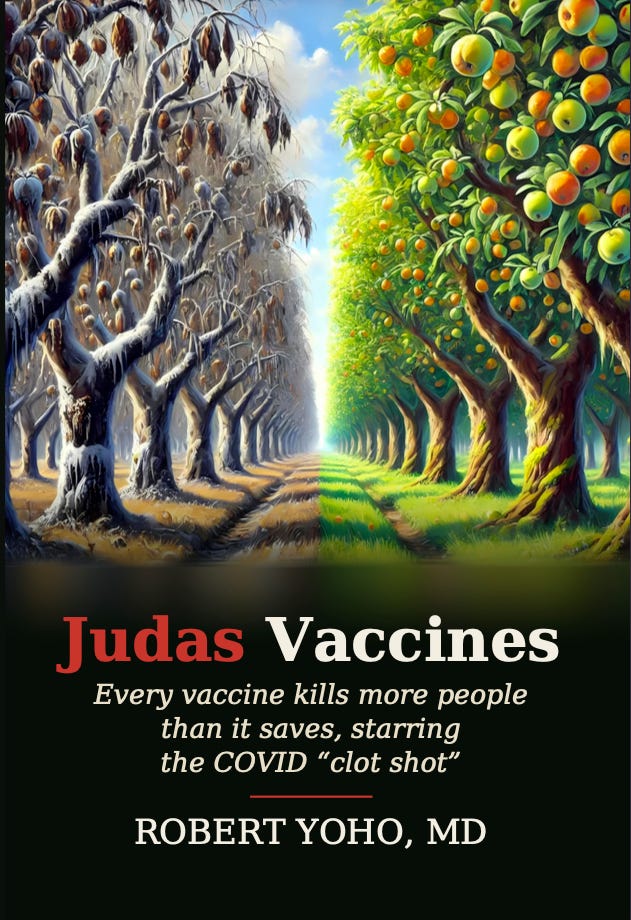
The painting on the cover shows one orchard with a path down the middle. The trees on the left are dead or dying. Frost covers the bark, the fruit has shriveled on the branches, and the ground beneath is littered with rot. The trees on the right are green, heavy with fruit, and standing in grass. Nothing separates the two halves except what was done to them.
That is what happens when you inject half a population and leave the other half alone. The image was composed by Unbekoming, the Australian writer whose summaries of Dissolving Illusions and Turtles All the Way Down appear throughout this book, using image-generation software, and it is reproduced with his permission and my thanks. He vaccinated his 2 children before he knew what was in the syringe, and he has spent the years since trying to make sure other parents learn in time. The orchard is his, and so is the warning.
Summary
• Deaths from measles, whooping cough, diphtheria, and scarlet fever fell by 90 to 99 percent before vaccines for them existed. Clean water, sewers, food, and the end of child labor did the work. The vaccines arrived after the war was won and took the credit.
• The smallpox vaccine, the founding miracle of the program, failed in every country that made it compulsory. The 1871 to 1872 pandemic struck the best-vaccinated nations hardest. The English city of Leicester stopped vaccinating in 1885, used sanitation and quarantine instead, and had lower smallpox death rates than the vaccinated cities around it for the next 60 years.
• No vaccine on the US childhood schedule has ever been tested against a saline placebo. Each new product is compared with an older one that has a similar injury rate, so nothing ever looks dangerous. In the trials the manufacturers did run, 1 infant in 22 to 1 in 40 was hospitalized or suffered a serious event. The authors of Turtles All the Way Down named this fraud, and no one has refuted them.
• The 5 studies cited to “debunk” the vaccine-autism link were rigged, one by one: raw data reversed by undisclosed adjustments, antigens counted instead of vaccines, sick controls, a 14-fold asthma finding dismissed, and autism in Montreal compared with vaccination in Quebec City.
• Of the 14 vaccines on the childhood schedule, only 5 are even able to provide herd immunity in theory. The moral basis for mandating the rest does not exist.
• Polio was a loose clinical label that covered pesticide poisoning, and the Salk vaccine was licensed in 2 hours, paralyzed children, and arrived after cases had already fallen by half. The oral vaccine now causes more paralysis in India than the disease it replaced.
• The unvaccinated are the healthiest people in America. The Control Group survey found chronic disease in 6 percent of unvaccinated adults and in more than 60 percent of vaccinated adults. Paul Thomas’s pediatric practice showed the same pattern, and the Oregon Medical Board took his license for publishing it.
• Autism prevalence rose from 1 in 10,000 to about 1 in 30 after Congress freed vaccine manufacturers from liability in 1986. The 75-shot schedule is the cause. The people who modeled the cost of this disaster were censored for saying so.
• SIDS, shaken baby syndrome, long COVID, and sudden adult death syndrome are labels used to hide vaccine injuries. Mothers went to prison for deaths that occurred hours after their babies’ shots.
• The World Health Organization spent decades developing a tetanus vaccine laced with a pregnancy hormone to sterilize women without their knowledge, and it was used in Kenya, the Philippines, Mexico, and Nicaragua. Bill Gates funded the same machinery. The COVID shot was made with the same contempt for consent.
• The COVID injections were manufactured in batches with wildly varying toxicity. About 1 in 200 vials came from a “hot lot” that caused thousands of deaths and disabilities. The pattern resembles a dose-response experiment, and a former Pfizer executive called it “the calibration of a killing weapon.”
• The shot does not stop. The spike protein has been found in the blood more than 700 days after injection. The vials contained plasmid DNA with an SV40 promoter, and the vaccinated shed onto the unvaccinated.
• Hospitals received a 20 percent bonus for each COVID diagnosis and additional payments for remdesivir and ventilators. Patients were sedated, intubated, denied food and water, and given do-not-resuscitate orders without consent. Grace Schara and Tasse Garmong were killed this way.
• Life insurers reported a 40 percent increase in deaths among working-age Americans in late 2021. The military’s own database showed miscarriages up 279 percent and cancers up by hundreds of percent. Live births fell 10 to 29 percent in the most vaccinated countries. None of this was investigated.
• The injured are treatable. Ivermectin, low-dose naltrexone, sulodexide, NAC, lumbrokinase, low-dose ketamine, and dietary changes help most people who try them. Nobody in mainstream medicine will admit the disease exists.
• The only defense is refusal. Every vaccine does more harm than good, so they should all be removed from the market.
Introduction: how I upgraded from “vaccine hesitant” to “vaccine denier”
Robert Heinlein coined the word “grok” to mean complete understanding, the kind that goes beyond the intellect and into the bones. If you still use the phrase “vaccine hesitancy,” you do not grok that every vaccine is Russian roulette. I did not either, for most of my career.
I am board-certified in emergency medicine and cosmetic surgery. I performed about 10,000 liposuction procedures, published peer-reviewed work on surgical anesthesia, and was president of the American Society of Cosmetic Breast Surgery. I believed what I was taught in medical school, namely that vaccines were the greatest public health achievement in history. When I wrote Butchered by “Healthcare” in 2020, I included the sentence “Vaccines have saved millions worldwide” in the chapter on what medicine does well. I regret that statement. It was the one thing in the book I did not verify.
The rest of that book argued that at least half of what medicine does is net harm. I documented the statins, the psychiatric drugs, the osteoporosis drugs, and the hospitals that kill 200,000 to 400,000 Americans a year because of horrible medical standards and errors. I learned that the journals are advertising vehicles, that the FDA is paid by the companies it regulates, and that the companies have criminal records for fraud that would embarrass a Mafia family. I found that the influenza vaccine was useless and later learned that it is still crammed with mercury. But I had not yet applied the same scrutiny to the rest of the vaccine program.
Then COVID arrived. I watched the same companies that had paid billions in fraud settlements announce they had produced a safe and effective injection in 9 months, using a technology that had failed in 30 years of trying. I watched Pfizer claim 95 percent efficacy while recipients developed facial paralysis within weeks. I wrote in Butchered that the COVID vaccine was a false promise and that if a true immunization were developed that fast, it would be the first time in history. I was right about that, but I did not yet understand how right.
Over the next 2 years, I lost friends. My lifelong climbing partner suffered a massive stroke and will never speak again. The man who invited me on a caving expedition died of a vaccine-induced stroke. He was one of 5 friends who ignored my advice and paid the price.
I came to know a father and a husband whose daughter and wife were killed in hospitals under protocols that paid a bounty for each COVID admission. I read the VAERS data, the insurance company reports, the military’s database, and the birth statistics from Taiwan, Germany, and Hungary. Then I went back and read the history of every other vaccine.
What I found was that the COVID shot was not an aberration. It was the vaccine program with the mask off. The same absence of placebo trials, the same fraudulent safety monitoring, the same invented diagnoses to explain away the dead, the same censorship of anyone who noticed, and the same population-control ideology behind the men who fund it all. The COVID “clot shot” was the worst example, but it was still an example of something, and that something is the subject of this book.
I first wrote most of this material as essays on my Substack, Surviving Healthcare, and in Cassandra’s Memo, my attempt to document the COVID crimes before they were memory-holed. I have pulled it together here with the work of the people who taught me: Suzanne Humphries and Roman Bystrianyk; the anonymous authors of Turtles All the Way Down; Tim O’Shea; Toby Rogers; Paul Thomas; Pierre Kory; Robert F. Kennedy, Jr.; A Midwestern Doctor; Unbekoming; and others I name as I go. I quote them at length because their words are better than any paraphrase and because I want you to be able to check them. When I quote my earlier work, I say so.
Two books get more space than the rest, and I make no apology for it. Dissolving Illusions (2013), by Humphries and Bystrianyk, is the history: 2 centuries of mortality tables, government reports, and physicians’ testimony that the medical schools never assigned. Turtles All the Way Down (2022) is the method: a product-by-product audit of how the vaccines on today’s schedule were tested, written from the manufacturers’ and regulators’ documents. Read those 2 and you will know more than your pediatrician. Part One of this book is my attempt to put their findings in front of people who will never open a 500-page book.
A word about tone. A reviewer once wrote that one of my books was “a horrible snipe attack” on a profession full of good people who would never knowingly harm anyone. She was right that it was an assault. I judge people by what they do, not by their self-knowledge or what they say about themselves.
The pediatrician who injects a newborn with a hepatitis B vaccine for a sexually transmitted disease on the first day of life, without ever having read a placebo-controlled trial because none exists, is doing harm. His good intentions do not matter. Willful ignorance is a scant excuse for anything.
I am retired and no longer practice medicine. Nothing here is personal medical advice. You are free to quote any of it, in whole or in part, as long as you credit me. My ebooks are free: Cassandra’s Memo is here, Hormone Secrets is here, and Butchered by “Healthcare” is here. Give them to your barber. He wants to know what has been happening.
Once you see this, you cannot unsee it. Some people must see it many times before they understand, however.
Part One. The myth
Chapter 1. The not so good old days
Every argument for vaccination rests on a single story. Once upon a time, infectious diseases slaughtered children by the millions. Then medicine invented vaccines, the diseases vanished, and anyone who questions the shots wants to bring back the iron lung. Doctors are taught this story in a few hours of medical school and never revisit it. I did not examine it for 40 years.
The story leaves out the world the diseases lived in. Suzanne Humphries, a board-certified nephrologist and internist, and Roman Bystrianyk, who spent years in the archives at Yale, the New York Academy of Medicine, and the Office for National Statistics in England, reconstructed that world in Dissolving Illusions: Disease, Vaccines, and the Forgotten History (2013). The first 3 chapters of their book describe the cities of the 1800s, the children who worked in them, and the diseases that followed. Nobody who reads those chapters believes the vaccine story again, which is why the chapters are never taught.
The cities
In 1750, about 15 percent of the English population lived in towns. By 1880, 80 percent did. London went from 800,000 people in 1801 to 7 million by 1901, and the housing, water, and sewers that would have made such growth survivable did not exist for most of a century. Friedrich Engels walked through Manchester in 1844 and described “small one-storied, one-roomed huts, in most of which there is no artificial floor; kitchen, living, and sleeping-room all in one… Everywhere before the doors residue and offal.” The people he met were “pale, lank, narrow-chested hollow-eyed ghosts.”
The Atlantic Monthly described American cities in 1861 as “pestilential enclosures.” In 1850, New York had 8,141 cellars sheltering 18,456 people, and Jacob Riis, who photographed the tenements, wrote that “the tenants died there like flies in all seasons, and a tenth of its population was always in hospital.” The water was sewage. Chicago drew its drinking water from Lake Michigan next to the mouth of the sewage-filled Chicago River. In 1858, the stench from the Thames forced the House of Commons to suspend its sessions, and residents drank the river. The streets were a barnyard. Street filth in New York reached “a depth of two to three feet in the winter,” and in 1860 an inquest at Bellevue Hospital took testimony from the mother of an infant who had been eaten by rats in the hospital.
The food was poison. Chicago’s milk came from distillery cows “fed on whiskey slops with their bodies covered with sores,” New York’s was “largely a by-product of the local distilleries,” and the New York milk dealers were “charged with the serious offense of murdering annually eight thousand children.” The 1865 report of the Citizens’ Association of New York described the children’s diet as slunk veal, the flesh of an unborn calf cut from its slaughtered mother, herrings approaching putridity, and “sausages not above suspicion, and horrible pies.” Among the urban poor of Victorian England the average age of death was 15 to 16 years. The worst tenement barracks were called “infant slaughterhouses” because 1 in 5 babies born in them died.
The children
Children were the labor force. An 11-year-old coal bearer named Ellison Jack told a commissioner in the 1840s: “I have been working below three years on my father’s account: he takes me down at two in the morning, and I am up at two the next afternoon.” She carried 4 or 5 tubs of coal a day, each of about 500 pounds, up 4 ladders. An 1843 government report found that children entered the mines at 4, 5, and 6 years of age. Trapper boys sat alone in the dark for 12 hours a day opening ventilation doors, and “they are allowed no light.”
Glass factories ran at 100 to 190 degrees, and the boys who worked beside the furnaces were “pale, have red eyes, often blind for weeks at a time.” A worker in one told an investigator, “I would rather send my boys straight to hell than send them by way of the glass-house.” Cotton mills in 1913 worked children of 6 and 7 from 6 to 6, and “there are days when the child works for seventeen hours at a stretch.” The Massachusetts Child Labor Committee recorded the same year that “a girl seven years old had worked sitting in the hot sun while she was sick with measles. The lack of care at that time was followed by her death.”
The mothers worked too, and left their infants with hired nurse-girls “sometimes not more than eight or ten years of age.” The 1843 report summed up the result: “the Children are pale, thin, delicate, feeble, stunted in growth, more than usually susceptible to certain formidable diseases, and much less able than common to resist the ordinary causes of disease.” In 1920, Rose Wilder Lane wrote that the United States “is allowing every year a quarter of a million of her own children to be killed by poverty. All other causes come back, in the last analysis, to that one.”
The diseases
Into this world came typhoid, cholera, dysentery, typhus, diphtheria, whooping cough, scarlet fever, measles, yellow fever, and tuberculosis. Typhoid alone killed 40,000 to 50,000 Americans a year in the late 1800s. The Union army lost 186,216 men to disease, twice the number killed in action, and Walt Whitman called the war “about nine hundred and ninety-nine parts diarrhea to one part glory.” Cholera came in 6 pandemics and killed 3,500 in Chicago in 1854, 5.5 percent of the city. Typhus went with war and filth; Russia had 25 million cases and up to 3 million deaths between 1917 and 1921.
Diphtheria killed 1,715 New Yorkers in 1910, scarlet fever 953, measles 785, whooping cough 461, and typhoid 558. Smallpox killed 5. The 2 biggest killers had no vaccine and never would. Tuberculosis and pneumonia together caused 1 in 5 American deaths in 1904, and in 1921, 132,000 Americans died of tuberculosis, 92,000 of them of working age. Humphries and Bystrianyk show that tuberculosis, pneumonia, and influenza killed 5 to 16 times more Americans through the 1900s than typhoid, scarlet fever, whooping cough, measles, or diphtheria. The diseases that vaccines are credited with conquering were never the main event.
The disease the doctors caused
One killer was medicine itself. Through the 1800s women delivered by physicians died at more than 3 times the rate of women delivered by midwives, because doctors went from the autopsy table to the delivery room without washing their hands. Ignaz Semmelweis showed in the 1840s that handwashing took maternal mortality in his Vienna clinic from 32 percent to zero. The profession’s answer was to destroy him. He was tricked into an asylum in 1865, beaten by the guards when he tried to escape, and died 2 weeks later of the wound. “Doctors were insulted at the suggestion that their hands were dirty,” Humphries and Bystrianyk write, “and many had the arrogance to continue to ignore factual evidence showing that they were the cause of maternal suffering and death up until the 1940s.”
Infants whose mothers died had 4 times the risk of dying themselves. “Had doctors simply washed their hands,” the authors add, “they would have prevented countless millions of deaths and raised the life expectancy curve markedly,” and vaccine enthusiasts never mention it. The same profession that would not wash its hands for a century now tells you it has studied the safety of 75 injections.
Starvation
Underneath all of it was hunger. The Irish famine of 1846 to 1847 killed perhaps 2 million, “far more from typhus and other epidemics consequent upon malnutrition” than from starvation outright. Scurvy, the disease of vitamin C deficiency, killed at least 10,000 men in the California Gold Rush, more than cholera did. At Andersonville prison, 688 Indiana soldiers died: 37 percent of diarrhea, 30 percent of scurvy, and 1 percent of wounds.
Vitamin C is the cofactor for the enzymes that move fat into the mitochondria to be burned, and the white blood cells that fight infection depend on it. Humphries and Bystrianyk put it this way: “The Recommended Dietary Allowance levels for vitamin C do not prevent ‘scurvy.’ They merely keep you from dying from complete mitochondrial shutdown.” The decline in scurvy deaths in England ran in parallel with the decline in deaths from whooping cough and measles. The same children who stopped dying of scurvy stopped dying of measles, and for the same reason.
What this means
A child breathing coal dust, sleeping in shifts on a bed that never cooled, eating slunk veal, and drinking sewage had no reserves to fight anything. Measles killed at rates 200 to 400 times higher among the malnourished. The bacterium that killed a slum child caused a mild illness in a well-fed child from a clean home. The physicians of the era knew this. J. M. French wrote in 1888 that “the depressing influences of extreme poverty, filth in all its forms, and the overcrowding of large cities, are great promoters of contagion,” while “strict cleanliness, fresh air, pure water, and hygienic living” restrict it.
Humphries and Bystrianyk close their description of the era with a sentence the vaccine story cannot survive: “The glimpse we have just taken of the underside of Western culture in the 1800s to the 1900s is never discussed in terms of the medical issues and diseases of that notoriously sickened era. Yet those were the most important aspects of susceptibility and spread of illness.”
Yoho comment: Every pediatrician who tells a mother that measles once killed thousands of children a year is telling the truth. What he leaves out is who those children were: 6-year-olds in coal mines, infants in cellars, children fed rotten herring and whiskey-slop milk. Measles did not kill them. Their lives did, and measles was the last straw. Once the lives changed, the deaths stopped, and the vaccines had nothing to do with it. The next chapter has the numbers.
Chapter 2. The diseases were dying before the vaccines arrived
The proof that the vaccine story is nonsense lies in the government’s own mortality tables. Humphries and Bystrianyk compiled those tables from the US Census Bureau, the vital statistics records of England and Wales going back to 1838, and the medical journals of the era, and Dissolving Illusions reproduces more than 50 graphs from them. Unbekoming, whose summary I draw on throughout, called it “the most important book ever written on vaccination,” and tens of thousands of people trace their awakening to it. I am one of them.
What the graphs show
Deaths from measles, whooping cough, diphtheria, and scarlet fever declined by 90 to 99 percent before the vaccines for these diseases were introduced. That is the main finding, and everything else is detail.
In the United States, whooping cough deaths fell from an average of 7,678 per year in 1926 to 1930 to 1,254 per year in 1946 to 1950, before the pertussis vaccine entered widespread use. In England and Wales, the whooping cough death rate had dropped by more than 99 percent before national vaccination began in 1957. A 1982 paper in Epidemiologic Reviewsconceded that pertussis immunization “was introduced at a time when mortality from the disease had been falling steeply for 70 years,” and that “there was relatively very little room for improvement.”
Measles is the same. The US measles death rate fell by more than 98 percent before the vaccine was licensed in 1963. In 1960, 3 years before the vaccine, 380 Americans died of measles in a population of 180 million. In all 6 New England states the year the vaccine was licensed, 5 people died of measles, while 283 died of asthma. A 1980 paper claimed a “striking decline” in measles deaths since licensure, using a logarithmic graph that magnified the tiny post-1963 change while compressing the enormous decline before it. Plotted on a linear scale, the vaccine mopped up the last 2 percent. In England, the decline from the peak had reached 99.96 percent by the time the vaccine arrived in 1968.
Scarlet fever killed at rates comparable to those of measles and whooping cough. In Providence, Rhode Island, 1 in 5 cases died in 1886 to 1888; 1 in 114 died in 1923 to 1924. The disease declined to nearly zero, and there has never been a scarlet fever vaccine. Typhoid, cholera, typhus, and dysentery disappeared from the developed world the same way, and no one vaccinates against them. The Encyclopaedia Britannica stated the matter in one sentence: “Maintaining public health is the responsibility of the engineer, not the doctor.”
Jayne Donegan, the British physician who wrote the foreword to Dissolving Illusions, was taught that vaccines were the single most useful health intervention ever introduced, and that diseases without vaccines had declined because of better social conditions. “You would think,” she wrote, “that some of us would have asked, ‘But if deaths from these diseases decreased due to improved social conditions, mightn’t the ones for which there are vaccines also have decreased at the same time, for the same reason?’ But we didn’t.” The medical curriculum sorted non-vaccinatable diseases into the social conditions box and vaccinatable diseases into the vaccines box, then moved on to the next subject.
The health revolution
What changed was the sanitary state. In 1849, the residents of a Soho street wrote to The Times of London in their own spelling: “We live in muck and filth. We aint got no priviz, no dust bins, no drains, no water-splies, and no drain or suer in the hole place… if the Cholera comes Lord help us.” Cholera came in 1854, and John Snow traced it to the Broad Street pump. London began building its sewers in 1859, and the last London cholera epidemic was in 1866.
The water was filtered and then chlorinated. In 1892, Hamburg drew its water from the Elbe and had about 18,000 cholera cases, more than half of them fatal. Altona, next door, drew from the same river but filtered it first, and had “comparatively few cases.” Dr. Thurman Rice summed it up in 1932: “It is not strange that health improves when the population gives up using diluted sewage as the principle beverage.” Milk was pasteurized, food was refrigerated and inspected, New York’s new board of health closed nearly all cellar lodgings within 4 years of its founding in 1866, and child labor laws removed 6-year-olds from the mines.
Osler wrote in 1898 that English deaths from typhus and typhoid had fallen from 1,228 per million in 1838 to 140 per million in 1892, and that “three factors have been concerned in this extraordinary saving of life, the cleansing of towns, the purification of the water supplies, and the introduction of good sewers.” Dr. James Gordon Cumming wrote in JAMAin 1922 that the eradication of diphtheria “will not come through the serum treatment of patients, by the immunization of the well,” but “through the mass sanitary protection of the populace.” Humphries and Bystrianyk give the verdict: “Medicine in general, and vaccines even more so, contributed very little to this phenomenal transformation.” René Dubos, the Rockefeller microbiologist, wrote in 1959 that “when the tide is receding from the beach it is easy to have the illusion that one can empty the ocean by removing the water with a pail.”
The amazing decline
By 1935, Dr. Louis Dublin of Metropolitan Life was writing that “all of the old menaces like typhoid, smallpox, measles, scarlet fever, whooping cough and diphtheria have become minor causes of death.” Life magazine announced in June 1941 that deaths from measles, scarlet fever, whooping cough, and diphtheria had fallen 31 percent in a single year “to a new record low, a point actually promising complete eradication of these diseases!” The Department of Labor’s 1941 handbook named the reasons: “Advances in sanitary science, including the Pasteurization of milk, the better refrigeration of foods, and the purification of water supplies, as well as the general rise in the standard of living.” None of those 4 diseases had a vaccine in general use in 1941. The eradication Life promised had been accomplished by plumbers before the vaccines existed.
The same tables show what vaccines did when they arrived, which was little. In the United States, diphtheria mortality fell 98 percent from 1900 to the mid-1940s, when DTP arrived, and the authors note that “the declining mortality rate was actually interrupted temporarily after the vaccine was introduced.” Tuberculosis fell from about 450 Massachusetts residents per 100,000 in 1857 to 35.6 in 1938, a decade before streptomycin, and BCG was never given routinely to American children. Typhoid and diarrhea fell more than 90 percent with no vaccine in use and before antibiotics. Thomas McKeown, who analyzed the English records from 1838 onward, found that 56 percent of the 20th-century decline in infectious disease mortality came before 1931, when neither sulfa drugs nor antibiotics existed.
The McKinlays reached the same conclusion for the United States in 1977. “Medical measures (both chemotherapeutic and prophylactic) appear to have contributed little to the overall decline in mortality in the United States since about 1900,” they wrote, “having in many instances been introduced several decades after a marked decline had already set in.” At most 3.5 percent of the mortality decline since 1900 was attributable to medicine. The CDC’s own researchers agree when they think no one is listening. Guyer and colleagues at Johns Hopkins and the National Center for Health Statistics wrote in 2000 that “nearly 90% of the decline in infectious disease mortality among US children occurred before 1940, when few antibiotics or vaccines were available,” and that vaccination “does not account for the impressive declines in mortality seen in the first half of the century.”
Turtles All the Way Down calls this “an open secret in scientific and medical circles: Everyone knows the truth but nobody cares to share it with the public.” The Department of Health’s website says the diseases were eliminated “primarily due to safe and effective vaccines.” The scientists who wrote the mortality papers say otherwise, and nobody has asked them to reconcile the 2 claims.
What came after
Then the diseases of childhood were replaced. In 1960, 1.8 percent of American children were limited in their daily activity by a chronic condition. By 2010 it was 8 percent, or 5.5 million children, and a 2007 to 2008 survey of more than 90,000 children found that 43 percent had at least 1 chronic condition. Turtles compares the 2 plagues in 1979: about 400,000 reported cases of infectious disease across all ages, against about 2 million chronically ill or disabled children.
Nobody in public health has called this an emergency. In 2009, H1N1 influenza was found in 2 American children and a global emergency was declared. The same year, about 1 million American children joined the ranks of regular consumers of chronic medication. In 2015, 84 measles cases in California produced a CDC press conference urging the whole nation to vaccinate. “One can only speculate,” the authors of Turtles write, “on the CDC’s response should a measles or influenza epidemic break out, threatening to permanently disable some 350,000 American kids.”
The diseases were dying before the vaccines arrived. The vaccines did not save us. Plumbers did. What arrived with the vaccines was a generation of children on daily medication, and the agencies that took credit for the first thing have never accepted responsibility for the second.
Yoho comment: Look at one graph before you decide anything about vaccines: measles deaths in the United States from 1900 to 1970, with the year of the vaccine marked. The line falls 98 percent and then the vaccine arrives. Every doctor in America has been taught the opposite, and almost none has seen the graph, because it was never in the curriculum. It is in the book, with 50 others like it. I did not reproduce them here, but once you have seen them, no press conference will work on you again.
Chapter 3. Smallpox: the founding lie
The smallpox vaccine is held up as proof of concept, the first miracle, the disease that vaccination conquered and drove from the earth. Every defense of every later product begins with it. The history says otherwise, and the history was written down at the time by the physicians who watched it happen.
Before Jenner
The practice that preceded vaccination was variolation: scratching pus from a smallpox sore into a healthy person in the hope of a mild case. Two or 3 of every 100 people inoculated died of it, and the inoculated spread smallpox to their neighbors. An analysis published in 1764 compared the 38 years before inoculation began with the 38 years after, and smallpox deaths per 1,000 births had risen 41 percent. Humphries and Bystrianyk conclude that “the medically sanctioned operation was as likely to start an epidemic as to stop one.”
In 1796, Edward Jenner scratched cowpox from the hand of a dairymaid into an 8-year-old boy, exposed him to smallpox, and announced that cowpox conferred lifelong, perfect immunity. The authors note that “his claims were based on a sample of one and no scientific method.” Nobody knew what was in the material. Jenner’s own lymph, a correspondent of The Lancet wrote in 1829, had been taken “not from the cow, but the horse.” Dr. M. Beddow Bayly wrote in 1952 that vaccine lymph was derived “either from a smallpox corpse, the ulcerated udder of a cow, or the running sores of a sick horse’s heels,” and a 2011 genetic analysis of Dryvax, the American product in use since the late 1800s, called it a “molecular fossil” of horse and human viruses of unknown origin. The CDC ordered the remaining stock destroyed in 2008.
The promise fails
Within a year of Jenner’s paper, physicians using vaccine from Jenner himself found that vaccinated children still caught smallpox. The Medical Observer for 1810 documented 535 cases of smallpox after vaccination, 97 of them fatal, along with 150 vaccine injuries. Thomas Brown, a surgeon who had vaccinated 1,200 people, wrote in 1818 that his conscience could no longer support vaccination after watching his vaccinated patients die of smallpox. William Cobbett described the 1829 epidemic in Ringwood, which killed more than 100 people, “every one of whom had had the cow-pox ‘so nicely!’” and asked what was said in response. “Not at all: the failure was imputed to unskillful operators; to the staleness of the matter; to its not being of genuine quality.” Parliament had voted Jenner £20,000.
The claimed duration of immunity shrank with each failure: from lifelong, to 10 years, to 3 years, and by 1911 to “six months to twelve months” with revaccination “advisable once a year.” A circular signed “The Doctors” in 1876 put it in verse: “Should it injure or kill you whenever you receive it, / We all stand prepared to refuse to believe it.”
When the promise of immunity failed, the authorities redefined success. Vaccination now “modified” the disease, making it milder. If a vaccinated person stayed healthy, vaccination protected him. If he caught smallpox and survived, vaccination softened it. If he died, he was reclassified as unvaccinated or as having a vaccination that had “worn off.” Nothing was allowed to count against the shot. This is the maneuver used for the pertussis and influenza vaccines today, and for the COVID injection: promise prevention, then settle for “less severe disease” when prevention fails. The milder-disease claim did not hold either. In the 1844 epidemic, about 8 percent of vaccinated people who caught smallpox died, and more people were admitted to the London Smallpox Hospital that year than in the 1781 epidemic before vaccination existed.
Compulsion, and the pandemic that followed it
England made vaccination compulsory in 1853 and tightened enforcement in 1867. Parents who refused were fined, then fined again, then had their goods seized and auctioned, and finally imprisoned. Massachusetts passed comprehensive compulsory laws in 1855, Chicago had vaccinated more than 95 percent of its people by 1868, Prussia had required revaccination of every schoolchild since 1835, and Japan made vaccination compulsory in 1872.
The pandemic of 1871 to 1872 followed. Deaths in England rose from 2,620 in 1870 to 23,126 in 1871, after 2 decades of compulsory vaccination. Dr. Alexander Wilder wrote in 1898 that “never did the faith in vaccination receive so rude a shock,” that “every country in Europe was invaded with a severity greater than had ever been witnessed during the three preceding centuries,” and that “many vaccinated persons in almost every place were attacked by smallpox before any unvaccinated persons took the disease.”
The best-vaccinated places did worst. Of 9,392 smallpox patients in London hospitals in 1871, 6,854 had been vaccinated. In Bavaria, 95.7 percent of the cases were in vaccinated people. Prussia, “the best revaccinated country in Europe,” lost 59,839 to smallpox, more than any other northern state. Boston, after 17 years of compulsion, had what the Boston Medical and Surgical Journal called in 1881 the most severe epidemic since the introduction of vaccination, and Humphries and Bystrianyk show from the city’s records that more people died of smallpox in the 20 years after the strict laws than in the 20 years before. Japan vaccinated and revaccinated more than 25 million people between 1885 and 1892 and recorded 39,979 smallpox deaths in those years; after the law was tightened again in 1896, the case fatality the next year was “nearly twice that from smallpox previous to the vaccination period.” The response everywhere was stricter laws. Humphries and Bystrianyk: “Compulsory vaccination laws did nothing to curb the problem of smallpox.”
The vaccine as a vector of disease
The vaccine itself spread disease. Arm-to-arm vaccination, in which pus was scraped from one child’s pustule and scratched into another, was used for 100 years and outlawed only in 1898. It transmitted syphilis repeatedly; one incident in Rivalta, Italy, infected 44 children and 39 of their family members. At a Bremen shipyard in 1883, 1,289 workmen were revaccinated from one batch of humanized lymph and 191 of them developed jaundice, an outbreak now recognized as hepatitis. Erysipelas, tuberculosis, and leprosy traveled the same route. A man named George Banford complied with the law 3 times: his first child “was covered with sores” after vaccination, his second developed erysipelas, and his third developed erysipelas and died in 14 days. Official records for England and Wales list more than 1,600 deaths from vaccination between 1859 and 1922, and from 1906 to 1922 the deaths from vaccination and from smallpox were “approximately the same.”
The calves were no cleaner than the children. “Pure” lymph under English law was permitted to contain 20,000 extraneous organisms per cubic centimeter, and the British Medical Journal conceded in 1950 that “as many as 500 million organisms per ml. may be present.” The Department of Agriculture traced the American foot-and-mouth epidemics of 1902 and 1908 to vaccine production; the 1908 outbreak took 100,000 inspection visits to contain and ended with 3,636 animals killed and buried in quicklime. Then the disease appeared in people. After the Boston Board of Health gave about 230,000 vaccinations in 1901 and 1902, Dr. James Howe presented 10 cases of a lethal blistering disease that followed vaccination, 6 of them fatal. Senator Money of Mississippi told the Senate in 1909: “It has been found that it sometimes makes them immune from smallpox, but gives them the foot-and-mouth disease, which is just about as bad.”
In 1948, the United States recorded 1 death from smallpox and an estimated 200 to 300 deaths from the smallpox vaccine. Vaccination continued until 1963. A 1970 study in JAMA found that “three of seven deaths definitely related to vaccination did not appear in our search of death certificates,” and that “the extent of underreporting is unknown.” The authors of Dissolving Illusions ask the question the textbooks skip: “Knowing the process of vaccine production and what was in them, is it really possible that this vaccine eradicated any disease?”
The damage was understood at the time and drawn for the public. An anti-vaccination print from the end of the nineteenth century, titled The Vaccine Upas Tree after the legendary poison tree of Java, shows the whole case in one picture. The roots are labeled cow pox, horse grease, swine pox, and calf pox, the sources of the lymph. The trunk is “Virus,” with the official promise, “one mark, protective for life,” climbing it beside the number of marks and years each revision of that promise required. The fruit is syphilis, erysipelas, scrofula, tuberculosis, cancer, eczema, convulsions, meningitis, and dozens of other diseases that physicians of the day had reported after vaccination, and the ground beneath is a graveyard. The caption reads, “The root that poisons the young life blood of the nation. It biteth like a serpent and stingeth like an adder.” Everything in this chapter was on that poster 130 years ago.
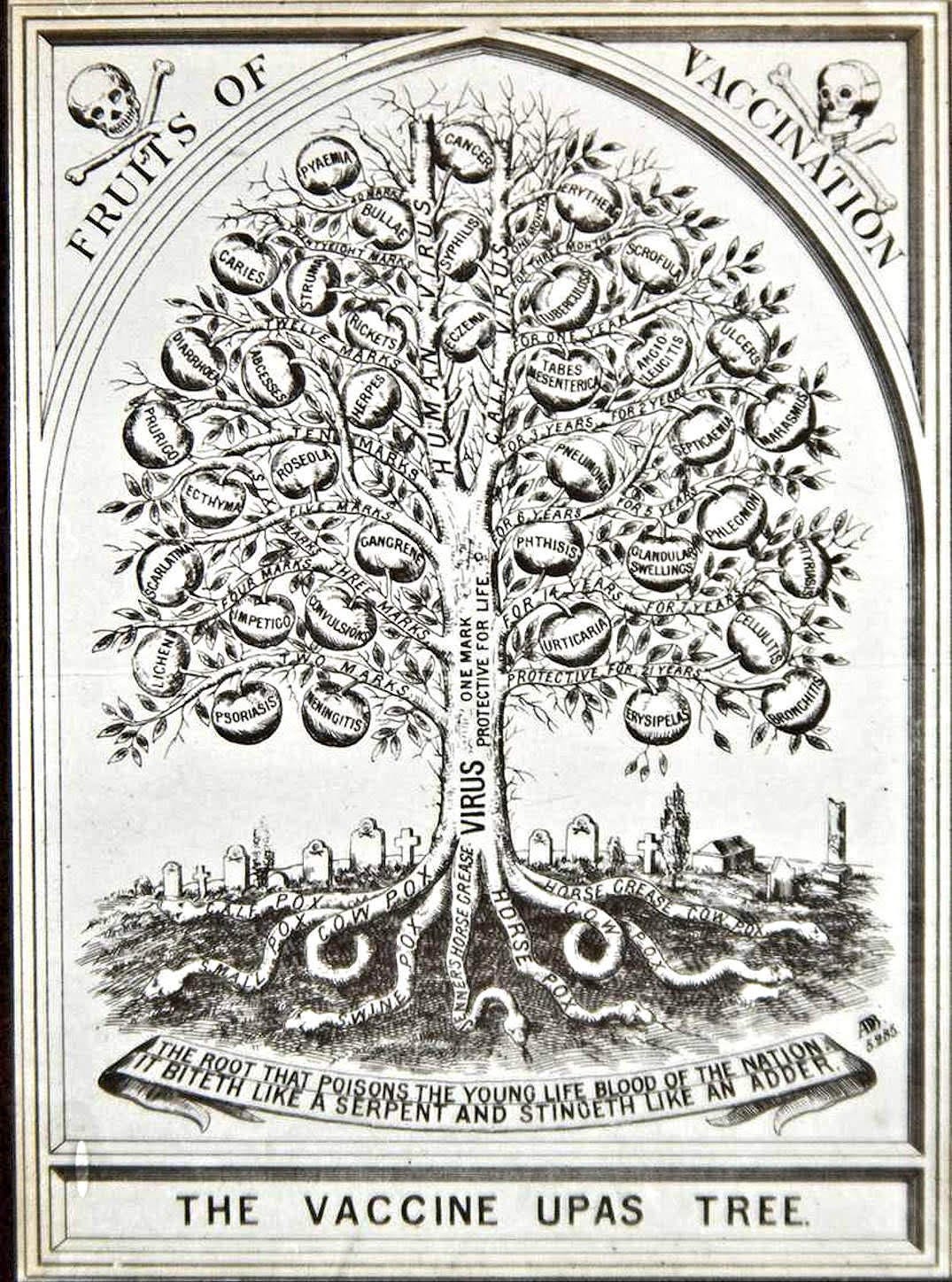
The Vaccine Upas Tree, an anti-vaccination print signed with the monogram A.D., late nineteenth century. Lantern slide in the Historical Medical Library of the College of Physicians of Philadelphia. Public domain.
Cooking the books
Dr. Henry May wrote to the Birmingham Medical Review in 1874 that when a vaccinated child died of erysipelas, “in my desire to preserve vaccination from reproach I omitted all mention of it from my certificate of death.” Elizabeth Sabin, age 4, “with six good marks of successful vaccination,” caught smallpox and died, and her case was excluded from the vaccinated column of the official statistics. “Statistics cooked in that way,” the statistician Noel Humphries told the Royal Statistical Society in 1897, “could not be accepted as accurate.” Those statistics formed the basis for the compulsory laws.
What ended smallpox
Smallpox deaths fell after 1872, and vaccination coverage in England and Wales fell with them, from nearly 90 percent to 40 percent by 1909. Around 1896, the disease itself changed. A mild form appeared in the American South with a case fatality of 0.26 percent instead of 20 percent, so mild that it was taken for chickenpox and given folk names like “Cuban itch” and “elephant itch.” North Carolina recorded 3,294 cases in 1911 without a single death. In 1921, a textbook warned, “We must prepare for a pandemic of smallpox!” because “the very young are almost unvaccinated.” English vaccination fell to 18 percent by 1948, and the pandemic never came.
The World Health Organization’s eradication campaign of the 1970s is credited to mass vaccination. Derrick Baxby, the British virologist, wrote in 1999 that “contrary to popular belief smallpox was not eradicated by mass vaccination. Though tried initially it proved difficult to implement in many countries and was abandoned in favour of surveillance-containment.” Surveillance and containment means finding cases, isolating them, and vaccinating and quarantining their contacts. It was invented in the English city of Leicester in 1885, by people who had been fined, jailed, and told they would be massacred for refusing the vaccine.
The pattern set in the 1800s is the pattern of everything that followed. A product is introduced with a promise of perfect protection. The promise fails. The definition of success is changed so the product cannot fail. Deaths caused by the product are recorded as something else. A city or country that rejects the product and does better is ignored. The record is rewritten, and the next generation of doctors learns the rewritten version in an afternoon.
Yoho comment: I was taught the Jenner story in an hour and believed it for 40 years. What I was not taught is that the people who lived through it wrote down what they saw: the vaccinated dying of smallpox, the deaths recorded as something else, the promise shrinking from a lifetime to a year. None of that was secret. It was in the medical journals of the day. It was simply left out of the version handed to medical students, and once you see that the founding miracle was built this way, you will read every later one differently.
Chapter 4. Leicester, the mob, and the power of the state
The city of Leicester is the control group that medicine has spent a century pretending does not exist.
The great demonstration
Leicester obeyed the law. Before the pandemic of 1871 to 1872, about 95 percent of its births were vaccinated, a higher rate than most English cities. In the pandemic of 1871 to 1872, the town had some 3,000 cases of smallpox and 358 deaths, many of them vaccinated. The authorities concluded that the vaccine had been applied too loosely and appointed officers to enforce it. Prosecutions rose from 2 in 1869 to more than 1,100 in 1881, with 64 imprisonments and 193 seizures of household goods.
The penalties fell on parents whose earlier children had already been hurt. Arthur Ward had 2 children injured by vaccination and refused to submit a third. He was fined, and 2 police officers came to his house while he was at market to collect the fine or seize the goods. His pregnant wife, alone and without money, refused to let them upstairs. “Harsh language was used by the officers, who threatened to take her husband to prison, terrifying Mrs. Ward.” She gave birth to a stillborn child on December 26 and died a few weeks later. Her own doctor, who believed in vaccination, said “he did not think it was the duty of any professional man to carry out the laws in the outrageous and brutal manner in which they were enforced.”
By March 1885, more than 5,000 Leicester residents were under summons, and The Times reported that “the defaulters and the objectors increase faster than the cases can be dealt with.” On March 23, between 80,000 and 100,000 people marched 2 miles through the town, with delegates from more than 60 towns and letters from across Europe and America. The banners read “The Three Pillars of Vaccination, Fraud, Force, and Folly” and “We no longer beg but demand the control of our children.” An effigy of Jenner was hanged from a gallows, the parliamentary acts were burned, a wagon of unvaccinated children bore the motto “They that are whole need not a physician,” and a coffin on an open bier was inscribed “another victim of vaccination.” A young mother and 2 men marched to the police cells to serve their sentences rather than submit, and the crowd gave “three hearty cheers” as they entered the doors.
Councillor Butcher told the crowd that “the best way to get rid of smallpox and similar diseases was to use plenty of water, eat good food, live in light and airy houses, and see that the Corporation kept the streets clean and the drains in order. If such details were attended to, there was no need to fear smallpox, or any of its kindred; and if they were neglected, neither vaccination nor any other prescription by Act of Parliament could save them.”
The Leicester method
That year the town’s government fell to the anti-compulsionists, prosecutions stopped, and by 1890 only about 5 percent of births were being vaccinated. In place of vaccination the city adopted what became known as the Leicester Method. The Times described it: “As soon as smallpox breaks out, the medical man and the householder are compelled under penalty to at once report the outbreak to the Corporation. The smallpox van is at once ordered by telephone to make all arrangements, and thus, within a few hours, the sufferer is safely in the hospital. The family and inmates of the house are placed in quarantine in comfortable quarters, and the house thoroughly disinfected. The result is that in every instance the disease has been promptly and completely stamped out at a paltry expense.”
The medical profession predicted a massacre. The Lancet wrote in 1886 that “the very industry of Leicester will be molested by a plague which will stagger the radical authorities of the borough, and bring the thousands of unvaccinated and unrevaccinated inhabitants to cry for the blessings discovered by Jenner.” In 1914 the New York Times was still predicting “a dreadful reckoning in England.”
It did not happen. During the 1892 to 1894 outbreak, Leicester’s smallpox death rate was 5.7 per 100,000. Heavily vaccinated Birmingham had 8.0, Warrington 10.0, and Middlesbrough 14.4. In 1893, Mold in Flintshire, “with all the births vaccinated for eighteen years previous to the epidemic,” had a smallpox death rate of 3,614 per million; Leicester, “with a population under ten years of age practically unvaccinated,” had 144. In the 1902 to 1903 outbreak Leicester’s rate was 5.3, and in 1903 to 1904 it was 1.2. J. T. Biggs, who sat on the town’s sanitary committee for 22 years, wrote in 1912 that each successive epidemic, “with a larger proportion of unvaccinated population, furnishes a still lower death-rate.”
Dr. C. Killick Millard became Leicester’s medical officer of health in 1901 and held the post for 34 years. He arrived a believer. “It was predicted that once the disease got amongst the unvaccinated children of Leicester it would ‘spread like wildfire,’” he wrote in 1904. “I certainly expected this myself when I first came to Leicester, and it caused me much anxiety all through the epidemic. Yet although, during the ten months the epidemic lasted, 136 children (under fifteen years) were attacked, inflicted largely by once-vaccinated adults, it cannot be said that the disease ever showed any tendency to ‘catch on’ amongst the entirely unvaccinated child population.”
The unvaccinated children were being infected by vaccinated adults whose mild, modified cases went unrecognized. Vaccination did not stop transmission. It created walking carriers who spread the disease while appearing healthy. “The mildest smallpox is admittedly as contagious as the most severe,” Millard wrote, so “vaccinated smallpox is no less dangerous to the community than unvaccinated; therefore there is no reason, and therefore no right, to enforce vaccination by law.” In 1948, the year England ended compulsion, he gave the verdict of 60 years’ observation in the British Medical Journal: the correlation between vaccination and the decline of smallpox “must have been a coincidence, because smallpox mortality continued to decrease even after vaccination was decreasing also.” In Leicester, “during the 62 years since infant vaccination was abandoned there have been only 53 deaths from smallpox, and in the past 40 years only two deaths.”
The World Health Organization’s eradication campaign of the 1970s was, in the end, the Leicester Method applied worldwide under the name “surveillance-containment.” In Yugoslavia in 1972, a vaccinated pilgrim brought smallpox back from Iraq, the government vaccinated 18 million people, and what stopped the outbreak was the quarantine of contacts in hospitals, motels, and whole villages. Humphries and Bystrianyk: “Vaccination, although known to be ineffective, had to be implemented if the history of vaccine success was to be upheld. But what really stopped the epidemic was use of the Leicester Method.”
Leicester’s experiment was never refuted. It was erased. Dr. Charles Creighton’s entry on vaccination in the 1890 Encyclopaedia Britannica documented failures and included tables of vaccine deaths. By 1903, the tables were gone. By 1922, the entry was gone, replaced by text assuring readers that vaccination provided immunity and that breakthrough cases would be “mild.”
The power of the state
The compulsory laws were enforced with the full weight of the state, and the newspapers of the time recorded it. In 1869, Mrs. Anne Sipple of England was sentenced to 7 days’ hard labor “and confined in a stone cell with an infant of eighteen months, the child deprived of shoes and socks, and a diet of bread and water only for both.” In Montreal in 1885, a compulsory by-law provoked a riot in which the mob burned the house of the public vaccinator. In Passaic, New Jersey, in 1901, 350 girls at the American Tobacco Company works were told that every one of them would be vaccinated; they found the exits locked, the police were called, and “some of the girls fought the officers and were led up to the physicians screaming, struggling, and kicking.” All were vaccinated.
In Boston in 1902, “125 surgeons, each accompanied by a policeman, made a house-to-house canvass” of East Boston. In Lead, South Dakota, the sheriff and his deputies escorted the city physician through “the saloons, theatres, and gambling dens” and vaccinated several hundred miners by force. In Sandersville, Georgia, in 1904, a man named Boss Garrett shot and killed a special officer who came to vaccinate him and was run down by a posse and shot by a deputy marshal. In 1918, a soldier in training at Camp Dodge who refused vaccination was court-martialed and “sentenced to fifteen years in the disciplinary barracks at Fort Leavenworth.” The Supreme Court ruled in 1922 that the states’ “police power” over public health overrode personal liberty.
Arthur Smith
One family shows what the orders did. In the fall of 1914, the New York State Department of Education ordered every school in the state to exclude unvaccinated children and warned that parents who kept them home “would ultimately be arrested and sent to prison.” Arthur Smith, Jr., was “a normal, healthy 11-year-old boy” in New Windsor, New York. The children were told every day that their fathers would be arrested. “They so intimidated the mother and I,” his father wrote, “that thinking we could not successfully fight the order, at last we consented to have our children vaccinated by a physician of our own choice.”
His sisters recovered. Within a week, Arthur’s “hands, arms, feet, and legs had swollen to twice their normal size. Blisters covered his entire body, and when they broke yellow pus was discharged and turned into sores.” The Newburgh Daily News reported in March 1915: “Now he is dying. His body is a mass of running sores. He cannot wear any clothing. His hair is falling out. He is suffering untold torments. Instead of attending school or playing with children of his own age he has to sit by the stove in the house, swathed in ointment-soaked bandages and suffer untold agony. All because he was vaccinated.”
A blood specialist diagnosed pemphigus, the blistering disease that the Boston dermatologists had tied to foot-and-mouth contamination of the vaccine a decade earlier. Arthur sat by the stove for 3 years, recovered in December 1918, and lived until 1983. Two girls vaccinated at the same school in the same month broke out in sores and fell behind their classmates, or developed St. Vitus’ dance. One girl’s brother, vaccinated years earlier at a Newburgh school, went blind for a year, was then paralyzed, and lost his speech.
Officials never wavered. These reports, Humphries and Bystrianyk write, “faded from societal memory. What remained was the myth and illusion of vaccination safety, necessity, and effectiveness.” England ended compulsory vaccination quietly in 1948, 3 years after Nuremberg made the state’s claim to own its citizens’ bodies temporarily unfashionable, and Millard noted that “the opposition was almost negligible.” The legal principle did not die with it. Justice Oliver Wendell Holmes cited compulsory vaccination in 1927 to justify the forced sterilization of the “unfit,” and the men who fund the vaccine program today are the heirs of the men who cheered him.
Yoho comment: I read these chapters with the eye of a man who ran an emergency department. The Leicester Method is what we would do today with any dangerous contagion: find the case, isolate him, trace his contacts, clean the house. It works, it costs nothing, and it injures no one. The vaccinators of 1885 called it a death sentence, and when it succeeded, they wrote it out of the encyclopedia. Everything that was done to the COVID dissidents in 2021 was done to the people of Leicester first.
Chapter 5. Turtles all the way down: no vaccine has ever been tested against a placebo
You can download the entire book as a PDF and share it with your friends if you sign up for a paid subscription.