READER RESOURCES:
-
Click HERE for my new print books available as paperbacks on Lulu.
-
THE APOCALYPSE ALMANAC: Hidden cures in our dystopian age. Check out the “Cure Cancer in Your Kitchen” chapter.
-
FULLSCRIPT SUPPLEMENTS: top quality and economical.
-
AFFILIATE STORE: I offer competitively priced products HERE that I have personally tested and used.
This is in my series on purported treatments for Parkinson’s disease.
Summary
· Smokers and snuff users develop Parkinson’s disease less often than people who never used tobacco, and the protection grows with the dose and the years of use.
· Part of that gap comes from the disease itself. People headed for Parkinson’s find quitting easy, years before the first tremor.
· Nicotine patches flopped in the only large placebo-controlled trial in early Parkinson’s, at doses up to 28 milligrams per day for a year. A French study pushed the dose to 90 milligrams and found no motor benefit.
· If something in tobacco protects the brain, the best candidates are compounds that block monoamine oxidase B (MAO-B), the enzyme targeted by the Parkinson’s drugs Eldepryl (selegiline) and Azilect (rasagiline).
· Nicotine is the hook, and the smoke is the poison. Tar, nitrosamines, carbon monoxide, and heavy metals cause the cancers and the heart disease.
· A cure in 7 days from a sliver of a patch is a testimonial without a single controlled study behind it. I have Parkinson’s, wore a patch for a day or two, and noticed nothing.
The claim
I have Parkinson’s disease, so readers have been pestering me about nicotine patches. Most of the traffic traces to Bryan Ardis, a chiropractor and podcaster who built a following during the COVID years with his snake-venom theory. A Facebook reel from May 2024 drew more than 350,000 views. In it, he told the story of a man whose Parkinson’s symptoms vanished within 7 days on the patch. According to the story, his neurologist then told him he no longer had the disease. Ardis has made similar claims for Alzheimer’s disease, multiple sclerosis, ulcerative colitis, and autism.
His website tells followers to cut a 14-milligram patch into 6 pieces and wear one piece per day, which he says is his daily routine. That amounts to about 2.3 milligrams per day.
Yoho note: Ardis is a promoter first, and a secondhand account of an unnamed patient is the weakest form of evidence in medicine. Parkinson’s does not melt away in a week. When it seems to, the most likely explanations are a misdiagnosis, such as essential tremor or drug-induced parkinsonism, or a placebo response. Parkinson’s patients show some of the largest placebo responses in medicine because expectation alone releases dopamine in the part of the brain the disease damages.
Smokers get less Parkinson’s
For decades, study after study has found that smokers develop Parkinson’s less often than people who never smoked, and the risk declines further with more cigarettes and more years. A 2024 review calls the lower risk among smokers well established.
The best evidence comes from Sweden, where many men use snus, a moist tobacco placed under the upper lip. Snus delivers about as much nicotine to the blood as cigarettes, but nothing burns. Researchers pooled 7 Swedish studies of 348,601 men followed for an average of 16 years and focused only on men who had never smoked. Snus users had about 60 percent lower risk of Parkinson’s than nonusers, and current, heavy, and long-term users had the lowest risk. Because nothing burns in snus, its protection likely comes from something in the leaf rather than from smoke.
Cause or early warning?
Beate Ritz, an epidemiologist at the University of California, Los Angeles, offered a second explanation in 2014. She compared 1,808 Danish Parkinson’s patients with 1,876 matched controls and asked how difficult quitting had been. Former smokers who called quitting “extremely difficult” had 31 percent lower risk of Parkinson’s than those who said quitting was easy. Her interpretation is that the disease dulls the brain’s dopamine reward system years before tremors appear. Nicotine gives future patients little pleasure, so they walk away from cigarettes without a struggle. On that view, avoiding tobacco is an early symptom of Parkinson’s rather than a cause of it.
Yoho note: Ritz’s theory does not apply to my case. I was a closet smoker for a decade, usually about 4 cigarettes a day, and quitting was more aggravating than getting off Klonopin (clonazepam). I developed Parkinson’s anyway. The physicians I consulted blamed my 17 mercury amalgams more than the cigarettes, although cigarettes are a source of mercury exposure.
Genetic studies use inherited differences in smoking behavior as a natural experiment, and the evidence points both ways. One study found that people whose genes favor continuing to smoke have lower Parkinson’s risk, supporting a protective effect. Another tied lower Parkinson’s risk to an inherited caution, the personality type that avoids fast driving and cigarettes alike, supporting Ritz.
My reading is that both effects exist. In the snus and genetic data, the protection belongs to current users and fades after quitting. That pattern looks like a drug effect that stops when the drug is discontinued. Personality accounts for part of the gap but leaves the rest unexplained.
The patch on trial
If nicotine protects the brain, a nicotine patch should slow Parkinson’s progression. The NIC-PD trial, supported by the Michael J. Fox Foundation, enrolled 162 patients with early Parkinson’s at 24 centers in the United States and Germany. None yet needed dopamine medications, so no medication would mask a benefit.
Half wore Habitrol (nicotine) patches, and the other half wore identical placebo patches for 52 weeks. The dose started at 7 milligrams per day and increased every 4 weeks to a maximum of 28 milligrams. Neither the patients nor their doctors knew who received which patch.
After a year on the patch and 8 weeks off, the nicotine group scored slightly worse on the standard Parkinson’s rating scale than the placebo group. The difference was too small to be meaningful, but it pointed the wrong way. Karl Kieburtz, one of the investigators, summed up the result: “Nicotine patches at this dosage did not favorably influence the rate of Parkinson’s clinical progression.” The full results appeared in NEJM Evidence in 2023.
A smaller French study tested whether the dose was too low. Forty patients were randomized, and the treated group increased to 90 milligrams per day by week 11 and remained there for 28 weeks. Raters who scored video recordings without knowing who was treated found no difference in motor scores. Patients on nicotine reported feeling better on some questionnaires, but they knew they were on nicotine.
Ardis’s defenders argue that a patch is the wrong delivery system. As I describe in Drugs Are Engineered Suicide, tobacco chemists free-based nicotine with ammonia so that each puff reaches the brain within seconds. The smoker doses himself in pulses throughout the day. A patch releases nicotine at a steady rate over hours. Snus answers that objection. Nicotine from snus soaks through the gum over many minutes without a sharp spike, yet snus users had about 60 percent less Parkinson’s.
Yoho note: This was no Pharma hit job. Nicotine patches are inexpensive and off-patent, so no company stood to gain from either outcome. The Fox Foundation backed the trial because it hoped nicotine would work.
If not nicotine, what?
Dopamine is the chemical messenger that dying nerve cells in Parkinson’s produce too little of. After dopamine delivers its signal, the enzyme MAO-B breaks it down, like a janitor sweeping up after a meeting. In 1996, the chemist Joanna Fowler and her colleagues at Brookhaven National Laboratory scanned the brains of smokers, nonsmokers, and former smokers. Smokers had 40 percent less MAO-B than either group. Former smokers had normal levels, so the effect wears off after quitting.
Reducing the enzyme helps in 2 ways. First, each release of dopamine lasts longer and does more work. Second, MAO-B does damage of its own. Breaking down dopamine releases hydrogen peroxide, which injures the cells that make it, and the same enzyme turns certain outside chemicals into nerve poisons. The best known is MPTP, a contaminant in a 1982 batch of street heroin that gave young addicts sudden, permanent Parkinson’s.
Fowler’s team found that nicotine was not the cause. Rats given a steady dose of nicotine for 28 days showed no change in brain MAO, whereas tobacco leaf extracts blocked the enzyme. Korean tobacco researchers tested 48 smoke compounds and found that hydroquinone, methylcatechol, and farnesol blocked MAO-B in the test tube. Among the tobacco alkaloids, only myosmine had any effect.
The 2024 review lists other candidates. One is a change in gut bacteria. Another is chronic exposure to low levels of carbon monoxide, which triggers the cell’s antioxidant defenses.
Eldepryl and Azilect block MAO-B on purpose, which is why they ease Parkinson’s symptoms: more dopamine lingers in the brain. Yet neither drug has been shown to slow the disease. The likely explanation is timing. Tobacco users receive a low level of this protection for decades before the disease would have started. A pill started after diagnosis does not make up for those lost years. Part 2 of this series covers those 2 drugs.
Methylene blue and selegiline
I take 60 milligrams of methylene blue every day, in capsules. The powder and the liquid stain everything they touch and have to be measured for every dose, so the capsules are worth their higher price. Methylene blue blocks monoamine oxidase too, but mainly the A form, which breaks down serotonin and norepinephrine. In the test tube, it is about 60 times stronger against MAO-A than against MAO-B. That makes methylene blue closer to the old antidepressant MAO inhibitors than to Eldepryl.
Because methylene blue shuts down MAO-A, it can trigger serotonin toxicity in people taking serotonergic drugs. These include antidepressants such as Prozac (fluoxetine), Zoloft (sertraline), and Effexor (venlafaxine), along with Ultram (tramadol), Demerol (meperidine), dextromethorphan cough syrups, Zyvox (linezolid), and St. John’s wort. No one taking any of those should take methylene blue without a physician who knows both drugs.
Comment: If you are taking SSRI antidepressants or related drugs, you should consider trying to get off them using thyroid hormone, which is a far better antidepressant that has few side effects. The damn SSRIs are some of the most addictive medications ever manufactured. I have an upcoming post about this.
The same goes for adding Eldepryl to methylene blue, since its label forbids combining it with other MAO inhibitors. I have never taken an antidepressant or any other psychiatric drug, so the warning does not touch me. A nicotine patch has no known interaction with methylene blue. Part 2 of this series covers what methylene blue does and does not do for Parkinson’s, and how it interacts with selegiline and rasagiline.
Where nicotine works
The tobacco paradox has one instance in which nicotine itself passed a controlled test. Ulcerative colitis, an inflammatory disease of the colon, is more common in nonsmokers and often flares when smokers quit. In 2 placebo-controlled trials of patients with active disease, 19 of 71 patients on 15- to 25-milligram patches went into remission, compared with 9 of 70 on placebo. The patch did no better than standard drugs such as prednisone and mesalamine, and patients on nicotine had more than 3 times the side effects.
Yoho note: The colitis trials prove nicotine is a drug with measurable effects in the body. When nicotine is the active ingredient, a patch shows it. Its flop in Parkinson’s is a verdict on nicotine, and the tobacco clue still holds.
What in a cigarette kills
Nicotine is the reason people smoke, and the smoke is what kills them. The National Cancer Institute identifies more than 7,000 chemicals in tobacco smoke, at least 250 of which are harmful and at least 69 of which are cancer-causing.
· Tar, the sticky residue of burning, holds polycyclic aromatic hydrocarbons such as benzo[a]pyrene, which cause lung and other cancers.
· Tobacco-specific nitrosamines form from nicotine itself as the leaf is cured and burned, and they cause cancers of the lung, mouth, and esophagus.
· Carbon monoxide takes the place of oxygen on hemoglobin and strains the heart.
· Benzene, 1,3-butadiene, formaldehyde, and acetaldehyde damage airways and cause leukemia and other cancers.
· Arsenic, cadmium, chromium, nickel, and radioactive polonium-210 come along in every puff.
In 1976, the British addiction psychiatrist Michael Russell put it this way: “People smoke for nicotine but they die from the tar.” Nicotine raises the pulse and blood pressure, and its addictive pull keeps smokers coming back to everything on that list. That is the sense in which some authors call it the worst ingredient. Yet in the EAGLES trial of 8,058 smokers, the 21-milligram patch caused no more heart attacks, strokes, or cardiovascular deaths than the placebo.
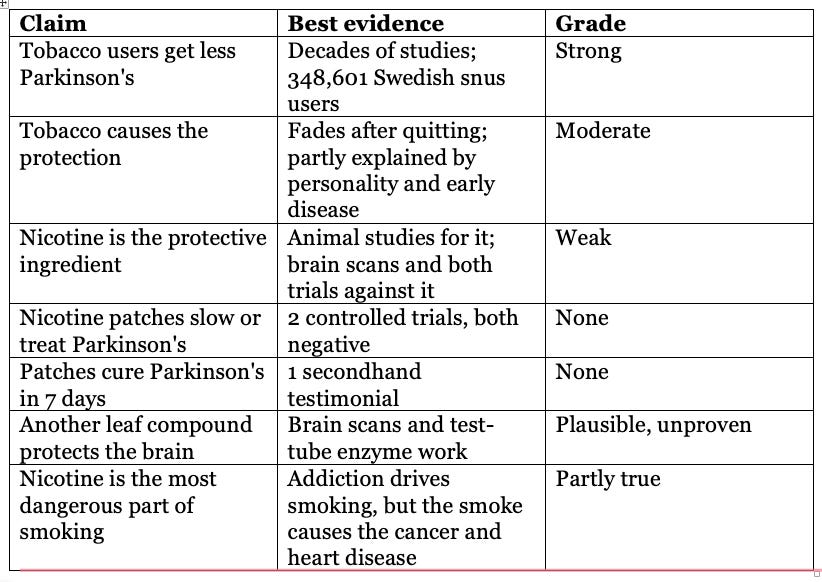
How each claim scores
Trying the patch anyway
No study shows a benefit, so no strength is best. Anyone set on a personal trial should copy the NIC-PD doses rather than Ardis’s sliver. Start with a 7-milligram patch in the morning, remove it at bedtime to protect sleep, and increase to 14 milligrams after 4 weeks if well tolerated. The trial went as high as 28 milligrams per day.
Nonsmokers may experience nicotine-related symptoms, including nausea, dizziness, a faster pulse, insomnia, vivid dreams, and a red, itchy patch site, among the common complaints. People with a recent heart attack, unstable angina, an irregular heartbeat, or uncontrolled blood pressure should avoid it.
Nicotine’s own effects, such as nausea, alertness, and a faster pulse, show up within hours of the first patch. Ardis’s story promises a cure in 7 days, but controlled trials looked for change over weeks to a full year and found none. I wore a patch for a day or two and noticed nothing, which proves little by itself. A change felt in the first days or weeks is indistinguishable from placebo and from the ordinary swings of Parkinson’s. To judge it fairly, record a baseline before the first patch. Draw a spiral, count finger taps in 10 seconds, and video the hand at rest, then repeat all 3 at 4 and 8 weeks and have someone else compare them.
Synthesis
Skip the Parkinson’s patch unless you want to run a careful experiment on yourself. I am not going to try it again. Readers who do should use the trial doses, record the spiral, finger-tap, and video baseline, wear the patch for 8 weeks, and send me their before-and-after results. If enough of you do, I will report what you find. Do not take up cigarettes or snus to prevent Parkinson’s, since the risks of cancer and heart disease outweigh the benefit. Anyone on an antidepressant or another serotonin drug should keep methylene blue and Eldepryl separate unless a physician is managing the combination.
The tobacco story is a clue, not a cure. Something in the leaf, absorbed for decades, lowers the risk of Parkinson’s, and nicotine has been tested and ruled out as the culprit. In 2025, Chinese researchers isolated 22 compounds from low-nicotine tobacco leaf, and several inhibited MAO-B. Those compounds are years away from a human trial. The answer is in the leaf, not the patch.
Selected references
· Transdermal nicotine treatment and progression of early Parkinson’s disease (Oertel et al., NEJM Evidence, 2023, reviewed by the European Academy of Neurology)
· Nicotine patch not beneficial in Parkinson’s (Michael J. Fox Foundation, 2018)
· High-dose transdermal nicotine in Parkinson’s disease patients (Villafane et al., phase 2 study)
· Moist smokeless tobacco (snus) use and risk of Parkinson’s disease (Yang et al., International Journal of Epidemiology)
· Parkinson disease and smoking revisited: ease of quitting is an early sign of the disease (Ritz et al., Neurology, 2014)
· Clearing the smoke: what protects smokers from Parkinson’s disease? (2024 review)
· Methylene blue and serotonin toxicity: inhibition of monoamine oxidase A (Ramsay et al., British Journal of Pharmacology, 2007)
· Transdermal nicotine for induction of remission in ulcerative colitis (Cochrane review)
· Cardiovascular safety of varenicline, bupropion, and nicotine patch in smokers (Benowitz et al., JAMA Internal Medicine, 2018)
· Harms of cigarette smoking and health benefits of quitting (National Cancer Institute)