
For new readers: HERE are free links to my ebooks and best recent posts.
How to read this: Read it carefully if you or a loved one has AF. If not, read both parts of Jan’s story, then look at the rest of the essay for details about natural cures. Finally, read the ending about cardiology corruption.
Jan’s story, Part 1
She was 68 when she began having overwhelming exhaustion, and her electrocardiogram (EKG) showed on-and-off atrial fibrillation. Jan’s cardiologist prescribed medications, and her heart normalized for two years. However, when she developed pneumonia, she went into AF at 180 beats per minute and felt terrible.
She worked with the cardiologist for months, but although her rate was controlled, she stayed in atrial fibrillation. He finally shocked her heart (cardioversion), but it stopped for a prolonged period. He considered implanting a permanent pacemaker.
The cardiologist repeatedly adjusted her medicines, and another cardioversion put her heart into normal rhythm for a year, but her atrial fibrillation always returned (Continued at the end of the post).
Key basics
Atrial fibrillation is an irregular beating of the top of the heart (atrium) that causes the entire heart rhythm to become irregular. The rate is often uncomfortably rapid, but others have it and never find out until a doctor does an EKG. Short periods of AF may evolve into a continuous problem. Like most heart diseases, AF is usually a chronic problem that requires management but is rarely immediately dangerous. (Note: Ventricular fibrillation is immediately life-threatening and may occur after heart attacks.)
People with AF may have underlying lung or thyroid disease, high blood pressure, or other more severe issues such as heart failure or coronary disease. And although the symptoms are often minimal or moderate, AF can produce chest pain, heart palpitations, shortness of breath, and even loss of consciousness. Drugs, smoking, alcohol, and emotional stress sometimes play a role.
The big concern with atrial fibrillation is stroke. These happen when a blood clot forms in the irregularly beating atrium, then flips into the brain circulation. The downstream area’s blood flow is compromised, which may result in permanent damage or death.
AF can be suspected by an irregular pulse and confirmed with an electrocardiogram (EKG):
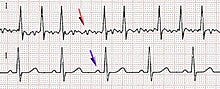
The upper recording is the irregular pattern of atrial fibrillation, and the lower one is a “normal sinus rhythm.”
In the normal heart of the lower tracing, “P” waves (lower arrow) arise from the atrial chamber at the heart’s top. The “wiring” in this area beats slowly and regularly to initiate each P wave and then heartbeat. The larger “QRS” waves after these are the electrical activity of the major heart chambers.
Although general internists and family practitioners treat atrial fibrillation, cardiologists see this problem daily and are the experts.
Beta-blockers such as metoprolol are typically used as the first treatment to slow the heart rate. They can sometimes “convert” the heart to a normal rhythm. However, other drugs and/or electrical shock(s) are sometimes necessary depending on the circumstances or in emergencies.
Some people are so treatment-resistant that the only therapy possible is to leave them in atrial fibrillation and reduce their heart rates to the normal 60 to 100 beats per minute. A few others have rates so low that they require electrical pacemakers.
(At one time, digoxin was used as the first-line drug, but its toxicity at relatively low doses has given the medical mainstream the idea that it is undesirable. Maybe this is also because it cannot be patented.)
Electrical burning or freezing of the heart’s wiring cells can be performed in an attempt to normalize the conduction defects causing abnormal rhythms. Although long-term results are debated, today’s techniques are more effective than those of a decade ago. This treatment may require an entire afternoon under anesthesia in the cardiac lab.
Anticoagulants, including aspirin and other low-grade anti-clotting agents like Plavix, are often used. For patients with heart disease or other factors that make strokes more likely, warfarin or the newer oral anticoagulants is standard practice. These reduce the yearly risk of stroke from a few percent to nearly zero but cause occasional serious bleeding. Warfarin works well but requires monthly blood testing, which leaves bruising.
AF affects about 2 to 3% of the population of Europe and North America. More recently, it has increased to 4% for the population between 60 and 70 years of age.
Astute AF patients know to get enough magnesium (MG)
Over half of all of us are magnesium deficient and should take it. MG should be used as part of the first-line therapy for hypertension and virtually every heart issue. It should be given intravenously to sick people as a routine, but few doctors do this even though it is harmless and effective.
For perspective about MG, see the diagram below from Henry Lahore’s vitaminDwiki.com. Click the image to access more information.

Spend time on vitaminDWiki.com, subscribe to the Substack, and wave to Henry while you are there. The most important lesson he has is to be careful about diet; avoiding seed oils decreases inflammation, cardiac disease, and atrial fibrillation.
You should also look at my posts about boron, iodine, vitamin D, and, of course, magnesium. D levels* of 100 ng/ml improve health. Vitamin K2 (100 to 200 micrograms a day) and zinc (25 mg daily) are also critical for successful AF treatment.
*This blood test is available for $40 without a prescription at LifeExtension.com.
Key point: High vitamin D levels, perhaps 100 or even more, independently improve cardiac function and decrease your chances of AF. Study Henry’s references at the end of this post to convince yourself of this. If you have not discovered the 50,000 international unit D capsules, buy some online now. I take one almost every other day, and my levels are 130 ng/dl. Note: I am not recommending this to you and not giving medical advice. Read the references to decide.
CoQ is essential for anyone with heart issues or hypertension and independently improves MG absorption. Vitamin C is also necessary. Henry told me he would include this in the next version of his diagram.
These supplements work together, and each becomes critically important if you are deficient. Over half of us have critically low iodine levels, and many of my readers had profound health improvements when they took it. See my post HERE about that.
There are many types of oral magnesium, and they all raise blood levels but have different side effects and efficacy. The Costco brand containing 400 mg of magnesium oxide is great for constipation, but the glycinate form is better absorbed and helps your sleep and mood (Thorne is a reliable but expensive source).
Atrial fibrillation patients should keep their levels up by taking oral MG twice a day. There is no limit on how much can be consumed, except for loose stools.
Magnesium Type Uses & Notes
-
Magnesium citrate General, digestion, migraines, calm
-
Magnesium oxide. Laxative, very low systemic absorption. I like it.
-
Magnesium sulfate. Epsom salts. Muscle relaxation, calm
-
Magnesium chloride. Liquid/topical magnesium salt. Skin, calm, digestion, general.
-
Magnesium glycinate. Bioavailability, gastric health, muscle relaxation, mood, sleep, calm. I was told to take this.
-
Magnesium bis-glycinate. Good bioavailability, mood, sleep, nervous system, no laxative effect
-
Magnesium malate. Energizing, stimulates ATP production
-
Magnesium L-threonate. Brain health, nervous system, learning, concentration
-
Magnesium bicarbonate. Mixed in water to create a bubbly solution, good general magnesium
-
Magnesium taurate. Heart health, general calm, blood sugar regulation
-
Magnesium orotate. Heart health, general health
-
Magnesium aspartate Cellular energy, all around health
Pro-tip for blood pressure, cardiac, and AF patients: MG oil applied to the skin twice a day raises blood levels and might make prescription medications unnecessary for a few people. I recommend the Electra brand HERE (on Amazon HERE). Sandy, the owner, is my friend, and I interviewed her. If you mix DMSO (see my article about this) with MG oil, it will be better absorbed. See the Parting Shots for more.
Overdosing on magnesium is almost impossible, and several grams (not milligrams) is safe to give intravenously all at once, even to sick, hospitalized people.
Other medications
In an ideal world, magnesium would be the first consideration for atrial fibrillation and beta-blockers the second. Toprolol (metoprolol) is a long-acting brand that works well.
Beware: generic beta blockers often do not last 24 hours as advertised. Many people learn this the hard way when they have recurrent AF as the medicine wears off each day. Accepting a random pharmacy’s generic is a recipe for problems; the solution may be to pay extra for the higher-quality brand name.
Few patients realize that their doctors may be incentivized to prescribe cheap, lower-quality drugs that may not be as effective. See the Generics chapter of Butchered by “Healthcare” for a more comprehensive discussion. I show you there how to reliably and legally purchase economical brand-name drugs from outside the USA.
Calcium channel blockers such as diltiazem and verapamil are the next drugs of choice for atrial fibrillation after MG and beta blockers. These control the heart rate by slowing conduction through the heart’s biological wiring.
Amiodarone is a powerful drug that consistently normalizes heart irregularities. It is often used in crises, especially if your doctor has to cardiovert (shock) you to restore normal rhythm. When I was in training forty-five years ago, its use was limited because of concerns about side effects. These include lung fibrosis, cataracts, dizziness, headache, chest pain, and many more. Nerve damage and numbness of the hands and feet can interfere with walking, and all these effects can be permanent.
Most people who take amiodarone are given it for three to six months, and side effects begin later, generally after a year. Most are given a high dose at first and then tapered down or off. The drug lasts many months in the body, even after you quit taking it.
Any blood pressure patient, cardiac patient, and almost everyone else should take magnesium. Newly diagnosed moderate hypertensives should routinely be placed on it before considering prescription medications.
Many have been sick for years and never learn they are magnesium deficient. Supplementation improves the heart, kidneys, blood pressure, and lowers heart rates. Those who are given amiodarone are often magnesium deficient. They should begin both the oral and topical forms immediately and think twice before taking amiodarone long-term. These situations are individual, of course, and your cardiologist will help.
Most blood pressure patients are given “non-loop” diuretics such as hydrochlorothiazide as their first drugs. I leave it to the reader to speculate why magnesium has been largely forgotten for this problem.
Omeprazole (Prilosec) is an acid-suppression drug sold by prescription and over the counter. Nearly everyone, with or without a medical license, passes it out like jelly beans. Prilosec blocks the effect of magnesium, which is terrible for everyone but particularly hazardous for those with AF because they may get breakthrough rhythm disturbances. When Prilosec is discontinued, atrial fibrillation sometimes vanishes.
Anyone sick, especially those admitted to the hospital, should receive intravenous supplementation with several grams of magnesium, five to seventy-five grams of vitamin C, at least 250 mg of hydrocortisone, and 250 mg of thiamine. When Pierre Kory proved that the last three saved lives, he lost his job as head of a major hospital’s intensive care unit.
Atrial fibrillation and blood thinners by the numbers
Those with AF have a three to four percent yearly chance of a stroke with brain damage. Blood thinners prevent this for all but a fraction of a percent but come with a small risk of bleeding into the brain or other parts of the body. Despite this, chronic blood thinner use is the best choice for most.
The older type, warfarin/Coumadin, requires monthly blood testing but is effective. The four newer ones, dabigatran, rivaroxaban, apixaban, and edoxaban, need no monitoring and also work well. Of these, the ones with fewer side effects are more expensive.
Temporarily stopping anticoagulants for five to seven days before surgery is standard practice and has few risks. A week off, for example, produces a stroke risk of (3 percent a year) divided by (52 weeks a year) equals .06 percent—.0006, six in a thousand. Your cardiologist can give you a more accurate idea of your situation, but it is guesswork even for him.
How Jan Conquered AF, Part 2
Since she is a registered nurse, Jan knows doctors and never believes anything they say on faith. Her husband is a physician, and she does not freaking listen (DFL) to him much, either—no man is a hero to his wife. She devised a natural program to help her body resist and prevent atrial fibrillation. Her goal was to get rid of some or all of her medications.
Jan always drinks a lot of water, but she started carefully measuring her fluids and now consumes an ounce per kilogram, 1/2 ounce per pound, every day. She is 150 pounds, so this is two liters. (I am 185 pounds, so this is 2.5 liters a day for me.)
Jan is hypertensive. Medical dogma says restricting salt controls blood pressure, but Dr. Brownstein encourages even his hypertensive patients to eat a teaspoon or more of yellow, unrefined Redmond or Celtic brand salt daily. This is successful. Jan might benefit because, like drinking more fluids, it would increase her blood volume and possibly make her heart function better. She knows that medical practice is largely folklore, but she is still “thinking on” using salt.
Jan’s research also uncovered Sandy’s magnesium oil, and she began slathering it on when she woke up and at bedtime. This creates reservoirs of the mineral in the skin that slowly release into the body. Since Jan has dry skin, she simply substituted the MG oil for some of the other creams she had been using. She also began taking oral magnesium twice a day and uses the oxalate alternated with the better-absorbed and calming glycinate.
Jan checked her vitamin D level and learned it was 125. Her doctor panicked, but she knew better from VitaminDWiki.com and ignored her. She also takes zinc, CoQ, vitamin C, and vitamin K2. She eats a lot of fish, so she rightly believes that iodine supplementation is unnecessary for her.
A careless doctor recently threw a prescription for Prilosec at Jan when she had a stomach upset. However, after Jan did her reading, she discovered that it blocks magnesium, so she trashed it. She never used alcohol or caffeine, so she did not have to quit these.
Jan read that higher magnesium levels improve women’s bladder control. This happened to her after she started topical magnesium.
Over a period of about two months, her vision began to fade, and she was forced to stop driving. Her opthalmologist diagnosed rapid-onset cataracts and sent her for surgery. She paid the extra $5000 for the fancy lenses that allow both close-up and distance vision and is very pleased with her “new eyes.”
Once she could see again, she began reading about her medications and learned that fast-developing cataracts were one of the many side effects of amiodarone. She had been on it for two years, but she immediately threw it in the trash and never took any more. (Note: I would ask the cardiologist’s advice before I would do that.)
Even though Jan quit many of her drugs, she has not had symptomatic atrial fibrillation for a year. She is now considering stopping her blood thinner, but I told her that if it were me, I would ask my doctor about that one.
NB: You likely know by now that this is not Jan but my wife, Judy. I added a few composite elements in Part #1 for illustrative purposes. As outlined in Judas Dentistry, her heart improved for other reasons during this period, so your results may vary using her program.
Judy is a skeptical animal, and this attitude has served her well. These days, it is survival itself.
References
Henry Lahore and VitaminDWiki.com’s info about the relationship between AF, vitamin D. and MG:
-
Atrial Fibrillation is DECREASED by Vitamin D or Magnesium – many studies and INCREASED by Calcium or high-dose Omega-3.
-
23+ VitaminDWiki pages with AFIB or FIBRILLATION in the title
-
5% less likely to get AFIB if ten ng higher Vitamin D – Maga-analysis Sept 2023
-
23% less likely for seniors to get AFIB if ten ng higher Vitamin D – 13 studies – 2019
-
Risk of Atrial Fibrillation Decreases if Vitamin D or Magnesium Increase – GRH Sept 2022
-
The Pathogenesis of Cardiac Arrhythmias in Vitamin D Deficiency – May 2022
-
Cardiovascular and Magnesium 17 studies
-
Cardiovascular and Calcium 14 studies
“Legal” disclaimer
You never read a Cliff Notes and thought the booklet was a doctor, did you? I am not your doctor, and this post is not your doctor, either. You must know your medical problems and medications well and carefully consider your care, but you should not treat AF without help from a cardiologist.
A few Cardiology Scams (excerpt from Butchered by “Healthcare”)
Heart doctors have their uses, but much of their work is expensive fraud supported only by faked studies. For example, the angioplasty procedures described below, with a few scant exceptions that I noted, are useless.
However you feel about cardiologists, be respectful and polite toward them. Like other doctors, they are mostly doing their best despite being tied up inside a box of lies.
The studies that debunked angioplasty and stents were unforeseen and staggering. In 2007, the NEJM published the “COURAGE” trial of over 2000 patients (study authors like acronyms; this one somehow stands for “Clinical Outcomes Utilizing Revascularization and Aggressive Drug Evaluation”). It showed that neither stents nor angioplasty improved survival or subsequent heart attack rates in patients with stable coronary artery disease.
A follow-up report by these COURAGE authors showed improvements in angina and a few quality of life measures, but these effects lasted less than 36 months. Based on this slender support, the operations continued. The cardiologists thought it was reasonable because stent deaths are so rare.
Finally, the ORBITA study showed conclusively that these procedures were without survival benefit for stable cardiac disease—for people who were not having a heart attack. Neither pain nor chances of further heart attacks decreased. This trial used an invasive “sham” or faked procedure for the control group, which is the most definitive type of surgical evaluation. There were only 230 patients, but the results were indisputable. (TheNNT.com has an excellent summary.)
Drug “eluting” stents leak drugs into the surrounding area, but they do not help patient survival either and cause an increase in blood clots. The science was clear: stents and angioplasty in routine care do not improve outcomes.
In 2019, a federally funded trial again discredited over 90 percent, possibly over 95 percent, of the cardiology and cardiac surgical invasive procedures. The researchers treated 5000 patients with stable heart disease with either CABG or stents. Neither therapy improved lifespan or heart attacks when compared to diet and drugs. These patients were not having heart attacks at the time of the interventions. The researchers also excluded those with left main coronary artery disease.
There is one narrow case where stents supposedly work. This is during a severe heart attack when the EKG has a pattern called “ST-elevation myocardial infarction” or STEMI. This is a complete or near-complete coronary artery blockage. When stents are placed during STEMIs, the cardiologists proclaim they save one person in 40, a number needed to treat of 40.
The American Heart Association and many others worldwide market this as “intervening during the golden hour” (lately, they have been promoting this more for strokes). Patients in their most vulnerable state, often in severe pain, get rushed from the emergency department to the catheterization lab and treated with angioplasty and stents. They are incapable of making reasoned decisions. Nortin Hadler summarizes: “Stenting belongs to one of the bleakest chapters in the history of Western medicine… Cardiologists are marching on because the interventional cardiology industry has a cash flow comparable to the GDP of many countries.”
The latest marketing ploy is to remind the public about “atypical” pain, which is serious but unlike the usual, distinctive heart attack pain patterns. People are now racing to the hospital, into this dysfunctional system, if they have any twinge in their chest.
Angioplasty causes strokes, heart attacks, rhythm disturbances, and bleeding. Does angioplasty save more STEMI patients’ during a heart attack than are killed by the procedure? When performed during a heart attack:
ANGIOPLASTY SAVES: 1/40, or 2.5%
ANGIOPLASTY FATALITIES: 1/167 to 1/43: .6% to 2.3%
ANGIOPLASTY COMPLICATIONS: 1/50, or 2%
Does the 1/40 “saved” figure already take into account the people who die from the procedure? Given the entire picture, I do not think it makes any difference, but if you still have doubts, ask your cardiologist. I doubt if they could convince me.
If we could forget the cardiologists’ conflict of interest and believe their numbers, the expense of doing angioplasties on 40 people to save one is 40 times the $35,000 cost, $1.4 million. This is on the outer fringes of acceptability; one to two million dollars spent for each life saved has somehow entered the literature as reasonable. Since heart attack patients have an average age in their late 60s, the number of years of life being bought is uncertain. And there are many other ways to spend this money that would do more good and save more years of life.
In the US, at least 85 percent (the lowest figure I could find) of coronary angioplasties are performed on patients who have uncomplicated, stable chest pain, where there is no chance of success. And STEMIs are likely only a percent or two of all heart attacks.
To justify the process, cardiologists often send their patients through the emergency room, claiming that they have “unstable angina.” This means chest pain occurring without physical exertion, not relieved by resting or medication, which may be worsening. This diagnosis gets abused since it is a judgment call with an imprecise definition. I spoke to emergency physicians in 2019, who confirmed they saw this scenario frequently.
Note: when angioplasty is done like this as an “elective procedure,” for no patient benefit, and not during a heart attack, it thankfully only kills .2 percent or 1/500.
Parting Shot #1
A reader sent me this about improving magnesium absorption using DMSO:
Trace Minerals Research is the cleanest magnesium I could find. You will experience a white residue on the skin that you can wipe off with a paper towel or washcloth. The white film is the chloride in the magnesium. It will not penetrate. Using this process, I was able to increase my serum magnesium levels.
Healing with DMSO by Amandha Vollmer is an excellent reference. She has recipes for eye drops, ear drops, and scalp spray, among many others. She says, “I have been using the eye drops and the scalp spray for a month or two now with no adverse reactions. It is too early to see if there are positive outcomes.”
Parting shot #2: for thirty years, captured sources have been running down coconut oil in favor of olive oil
Pritican: “The artery-clogging – and therefore most damaging – fatty acid is saturated fat. The fat in coconut oil is 92% saturated fat.”
Mayo Clinic: “Myth: Coconut oil is a heart-healthy cooking alternative.”
Harvard: “Because its cholesterol-raising effects were comparable to other saturated fats, [coconut] oil should not be viewed as a heart-healthy food and should be limited in the diet.”
If these “authorities” are against it, what more proof of its virtues do you need?
Coconut oil is almost magical. It is antifungal, antioxidant, and antimicrobial. “Oil pulling” after brushing improves oral health and kills plaque. I brush with it, then oil pull, and I hardly need to floss. It is 90 % saturated and has many other advantages described here.
Lineolic acid is the damaging polyunsaturated fat that accounts for almost 90% of PUFA intake in the US. Like macadamia oil, coconut oil is only 2 percent linoleic. Ghee is even lower, but olive oil, touted as the best, is 8.4 % linoleic.
Macadamia nut oil is 80% monounsaturated, 1% to 7% polyunsaturated, and the remaining 14% to 21% is saturated fat. It is great but not as good as ghee.
The first two places to go if you have most any heart problems, if you are still able to get around and aren’t in acute pain, are 1) to a good corrective chiropractor, to determine if your rhythm irregularities are being caused by nerves being irritated as they exit the spinal column (caused by postural issues that need to be corrected), and 2) your local infusion lab for a quick magnesium fix. Better to get the magnesium fix before you (really, really) need it (most of us need it and don’t know it). Transdermal magnesium (magnesium oil) is the fastest way to get levels up short of an IV.
The Standard of Care is designed in such a way to increase the odds that you will end up in a crisis and will need treatment in the ER. And like you said, once you are in there, and they smear their fear-porn all over your already frightened and stressed out pysche, there is no way you’ll get informed consent for what they will do to you.
After 50 years as an adult where I’ve had few successes with mainstream medicine, I’ve slowly discovered how most everything outside of trauma care is bogus and grossly overpriced. It was good to see you take aim at the holiest of the holy – cardiologists. That said, there are lots of white hats out there – Thomas Levy, Malcolm Kendrick, Peter McCollough, Steven Sinatra, plus others I’ve forgotten, and still more who have yet to show up on my radar.
You caught it or already knew it. If you have crushing chest pain or severe shortness of breath, better go to a hospital sooner than later after you have lost half your heart muscle. Don’t fool yourself that a chiro can help you then.
If there truly was something called preventive medicine, everyone would see a chiropractor to screen for structural deviations that could lead to organ impairment, especially those that could lead to heart issues, sleep apnea and other issues that arise in the thoracic spine. What is currently termed by allopathic medicine as ‘preventive medicine’ is actually early victim identification: the search for an early payday and the change to practice their barbarism on someone young enough to have a better chance of surviving its ill effects.
I took a standard route for help with my severe ventricular arrhythmias (which can lead to sudden cardiac arrest – first symptom: death) – I started with a visit to a doc-in-the-box (we were traveling) to put a name on the problem, and then saw a cardiologist. I was clearly on the edge of the bell curve, as that man (with at least 40 years experience) was having great difficulty in putting me in one of the categories that 95% of his patients would fall into. And despite my issue being urgent (though I was in no panic), the best he could do was to schedule me for a treadmill and Holter monitor two months out! I was told the route to the head of the line was through the ER. That is standard of care – no triage for care outside of the ER. Anyone unwilling to go that route is made to wait in the hope that a crisis will precipitate and they will either end up in the ER or on a slab in the morgue.
The only worthwhile part of the talk with the cardio was that he gushed about the new EKG devices that were hitting the market (in 2018). I got one, in order to have better information to share with the next doc that I believed I would inevitably see. But the first time I used it, it became obvious to me that the problem was postural – I had a nice, normal heart rhythm until I looked down at the tiny screen, at which point things instantly went haywire.
Dr. Google’s top recommendation was a video on heart disease by Dr. John Bergman, and he nailed my problem in the first two minutes of the video – a right hand curve in my upper thoracic spine, caused by an accident 8 years earlier. I found a local chiro and was out of trouble in 10 days and the problem was completely corrected within three months.
Of course today, that video is virtually nowhere to be found – buried by the misinformation algorithms that Big Pharma has paid Google to create and utilize.
I’m no expert on heart attacks. I’ve not had one (at least one that I was aware of, or that motivated me to go to the ER – one brother says his doc told him that he’d had a couple he never knew about, the other brother had a couple of massive heart attacks that he has survived by 16 years). So I’m not certain if heart muscle truly dies, or if most of it goes into hibernation as Dr. Steven Sinatra claims in his book, The Sinatra Solution. In it, he claims that heart failure is reversible when the heart is given proper nutrition to wake up the hibernating muscles. Which makes sense to me, as the power that creates the human body, heals the human body. It has to be possible for anyone with enough vital energy remaining in their body for the heart to heal.
Thanks for your input. My confidence in postural and adjustment modifications by chiros is less than yours. The theory that this is the totality of medical care is ridiculous. Isolated ventricular ectopy, if that was what you had, can be a malignant sign of many things, and cardiologists seldom look at underlying causes. If I were you, I would look in my mouth; see Judas Dentistry. If you want the best care. No one has his hands around the whole healthcare elephant. This reply is not medical care.
I doubt any chiro would tell you that they practice the totality of medical care, since Allopathic medicine has been trying to claim a monopoly on medicine for over a century. They are well fenced in regarding what they legally can do to help a patient. Dr. John Bergman has offices in Long Beach, CA and Tijuana. The Tijuana clinic includes allopaths that offer treatments not allowed in this country. His practice is perhaps the closest that I know of that is closing in on the totality of medical care, and I suspect they don’t do acute trauma or emergency care (the allopathic wheelhouse).
But my point in seeing a chiro first is that no allopaths (and likely few osteopaths) are trained to look at the spine as a potential cause of serious organ problems. That’s their wheelhouse, with correcting issues causing pain and/or numbness close behind.
A year or so prior to having my heart issues, I saw a biologic (Huggins Protocol) dentist because I’d lost part of one tooth and EVERY tooth in my mouth was cracked. That was after a lifetime of good dental hygiene. At the time, I was brushing and flossing three times per day and had been for a couple of decades (and only a bit less often for decades prior to that). The techs were amazed that someone in their sixties had zero gum problems. The dentist had no clue why all my teeth were cracked. She crowned the broken tooth and one cracked tooth on that side. I had all my mercury fillings on that side removed at that time. I was supposed to come back for four more crowns and the rest of the mercury.
Then the heart issue occurred. I was having some very serious lactic acid build up caused by the racing, erratic heartbeat. I’d spend an hour or more each night trying to figure out how to calm things down, often with at least some success. The trend was definitely headed in the wrong direction until I started seeing the chiro.
A couple of years later, I returned to the dentist, interested in finishing up the mercury removal and having recently learned about cavitations. At that time, NONE of my teeth were cracked – they all healed on their own after the heart crisis resolved – my body had been stealing minerals from my teeth to keep my heart going. The Triage Theory of Disease in action – the body prioritizing short term survival over long term needs. I could live without teeth, but not without a heart!
So, I had no mercury fillings in my mouth, and all my cavitations have been treated. I guess an infection can cause an arrhythmia, though I doubt one as bad as those I would experience from time to time.
There’s an entire book written about what had happened to me, called The Haywire Heart. About elite athletes (mainly runners and cyclists) who mysteriously keel over dead every now and then. It’s co-written by an electrophysiologist, who was clueless about the structural component. His therapy of choice was to roll the dice on ablation – killing part of the heart muscle to “solve” the problem. But at least he was honest about:
The number of attempts often needed to eliminate the symptom,
The chances that an athlete would subsequently lose their ability to compete, and
The chances that an athlete wouldn’t survive the treatment.
Great story and comment.
When dental abscesses are removed, cancers are often healedu2014in my wife’s case, amyloidosis. If you look at the back first, you miss the all-important first step of any natural medicine evaluationu2014the mouth.
Best single reference: Gammal’s The Garbage Collector. Second best: Judas Dentistry. Until you have read that, you can’t intelligently comment on ruined healthcare
I think in essence we’re making the same point – that siloed healthcare misses some very obvious causes. Because the cause of disease isn’t even a consideration. Except in trauma care, where it’s obvious that the bullet wound is causing the symptoms. And even there you will get patched up without regard for how fascial planes are disrupted, which can result in degraded health down the road. I’ve read neither of the books you recommend, but after more than two decadesof reading passionately on a range of healthcare topics it’s hard not to recognize the patterns of failure in insurance-based healthcare. Though it has also been obvious from decades of my own experiences and of those of people I’ve cared deeply about. How many docs of any flavor would have known why I had a mouthful of cracked teeth? My biologic dentist was clueless, and didn’t seem all that interested when I shared my story at our last visit. In hindsight, it’s obvious – my body was in crisis, though outwardly I looked exceptionally healthy for my age.
Rx is deadly. The natural nutrient Rutin is both clot preventing and clot dissolving. The powder form is widely available. I take a quarter- to half- teaspoon daily. Never had a problem and I’m OLD uD83DuDE00
Great post- Jan is one smart lady! I make a shower scrub with 10 pt Epsom salt, water, 1 pt coconut oil and essential oil. Mix the Epsom salt with just enough water to the consistency of sand add essential oil and melt the coconut oil and add that. Mix up and store in a container. Rub it all over your body – scrub into the joints and even the face. Best to have a stool in the shower- then shower. Warning it can make the bath slippery. Thanks
fantastic
If I were you I would not forget the DMSO. read my post
Been using it for years – but not with the scrub . I use a roll on from farm supply . The recipe for the Epsom salt scrub is from Dr. Darrell Wolfe .
Jewell, are there any specifics I should ask for when buying DMSO at a farm store? Thanks.
They usually have it in a roll on 3 oz – but the purity is is listed as 99% and 90% by volume. I’ve never had a problem with using it on my joints – but I would recommend something with higher purity to be on the safe side.
I would only consider 99,995 percent pure for myself.
Have you ever looked into Emu oil? IMHO, that is some potent stuff for wound healing, eczema and general skin care. Perhaps it functions like groundhog grease which use to be a common remedy in Appalachia.
read my post on DMSO
I’d be interested to know if you have a take on tying off the appendage during an open heart procedure? Also, the watchman device to occlude the appendage? I’m assuming this is a last resort after cardioversion and meds.
sorry no idea
I was first diagnosed with afib 35 years ago. When it occurred I went to the ER and it resolved on its own. Afib is a chronic problem that comes and goes and, almost always, gets worse as time goes by. When it occurred I was very athletic, a runner mostly, and a high carb consumer. I now think that those two things were contributory to the problem. That said, I think there may be many causes for the condition.
Today, I’m 70 something and except for aspirin daily, I take no other medication. I take many of the supplements you discuss. Except for afib I have no other chronic conditions. I’ve been prescribed everything you can think of by many Cardiologists. It has now been many years since I’ve seen any doctor… I’ve walked away from it all. I’ve never had intervention, cardio version or any kind of electrical intervention.
So here’s some history. For the first ten years or so my afib would come and go without any identifying pattern. Then I realized I was in afib longer than I was not. Then I was permanent… Then, occasionally I would come out for a few weeks then back to long term afib. My current afib has been constant for the last 18 months.
My afib does NOT interfere with my physical activity in ANY WAY.
Here’s my message. For the last 12 or so years I’ve been very low carb. Long periods of ketosis has, in my opinion, has changed my health completely. I’ve always been low sugar and very low seed oils and I think that is important too. My LDL is through the roof but my HDL is over 100! ( My nutrition is obviously high fat and LDL carries that energy and THAT is why it’s high – think about it). So that’s it. Read a lot and question everything. Here’s to your good health!
Oh… How did the Borax experiment turn out?
If I were you, I would be on one of those blood thinners See the numbers in the post. You don’t want a stroke. Get a cardiologist and be pollite.
I took Borax for a few weeks, and now intermittently My friends say the sexual effects take many months to kick in and to continue. I’m hoping ha
Can you tell me why you have confidence in these medications?
Please read the statistics about their use in the article; I understand your general lack of faith, however.
Being low carb and few veggies Boron is a concern… As far as all those FDA approved anticoagulants… No thank you. No more trust.
From the website of Dr Tom Cowan on Strophanthus. From an African plant the active ingredient of Oubain has been used in Germany and Switzerland for decades for tonifying the heart, resolving A-Fib, resolving congestive heart failure symptoms, and has other health benefits as well. https://drtomcowan.com/pages/strophanthus
99% of all cardiologists have never heard of this remedy.
As for magnesium and its benefits for the entire body; absolutely correct. Using magnesium topically AND internally will ensure its effectiveness.
One can easily make their own magneisum “oil” by combining a cup of magnesium flakes with a cup of distlled water. Adding a tablespoon of DMSO will enhance the topical mixture into the body. If adding DMSO, use a glass spray bottle only.
An 80 year old male friend of mine was diagnosed with A-Fib and lower ventrical hypertrophy in January. After one month taking strophanthus capsules, all was resolved and his blood pressure returned to what it was in his 20s … 115 over 75. Not saying it will work that quickly for everyone either but it’s worth a try instead of loading up on blood thinning drugs and having stents and pace makers inserted.
Yes! Strophanthus is really an amazing medicine! Thanks for mentioning it here!
Trad medicine has its place. I have two friends who had severe MIs in the past month. Both had angioplasty; one had treatment within 2 hours and now has an ejection fraction of 79 percent–excellent. The other one waited and has 40 percent. She will improve but had more damage. Read the last part of this post to understand more.
Do AMA-approved medical school graduates ever hear about the natural anticoagulant, vitamin K1?
Iu2019ve had several bouts of SVT over the years and although itu2019s not afib, itu2019s still a heart rhythm issue so has a bit in common?I wonder if berberine and taurine would help afib sufferers as much as theyu2019ve helped me? I thought Iu2019d mention them just in case. Also I want to second another person in the comments who mentioned strophanthus. Tom Cowan has a video called u201CThe Heart is Not A Pump and Strophanthusu201D. I believe thatu2019s the title anyway. Itu2019s quite illuminating and might be a good resource for anyone with heart issues of any kind.
I can’t get over the idea that medicine is upside down, inside out. For every disease, malfunction or illness, there must be reasons that they occur. Modern medicine very seldom queries for the answer. Something is always happening inside the body that causes a mishap or condition or sometimes the more obvious occurs where an external force causes problems. Medicine has no concern about what causes disease. All they have are tests, more tests, procedures, surgeries and the ultimate in care; DRUGS of every specification and promise and forever!
About 3 years ago, I had a mild heart attack, or so they tell me. No damage was done to the heart. There had to be a reason or reasons for this event to occur. Whatever caused this to happen, the process was in motion at some point earlier in time and for specific reasons. Doctors do not want to know and don’t care anyway. They are all about the money, power and prestige. Otherwise at least a few would have the guts to say enough fake medicine is enough.
The cardiologist concluded that I had a hearth attack, then did a stress test but didn’t tell me or explain what the results were. He told me it wasn’t normal and that I needed to get into surgery right away for a catherization and stent(s). Also start on several heart drugs. Rack ’em, pack ’em and stack ’em. That how it felt.
I did not do anything and have taken on the task of doctoring myself with more natural remedies. I am not going back to the doctor unless there is an emergency. After doing lots of research, I concluded that whatever the doctors did, there was no proof it would be any better than doing nothing. I might as well have the local witch-doctor on speed dial…it’s all the same. Voodoo guesswork and incantations to the lords of big pharma.
Great comment and spot on. Read Butchered by Healthcare to learn more.
I tend to look at the studies suggesting Omega e FAs, especially the bioavailable DHA/EPA, are problematic for AF with a jaundiced eye. First of all, fish oil has been considered anti-inflammatory, as well as anti-arrhythmic in numerous reviews and primary studies, and simply reviewing the basic metabolic pathway for fatty acids suggests as much. Second, since AF itself poses clot/stroke risk, isn’t the inclusion of anti-thrombotic food or supplement sources going to decreers that risk?
As far back as 2007, in Cardiovascular Research, Volume 73, Issue 2, January 2007, Pages 316u2013325, the authors of “Pro- and antiarrhythmic properties of a diet rich in fish oil” wrote: DART-2 reported that fish oil supplementation resulted in an increase in cardiac death in patients with angina pectoris [6]. Moreover, in patients with implanted cardioverter defibrillators (ICDs) fish oil supplementation resulted in a pro-arrhythmic response [7]. Two other trials reported that fish oil supplementation in patients with ICDs did not result in a pro- or antiarrhythmic response [8,9]. A systematic review concluded that additional intake of u03C93-PUFAs does not have clear effects on mortality and cardiovascular events [10]. The reduction in cardiovascular mortality by u03C93-PUFAs may be limited to a population subgroup (e.g. patients with myocardial infarction and with heart failure) [10]. Indeed, fish oil supplementation reduced sudden cardiac death in post myocardial infarction patients [4] while an increased risk of cardiac death was observed in patients with angina pectoris [3,6]. This may be related to different mechanisms of the prevailing arrhythmia in these population subgroups. Arrhythmias in heart failure are induced by triggered activity [11,12], while those in acute myocardial ischemia are caused by reentry [13].
It should be pointed out the the DART 1 study gave great marks to fish oil, and DART 2 “fixed” that with negative studies. Are we simply dealing with data manipulation again?
Can’t tell, can we? It’s dystopian.
Fish oil has always led to AF in my case. I no longer take it as it caused such a dramatic increase in AF.
If I were you, I would slather on that magnesium and DMSO
Hub has a rare condition, that the Cardio termed Pre-Beat, it causes pain between the shoulder blades. In all the EKGs he’s had in 25+ years every 6 months, it was never detected. His primary was the one who finally caught it. 12 pill extra it seems to have stopped, but for how long is a question at 83 in July?
As a Hypothroyid patient, my heart rate is faster than normal, with occasional sharp short chest pain. The congential Enlarged Heart with a small Mitrial Valve leak, is more of a worry. Not one doctor bothered to inform me I had one, till this new primary. Withholding information is not a good way to keep patients informed. IT makes me spitting mad.
You must learn as much as you can these days; it’s hard even for me with my background. Hormone Secrets has a great thyroid section that I would read if I were you.
I did, hormones either the regular or biosimilar HATE my GI tract. Which is in horrible shape, now adding gallbladder issues to the others. That the trip to Physio revealed last year. No answer to how that will be treated. I don’t want a 6th AB surgery. I have to watch the gastro issues my hub goes through because he submitted tamely to Gallbladder surgery. And NO crappy Mesh for the small hernia that was found on the MRI, but not the ultrasound. Both left/right pain under the floating ribs.
testosterone cream needs no GI tract and is often used in isolation because it breaks down to estrogen. Get from Anazao compounding pharm but needs rx. Get that from worldlinkmedical.com doctor.
I even tried Black Cohosh and Wild Yam, which had the same GI results. I don’t want to live on Nexium. Which I’ve been able to reduce from 40 mg to 20 mg. The other GERD meds are on the reaction list. Red Rice Yeast didn’t help.
Caveat on Cardiologists … for your readers. McCULLough is not your friend. Shilling products for TWC and happily pushing mRNA & related products. Shame on him. https://conspiracysarah.substack.com/p/peter-mccullough-breakthrough-inject
Edit: I 2nd the Mg orotate & glycinate – helped me very much. +1 for anecdote.
Tips re Afib from experience:
-Andrea Natale, MD | Clinical Cardiac Electrophysiologist in Thousand Oaks, CA
The father of ablation, I guess. In case you ever want to have the very best, he comes to Thousand Oaks for a few days every month. Do your homework re him, and call and get an appt. This was done without a referral.
– Kardia 6-Lead EKG thing. This personal device is extremely cost effective. It will give a decent amount of info 24/7. The reliability of info is quite high.
My two thumbs up to “…no man is a hero to his wife…”
Many thanks for this, which I assure you I’ll read very carefully indeed. I’m old and have a heart arrhythmia which pre covid was managed chiefly with betablockers and other drugs. We’re in Sweden now and I’ve deregistered from the medical system due to both mistrust of same but also, the last time I saw a doctor he spent a whole half hour ignoring my issues and bragging about how he cheated the system for getting his C19 boosters by going down the corridor and demanding the nurse jab him there and then. All told to me whilst he stood, back against the wall of his office, looking jittery and for all the world like someone on hard drugs. I now try to manage my own health (COPD, arrhythmia and arthritis) using what herbs I can grow or purchase and have taught myself best I can but of course will always be learning. Lately, my feet and ankles have been swelling and I know this is a sign of fluid retention so am taking mostly dandelion root tea as a diuretic. I’m not asking for medical advice here, have to stress, just wanted to share this. I do actually feel at least emotionally better for being out of the system. I did something I’d never recommend to anyone…I quit my scrip meds cold turkey. Please, folks, if you want to come off them don’t do that! Having said that I got through it and do actually feel better for it. Still have the health issues and they won’t go away or improve with time but I’m managing to date. There’s simply very little trust anymore in the established medical system, after the last four plus years. I won’t be going back and when my time comes won’t be going to hospital or a doctor. This isn’t radical. People have been dying at home since we began as a species if folks think about it. The medical establishment we know is a very modern construct and not, I feel, an entirely healthy one. No pun intended.