READER RESOURCES:
-
Click HERE for my new print books available as paperbacks on Lulu.
-
THE APOCALYPSE ALMANAC: Hidden cures in our dystopian age. Check out the “Cure Cancer in Your Kitchen” chapter.
-
FULLSCRIPT SUPPLEMENTS: top quality and economical.
-
AFFILIATE STORE: I offer competitively priced products HERE that I have personally tested and used.
Preamble: What orthopedists never tell you about the problems with joint implantation surgery
Some of this is ignorance – for which there is no excuse – but most is greed. Few of these surgeons know much about metal allergies, and almost none screen for them before surgery, despite the widespread problem among their patients. The titanium alloys used for these prostheses contain many metals in proprietary blends that would require suing the manufacturers to fully identify. Nickel allergy is 15% among their patients. There is a lower but significant allergy incidence for many of the other metals used in implants. Allergies cause problems post-operatively and unsatisfactory results. Blood tests can identify these, but they are almost never done.
If you don’t go any farther with this essay, I want you to learn that oral DMSO — which is totally harmless — at a teaspoon to 3 tablespoons a day in a glass of juice, along with some boron, can often prevent joint symptoms enough to avoid implant surgery altogether. The corollary to this is that X-rays have little relation to pain. Read my article about DMSO HERE in the Apocalypse Almanac book available free at the top of every post.
Anyone contemplating joint replacement, or who has had this kind of surgery before, must read this essay to the end and understand every detail. My personal story is here only as an introduction; the critical message is about you and your future.
See THIS post for more about boron. Its title is “Eating Borax laundry booster did not help my arthritis until I salted my food with a quarter of a teaspoon of it daily.” Go to your Substack membership page at robertyoho.substack.com and use the search bar in the upper right-hand corner to find the title.
As you go through this process, my advice is to do your own research and NEVER trust anyone wearing a white coat. I know this sounds draconian, but we are living in dystopian times. And as for joint implants, say no until your tongue bleeds.
Summary
· Samuel Johnson wrote the line in the title. My version is the dog. Both describe a man who has run out of options, and this essay is about what happens when he hasn’t.
· This essay is about joint replacement itself: an operation that saws off living bone, discards it, and implants metals that provoke allergies and electrical currents in a patient who was not screened.
· Hips last 25 years in about 6 of 10 patients, knees in about 8 of 10, and shoulders fail sooner, with about 1 in 6 revised within 10 years. Pain and X-ray findings agree poorly, and oral DMSO often relieves pain, which means no operation at all.
· Nickel allergy affects about 1 in 7 adults in the general European population, with 22 percent of women and 5 percent of men affected. Orthopedists seldom screen for it before implanting metal.
· My September 2026 MELISA.org blood test, a lymphocyte test for metal hypersensitivity, was positive for nickel, manganese, and methylmercury, and negative for titanium, aluminum, vanadium, cobalt, chromium, and zirconia. My operative reports indicate cobalt-chrome shoulder heads, an alloy permitted to contain up to 1 percent nickel and 1 percent manganese, on titanium alloy anchors.
· I found a fabricator for ceramic heads and a surgeon to implant them. Then a retired orthopedist walked me through the horrors of revision infections and how common they are. This often requires multiple procedures: removing the implant and filling the space with antibiotic-containing spacers for months, often leaving a completely dysfunctional, chronically painful shoulder. I added it up; the decision, the arithmetic, and what I am doing instead are at the end, and I have included a downloadable guide to getting your own implant records.
Where I stand
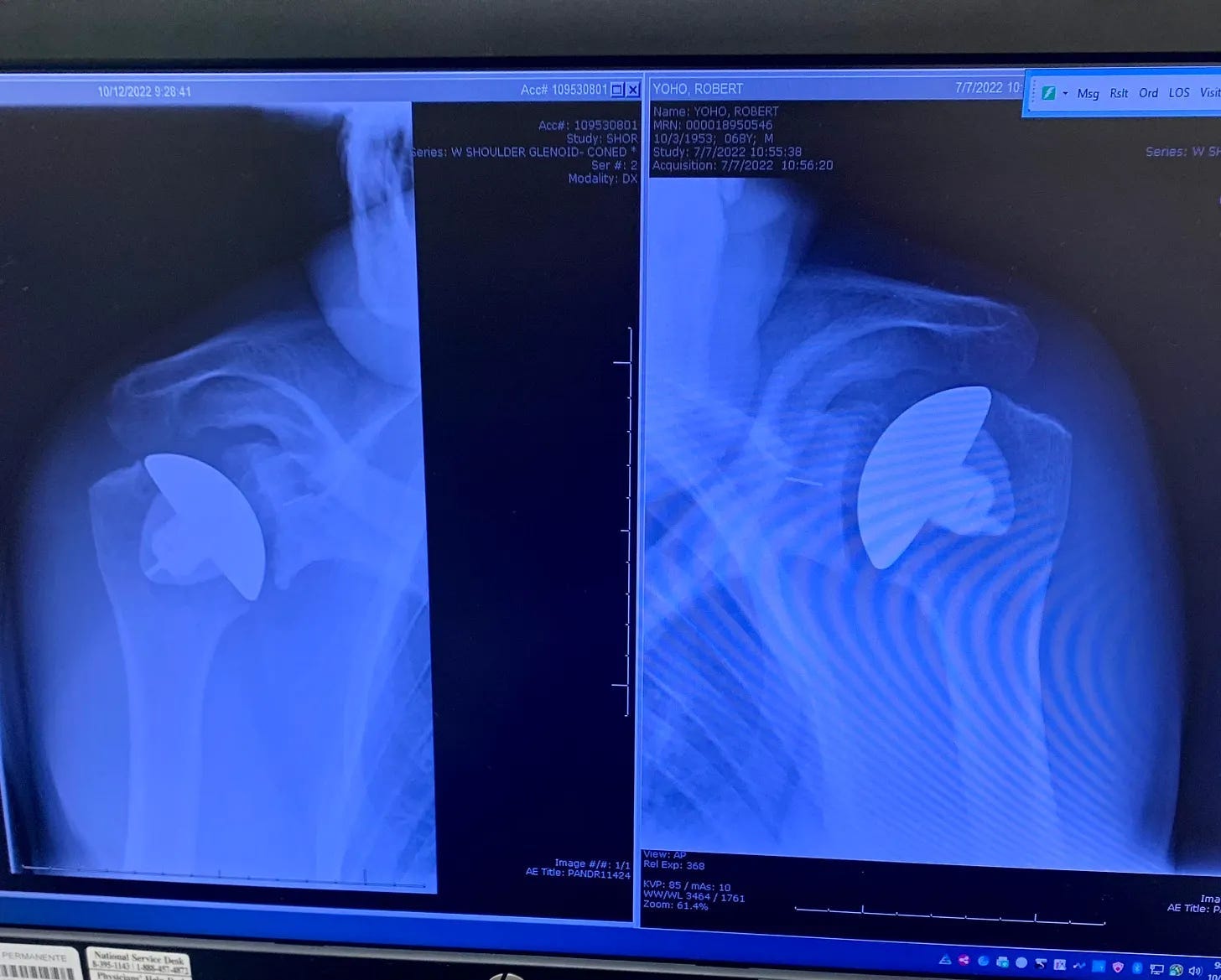
In 2022, I had both shoulders replaced, 4 and a half months apart, and wrote a cheerful post about it, with Jeff Martin, my medical school roommate and a fine orthopedist, as my guest. I called the operations modern medical miracles. The advice we gave was sound as far as it went: never replace a joint for modest pain, choose the surgeon with the most cases, and check the teeth and urine for infection first. Neither of us mentioned alloys, allergies, or testing. I was 69, almost pain-free in 2 weeks, and planned to keep swimming, lifting, and climbing a little.
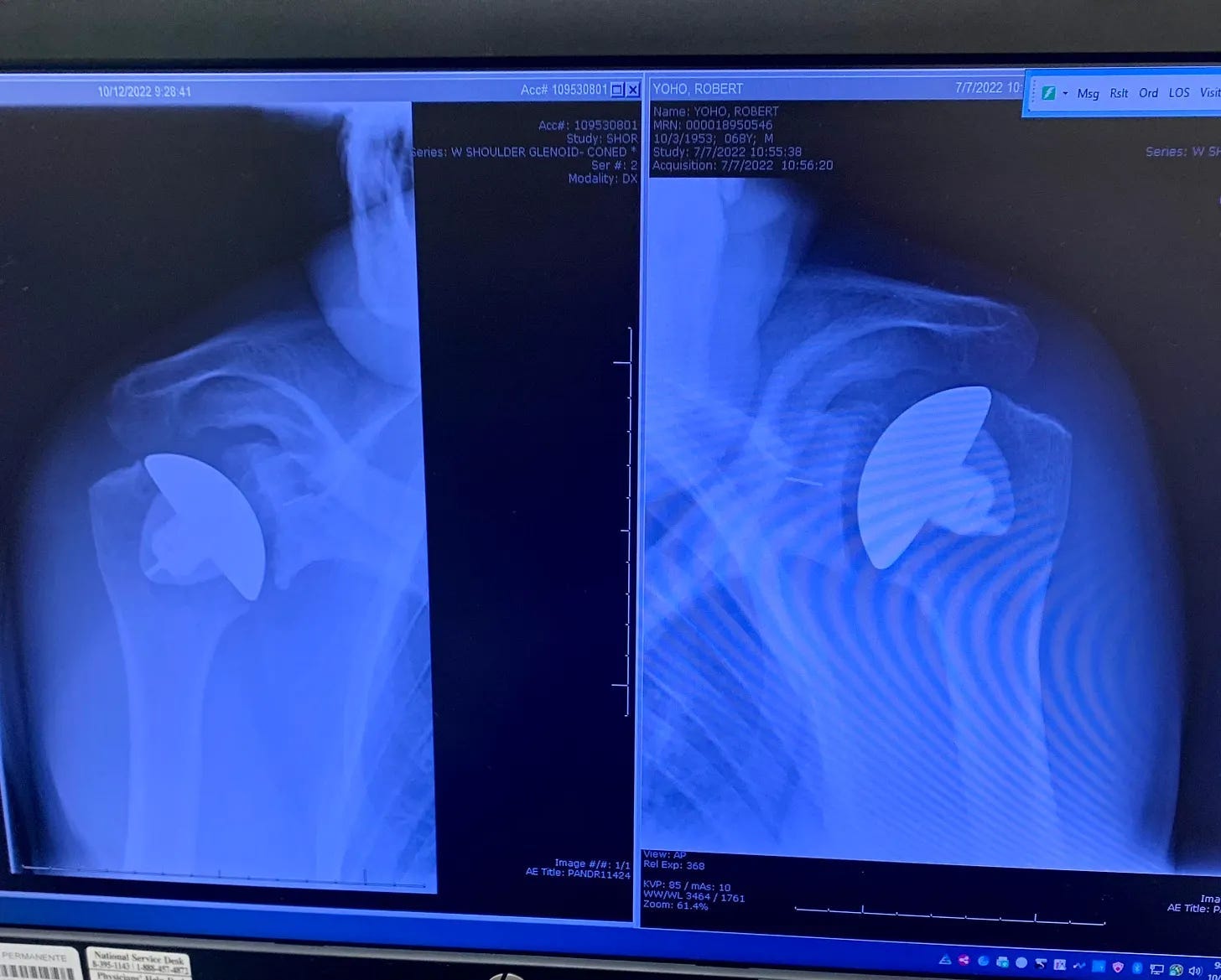
My shoulders in 2022, photographed from the Kaiser monitor. Only the metal caps are visible. The sockets are polyethylene and cemented.
My shoulders were worn down by a career in liposuction, manual labor, and too much rock climbing. They hurt, but I was never desperate, and I decided to have joint replacements almost casually, without much thought, the way a man gets a new set of tires. The only other metal I knew of was a small titanium button at the lower pole of my left kneecap, anchoring the suture that repaired a torn quadriceps tendon. I had removed all the mercury and other metals from my teeth at about the same time.
Since then, my Parkinson’s disease has progressed, and the pace has picked up over the past year. My balance is poor, my strength and energy have declined, and I tire in ways I did not at 65. My mind is intact (or at least it freaking seems to be), which is the one piece of luck in all this, because it lets me do the detective work my doctors will not.
Part of the fatigue turned out to be hypothyroidism. I missed it for 8 months, even though I had written a chapter on the thyroid in Hormone Secrets. My labs were within the reference ranges; my Kaiser physician called them stable, yet a short trial of thyroid hormone answered the question within weeks. A ferritin of 17, iron deficiency by any standard, was the second half of that confession, and it came from years of scheduled blood donations. That story became a book, Thyroid Secrets. Thyroid hormone and iron fixed the prostration but not the Parkinson’s, so something else was going on.

Thyroid Secrets, Inverness Press, 2026. The cover is Goya’s Caprichos plate 40, “Of what ill will he die?”
What Scott taught me
Scott Schroeder, DPM, is a foot-and-ankle surgeon in Wenatchee, Washington, and a friend. I got to know him on a road trip to Kentucky to visit Boyd Haley, the inventor of NBMI, the only mercury chelator that works.
Scott placed thousands of metal implants over a 30-year career. When his partner put titanium-alloy screws into his wife’s foot during a bunion operation, she had burning, shooting pain every night for 4 months and had to sleep with an ice pack. After the screws were removed, the pain stopped. She was later found to be allergic to aluminum and nickel; the screws contained vanadium, aluminum, and a trace of nickel. That was 16 years before I interviewed him in 2023, and it turned him into a surgeon who removes hardware once the bone has healed and no longer needs it.
His most dramatic case involved an engineer in his 40s who became paralyzed for up to 10 hours per day within 3 months of Scott placing 8 small stainless-steel screws in his feet. Mayo Clinic told him he would spend his life in a wheelchair. Scott removed the screws, and the paralysis dropped to 3 hours per day. A MELISA allergy test was positive for nickel and palladium. The man’s gold crowns were 26 percent palladium. The day his last crown came out, the paralysis stopped, and it has not returned.
Scott presented cases like this to the FDA Immunology Devices Panel in November 2019. His title was “Systemic Effects of Metal Implants.” When I called him this fall about my shoulders, he told me to get tested and sent me the X-ray below. It shows the foot of a disabled 42-year-old man with a small nitinol tendon anchor, a nickel-titanium alloy that is about half nickel, which a surgeon had used to reattach a tendon. The patient had severe neurological symptoms. Scott removed the anchor, and within a few weeks the man had improved enough to return to work. One fragment of nickel alloy in one foot did that.
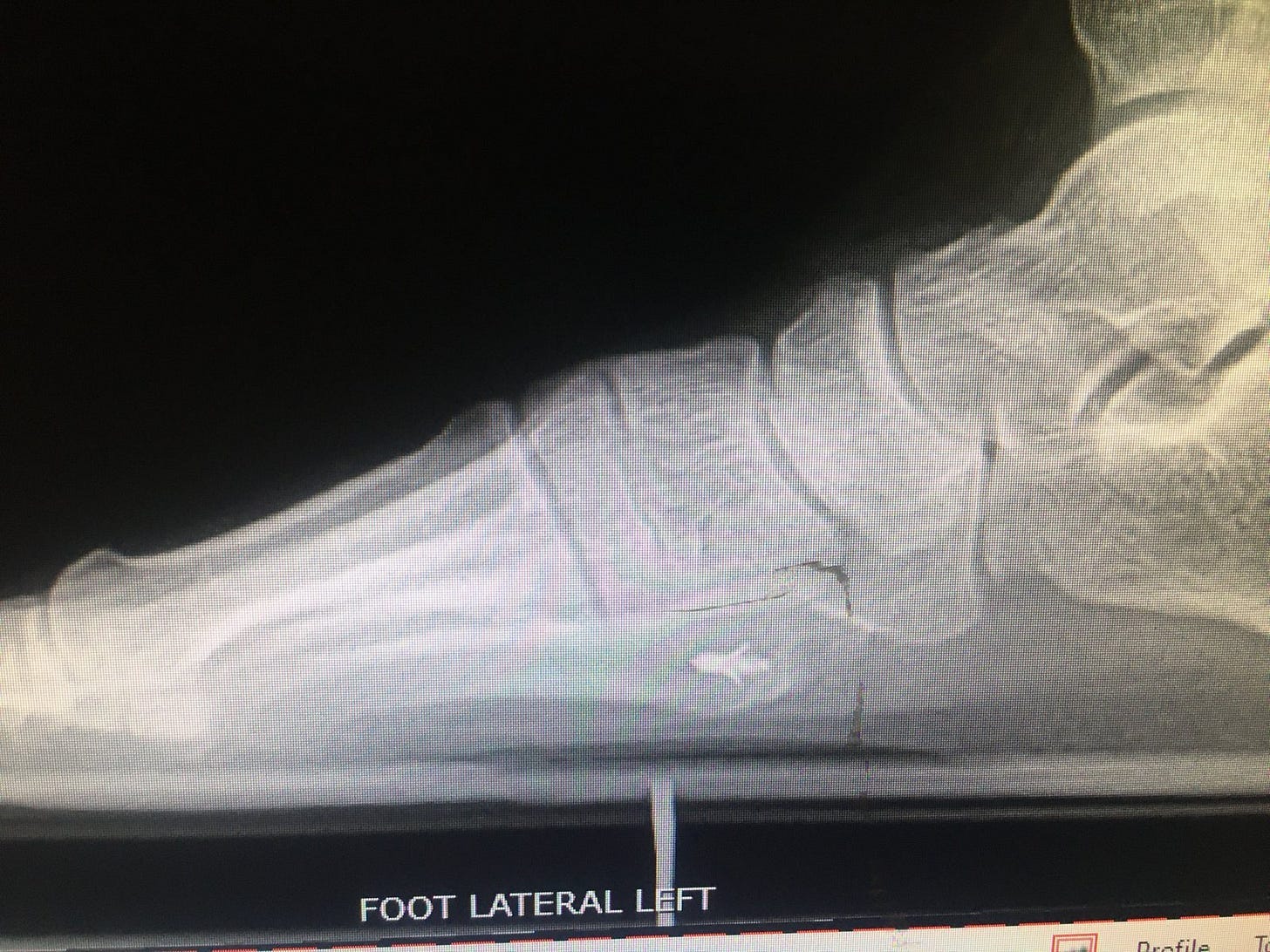
A nitinol tendon anchor, about half nickel, in a 42-year-old man’s foot. His neurological symptoms resolved within weeks of removal. Courtesy of Scott Schroeder, DPM.
Since then, Scott’s story has been the best advertisement for his ideas. In 2018, he received a bioprosthetic heart valve containing titanium, and by 2025 it had failed prematurely, causing severe aortic stenosis. His second cardiac surgeon listened. He removed 26 titanium clips left from the first operation, implanted a carbon-based mechanical valve, and closed the sternum without metal. Nine weeks later, Scott hiked 2 miles on steep terrain. A New York physician wrote up his case in September 2025.
I interviewed Scott in episode 231 and his patient, Teri Franklin, PhD, in episode 232. Dr. Franklin had all 4 problems that metal in the body can cause: allergy, mercury toxicity, electrical currents between dissimilar metals, and chronic infection. Her local orthopedists told her she was crazy. She flew across the country, Scott removed her bone screws, and she improved. She coauthored Mercury-Free with James Hardy, DMD, and calls the American Dental Association the (mercury) Amalgam Dental Association. Robert Gammal, a retired dentist who wrote the seminal book about his colleagues, The Garbage Collector, has a more brutal characterization. He calls them criminally insane. Either this or my Judas Dentistry is a good place to learn the story.
The electrical problem is the oldest of the 4 and the least studied. Two different metals in a conducting fluid make a battery. Dentists have known this for a century as oral galvanism: a gold crown next to a silver-mercury amalgam, bathed in saliva, produces a current, the patient tastes metal or feels a shock when a fork touches the filling, and the current corrodes the amalgam and releases its mercury. A 2022 systematic review of titanium dental implants paired with other alloys ranked the couples by how fast they corrode. Titanium against titanium or gold was best, cobalt-chrome next, and nickel-chrome worst, and low pH and fluoride made every pairing worse. The authors’ advice was to put as few different metals in a mouth as possible, and nobody has extended that advice to the rest of the body.
Scott has. He brings a Fluke 117 multimeter into the operating room, on the advice of a neurologist who told him to buy a good one, and sets it to read millivolts of direct current. One lead is a sterilized cautery probe touched to the hardware in the wound; the other is the meter’s own probe, disinfected, touched to a filling or crown in the patient’s mouth. The reading is the voltage between the 2 metals, with the patient’s tissues as the wire.
Before the hardware comes out, and in patients with no implant, he measures between the gum and the exposed tissue or bone in the incision for a baseline, and every baseline he has recorded is under 60 millivolts. After the hardware is removed, he measures again between the same dental metal and the bone. His photographs show readings of 7 and 154 millivolts; for scale, the voltage across the membrane of a resting nerve cell is about 70 millivolts, so a filling and a screw in the same body generate more voltage than a nerve does.
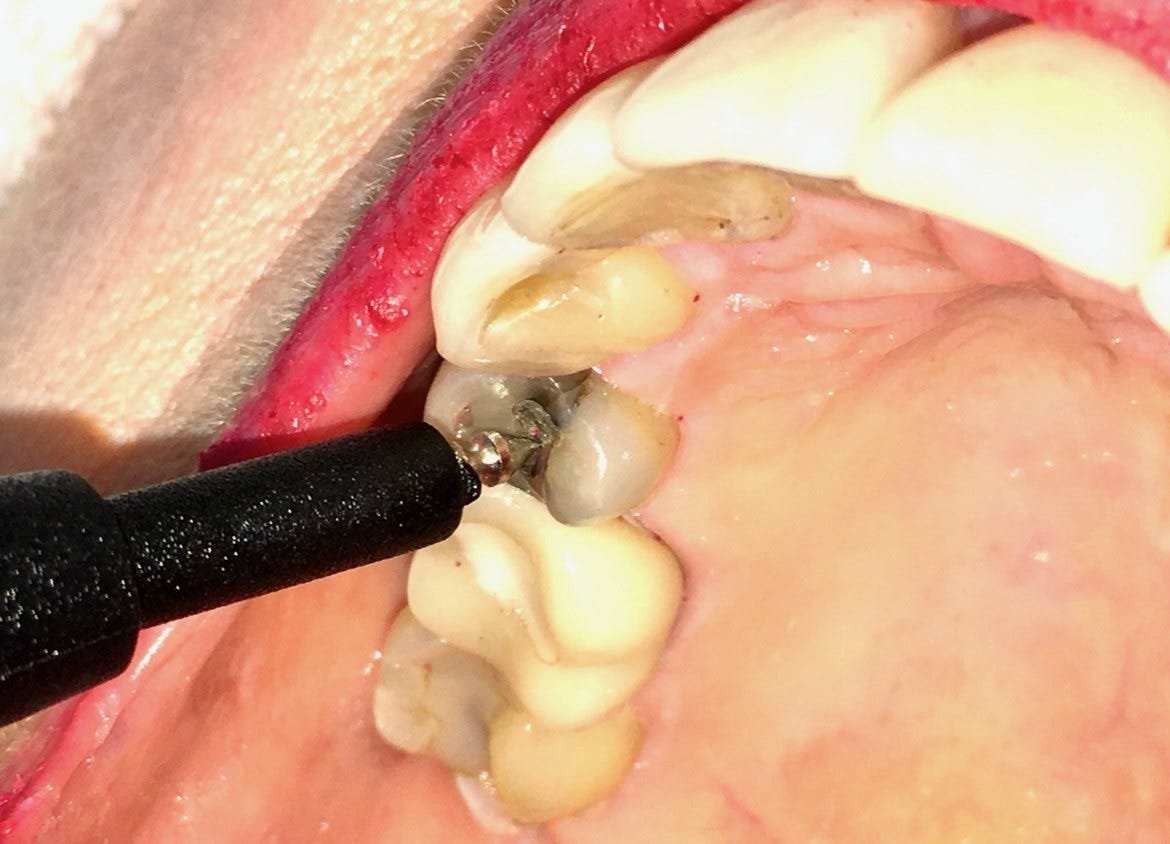
The dental lead of Scott’s multimeter on an amalgam filling. The other lead is a sterilized cautery probe on the orthopedic hardware in the surgical wound. Courtesy of Scott Schroeder, DPM.
Vera Stejskal, the Swedish immunotoxicologist who invented the MELISA test, had collected European cases before her death in which the pain of a hip or knee replacement went away when the patient’s dental metals were removed, with the joint left in place. Scott was skeptical until he saw the same pattern in his own patients. He now works with engineers who specialize in galvanic corrosion inside the body, and an ethics committee has approved their study of explanted hardware from symptomatic patients at the University of Victoria and the University of British Columbia.
Dr. Franklin’s experience, and Scott’s, is that a patient with amalgams and orthopedic metal has 2 electrodes and a body full of electrolyte between them, and that removing one set of metal changed how fast the other released its contents. That is their testimony, and the study is what will turn it into data. My amalgams are gone, so whatever current my shoulders generate today flows between the cobalt-chrome head and the titanium anchor in each joint, and the 2 titanium buttons in my knee are the only other electrode left.
How common is this?
Nickel is the most common contact allergen worldwide. The EDEN Fragrance Study patch-tested a random sample of the general population across 5 European countries. It found age-standardized nickel sensitization in 14.5 percent of adults, 22 percent of women, and 5.3 percent of men. Portugal had the highest rate at 18.5 percent, and Sweden the lowest at 8.3 percent, a difference the authors attribute to Sweden’s early restrictions on nickel in consumer goods. These were people off the street, not patients with complaints.
Among patients who are already sick and have metal in their bodies, the figures climb. A 2006 series from the laboratory that performs the MELISA.org allergy test examined 700 symptomatic, metal-exposed patients. Three-quarters reacted to at least one metal, and 68 percent reacted to nickel.
The orthopedic literature knows this and ignores it. A 2025 report on a ceramic-headed shoulder implant notes that 11.4 percent of the population is nickel-sensitive and then explains that ceramic is available for those patients. Virtually no one tests for the allergy before implanting the standard metal parts, and when a patient like Dr. Franklin complains afterward, the surgeon’s first move is to question her sanity.
Yoho comment: A 1-in-7 allergy to the main contaminant in orthopedic hardware, with no screening. If Pharma sold a drug that 14 percent of people were allergic to, the package insert would say so in a black box, and the doctor would be sued for skipping the test. Orthopedics gets a pass because implant companies write the training, and surgeons, me included until this year, repeat what they are told.
My test
The MELISA test is a lymphocyte transformation test. White blood cells from a blood sample are cultured with each metal; if they proliferate, the person is sensitized to that metal. Results are reported as a stimulation index, the ratio of cell division with the metal to cell division without it. An index above 2 is weakly positive, above 3 is positive, and above 10 is strongly positive. The lab also examines the cells under a microscope and counts the enlarged, dividing lymphoblasts.
The test is ordered through melisa.org and costs about $1,000. The laboratory is in Europe, and to my knowledge, no American laboratory offers it. Scott’s clinic drew about 15 blood tubes on September 30, 2026, and shipped them. The report came back in 3 weeks. An allergist’s skin patch test is the cheaper alternative. A positive result is reliable, but a negative one isn’t, because the patch sits on the skin for 2 days while an implant reaction takes weeks.
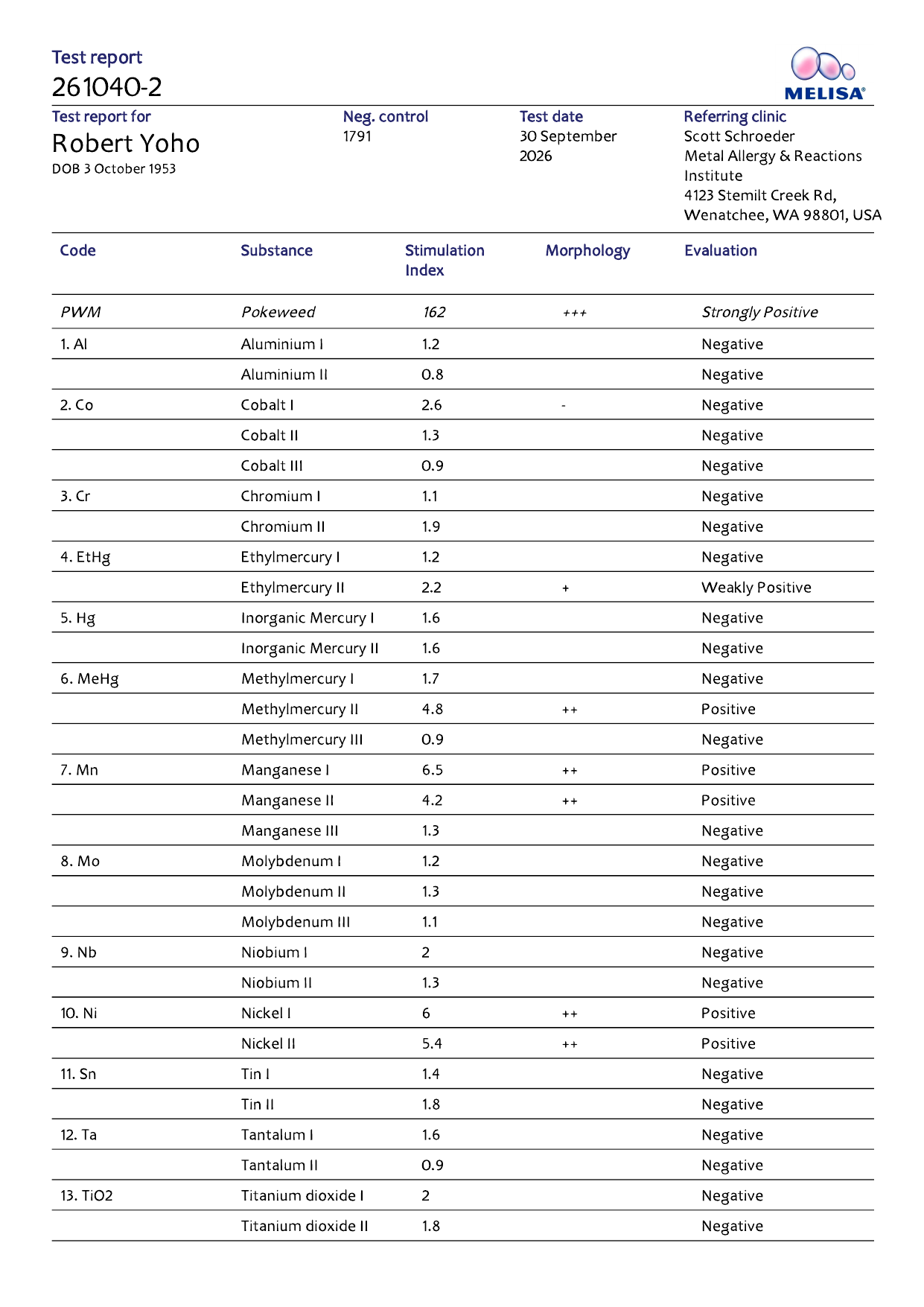
My MELISA report. Positive to nickel, manganese, and methylmercury; weakly positive to ethylmercury; negative to everything else tested, including titanium, aluminum, vanadium, cobalt, chromium, and zirconia.
Nickel was 6.0 and 5.4 at 2 concentrations, both positive, with blasts observed. Manganese was 6.5 and 4.2, positive. Methylmercury was 4.8 (positive), and ethylmercury was 2.2 (weakly positive). Every other metal was negative, and that list matters as much as the positives: aluminum, cobalt, chromium, inorganic mercury, molybdenum, niobium, tin, tantalum, titanium dioxide, titanium sulfate, vanadium, tungsten, and zirconia. The 2 mercury results are the ghost of 17 childhood amalgams that were removed several years ago. The nickel and manganese are the live question.
Manganese caught my attention because manganese poisoning causes parkinsonism. Welders, miners, and smelter workers who inhale it develop bradykinesia and rigidity. The 2015 review comparing manganism with Parkinson’s disease lists these differences: manganism damages the globus pallidus rather than the substantia nigra, produces more dystonia and less resting tremor, lacks Lewy bodies, and does not respond to levodopa. A MELISA.org result is not a tissue-level finding. It indicates that my immune system reacts to manganese, not that manganese is what is wrong with my brain. But a man with Parkinson’s and 2 metal joints is entitled to ask WTF is in them.
What is in the metal
Implant companies treat alloy composition as proprietary (!), and patients sometimes have had to litigate with manufacturers to learn what was implanted. The slide below shows a mass spectrometry analysis of a piece of titanium spinal hardware Scott tested. It is 95.8 percent titanium, 6.3 percent aluminum, and 4.4 percent vanadium, which is the standard Ti-6Al-4V alloy. The rest is contamination: 0.21 percent iron, 0.14 percent magnesium, 0.031 percent copper, 0.020 percent chromium, 0.013 percent nickel, and traces of manganese, cobalt, zinc, gallium, niobium, molybdenum, and tantalum.
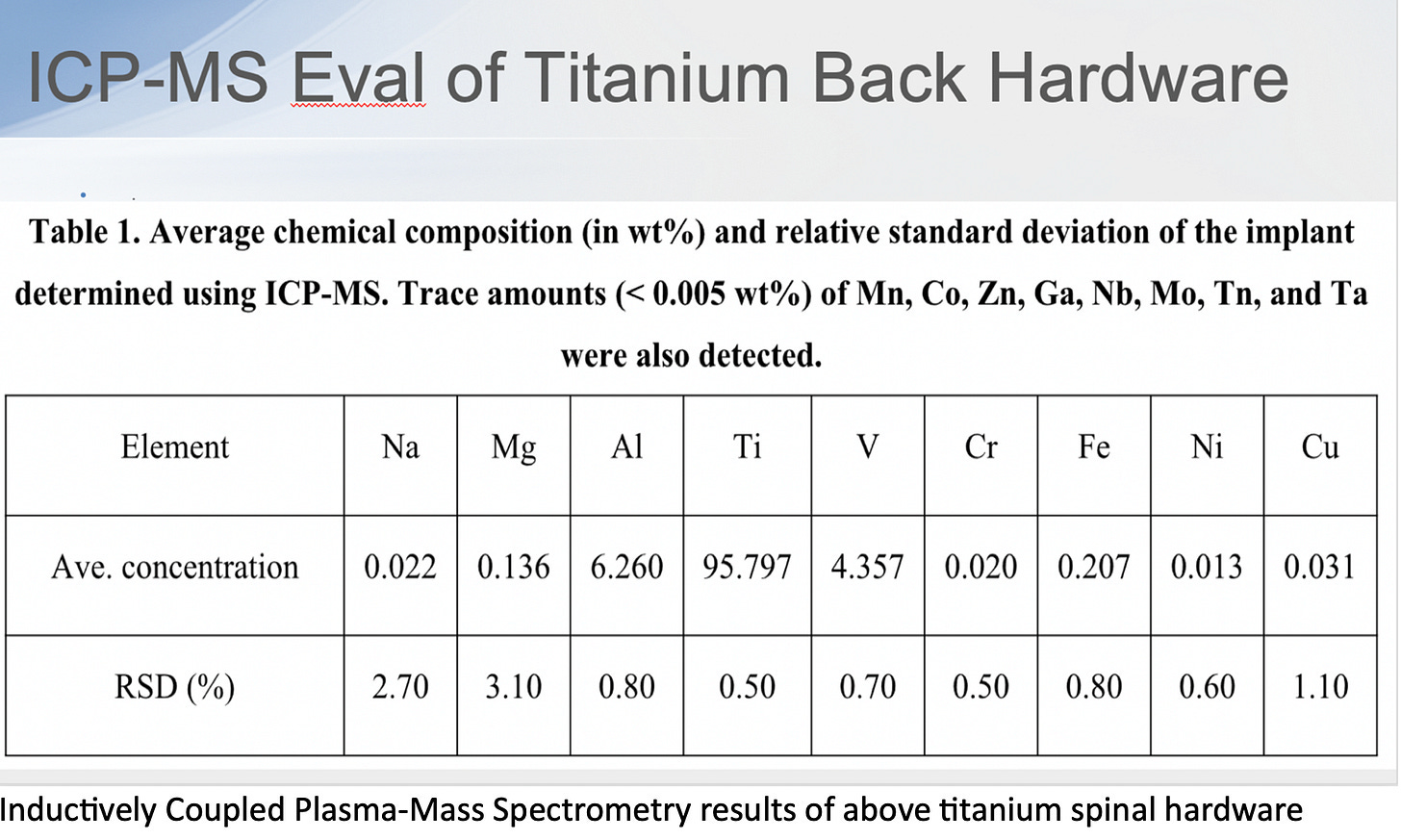
Inductively coupled plasma mass spectrometry of explanted titanium spinal hardware. Courtesy of Scott Schroeder, DPM.
The surgical grade of that alloy permits no more than 0.4 percent of all residual elements combined. Nickel is not a design ingredient but an impurity, and 0.013 percent equals 130 parts per million. Whether 130 parts per million matters to a sensitized immune system is unknown, because no one has studied the threshold. Allergists will tell you that a sensitized person reacts to amounts far below what a healthy person notices.
The ball of a shoulder replacement is a different story. Titanium is a poor bearing surface against plastic, so manufacturers make the ball from cobalt-chromium-molybdenum. The standard for that alloy, ASTM F1537, specifies 26 to 30 percent chromium, 5 to 7 percent molybdenum, and cobalt for the balance, with nickel and manganese allowed up to 1 percent each. One percent is 10,000 parts per million, 77 times the nickel in Scott’s titanium sample. My test is negative for cobalt and chromium and positive for nickel and manganese, the 2 permitted contaminants of the ball.
I wrote that as an inference, and then Kaiser sent my operative reports. Both shoulders have Tornier Simpliciti stemless implants: a 52 by 19 millimeter cobalt-chrome head on a titanium-alloy anchor with a sintered titanium bead coating, over a cemented polyethylene socket. The FDA clearance for the system names the alloys. The parts I am allergic to are the balls of both my shoulders. My immune system ignores the anchors that bone has grown into for 4 years, and the sockets, cement, and sutures contain no metal.
Yoho comment: An orthopedist might say the nickel in a cobalt-chrome head is bound within the alloy and does not migrate. The same specialists told hundreds of thousands of patients that metal-on-metal hips were inert, yet cobalt poisoning from those devices caused heart failure, deafness, and dementia before the recalls.
What the records said
The same surgeon performed the left shoulder procedure on May 25, 2022, and the right on September 28, 2022, using the same parts. During the right-sided repair, the suture needle’s eyelet broke. The surgeon took a film. The radiologist read “small metallic fragments in the glenohumeral joint space measuring 1 to 2 mm.” The surgeon wrote that the eyelet was not found and that the fragments were “metallic debris from reaming and inconsequential.” He irrigated with 3 liters of saline and closed. Surgical needles are stainless steel, which contains 10 to 14 percent nickel. The follow-up film 3 months later said “hardware appear stable” and did not mention them.
The knee was the surprise. In 2018, I tore the quadriceps tendon off the top of my left kneecap, and the first repair failed, probably because I ignored the surgeons advice and was ridiculously active after the repair. Years later, the second surgeon told me he had left one small titanium button in the bone. His operative report says 2: “Two biceps buttons were then passed down each tunnel and flipped on the inferior pole of the patella.” It says that the 2 anchors from the first repair “could not be easily removed, so they were left in place,” and that he added 2 more.
The first pair came from an Arthrex kit whose standard anchors are a dissolving polymer. The second pair is not in the record because that day’s implant log did not print. A man who has had 7 operations has hardware he doesn’t know about, and neither does his surgeon.
Yoho comment: Get your operative reports and implant logs, every one of them, and read them yourself. Ask the Release of Information unit for patient copies, specify the surgery date, and request the implant record with catalog and lot numbers. The surgeon’s memory is not a record. Mine remembered one button; the report says 2, and the report is right.
What the operation is
Readers who have not had a joint replaced should know what the operative report describes, because the brochure does not. The surgeon makes a 6-inch cut from the collarbone down the front of the shoulder and splits the two muscles to reach the joint. He cuts the biceps tendon from its anchor inside the joint and stitches it to the chest muscle lower down, where it will heal in a new place. With a curved chisel, he knocks a chip of bone off the front of the upper arm, with the rotator cuff tendon still attached, folds it aside, strips the joint capsule off the bone, and leverages the ball of the arm bone up and out of the wound. Then he saws the ball off.
With the ball gone, he pounds a tapered metal rasp into the soft bone of the arm to carve a socket for the anchor, drives the anchor in, and fits the metal cap on top. He turns to the shoulder blade, drills a center hole in the natural socket, grinds its surface flat with a power reamer, drills peg holes, packs them with cement under pressure, and hammers the plastic socket into the cement until it sets. He puts the arm back together, pulls the bone chip back into place with heavy sutures through drill holes in the arm, ties it down, and closes. The report records 150 cc of blood loss and no complications, and it was a good operation, done well. My arm was in a sling for weeks. I was pain-free in 2, and the cut tendon and the chipped bone took 12 weeks to become strong enough to use.
A revision repeats all of that over 4 years of scarring, except that the chip of bone and the tendon are now healed in place and must be removed a second time, the ball must be knocked off a post designed to hold it forever, and if the anchor must come out, the surgeon has to break it loose from bone that has grown into its surface. That is why revisions take hours instead of 1, why they get infected 4 to 15 times as often, and why nobody should have the first operation for pain that was livable or treatable–and why this applies 10 times over for a revision.
How long they last, and who should have one
The best numbers come from national registries, which track every implant in a country rather than the ones a surgeon chooses to report. Two reviews in The Lancet in 2019 pooled data from the Australian and Finnish registries. Hip replacements were intact in 89 percent of patients at 15 years, 70 percent at 20, and 58 percent at 25, based on 215,676 hips. Total knee replacements did better, with 82 percent intact at 25 years, based on 299,291 knees.
Shoulders fare worse. In the Australian registry, anatomic total shoulders in patients aged 55 to 64 were intact in 91 percent at 5 years and 84 percent at 10 years, and in patients under 55, only 79 percent reached 10 years. Long-term series report about 75 percent at 20 years. The younger and more active the patient, the sooner the implant fails, because he uses it harder for longer.
The arithmetic that follows is the one orthopedists do not say aloud. A 55-year-old man with a new shoulder has a 1-in-5 chance of needing it redone by 65 and a 1-in-4 chance by 75. Every redo is the operation described above, performed through the scar, with an infection risk 4 to 15 times higher. A 75-year-old with the same shoulder will probably die with it in place and working. The old rule, which the industry abandoned when it discovered how many 50-year-olds it could sell to, was that a joint replacement belongs in the declining years, when the implant is likely to outlast the patient.
The other number doctors skip is how poorly X-rays predict pain. A 2008 systematic review of the knee literature found that among people whose X-rays show osteoarthritis, the share with pain ranged from 15 to 81 percent, and among people with knee pain, the share with osteoarthritis on the film ranged from 15 to 76 percent. A worn joint on a film is not a reason to operate, and a surgeon who points at the film to sell the operation, saying, “You are bone-on-bone,” is selling the film. The operation is for pain, and pain responds to things like DMSO and boron that are not surgery. A joint that does not hurt and works never needs replacing, whatever the film says.
Yoho comment: My opinion, which no registry measures, is that the allergic and electrical effects of implanted metal shorten lives as well as joints. The registries count revisions and deaths from infection and clots, and nobody counts the patient who slows down, loses his edge, or develops a neurological disease 5 years after his hip went in due to the implanted metals. The trade for a joint replacement is not pain against the risk of a bad operation; it is pain against a lifetime of metal in a body that was not designed to hold it, and the second half of that trade is never acknowledged on the consent form.
The rest of this post is behind the paywall.
If you are a paid subscriber, just keep reading. If not, a paid subscription is $50 a year. This gives you access to all my paid content, the books I’m publishing now, and more.
The critical topics I cover below are:
Why ceramic implants are superior.
Where you can obtain them. Hint: it is not in the United States.
How I decided what to do and the plan I followed.
How I learned the hidden truth about secondary shoulder surgery and what I decided.
Details and doses of safe supplements that relieve shoulder arthritis pain without having to saw bone out of your shoulders and replace it with toxic metals.
Statistics about metal allergy that you must know before considering any shoulder, knee, or hip replacement.
Where to measure your metal exposure with a convenient blood or urine test.
At the end, I have a reader’s guide to understanding the metals you have been exposed to.